

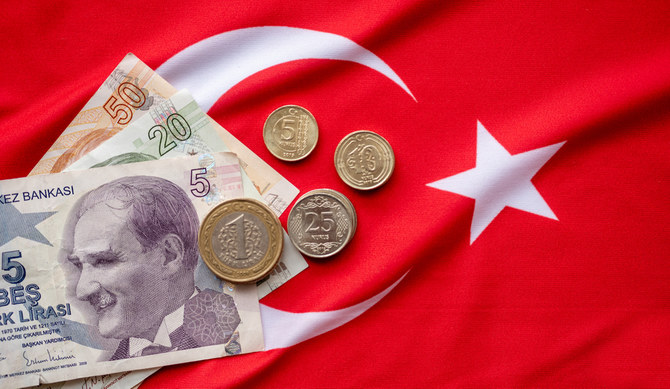
Lira in free fall on fears of lower interest rates, sinks below 12 a dollar

Image: Shutterstock
Short Url
Updated 23 November 2021
Follow

Lira in free fall on fears of lower interest rates, sinks below 12 a dollar

  • Speculation that Erdogan might soon replace Finance and Economy Minister Lutfi Elvan further fanned worries

The lira slumped 8 percent to a record low of 12.49 versus the dollar on Tuesday on intensifying worries about Turkey’s unconventional monetary policy, while Russia’s rouble recovered but worries about a war with Ukraine kept it at four-month lows.


Turkish President Tayyip Erdogan, long demanding stimulus to spur economic growth, defended lower policy rates on Monday, vowing to succeed in his “economic war of independence.”

The policy rate now stands at 15 percent while inflation runs at 20 percent.


Speculation that Erdogan might soon replace Finance and Economy Minister Lutfi Elvan further fanned worries.


The lira is now down more than 37 percent against the dollar in 2021, significantly lagging other emerging market peers, with volatility gauges spiking.


“We would have to really start to see strains building in the banking sector before we might get a change in course. So far banks have been weathering this really well.

So long as that remains the case, I suspect the central bank will not raise rates,” said Jason Tuvey, senior EM economist at Capital Economics, adding the lira may fall beyond 13.


Risk sentiment was more broadly hit after US President Joe Biden picked Federal Reserve chief Jerome Powell to lead for another term, raising bets that the central bank may tighten policy faster than expected, which could pull funds away from EM assets.


EM stocks hit six-week lows, with some gains in mainland China, India, Turkey and Russian stocks capping losses.


Central banks in developing economies ramping up interest rates will be supportive for emerging market debt, but could spell trouble for equities, BlackRock said on Monday.

First EU–Saudi roundtable on critical raw materials reflects shared policy commitment

Updated 16 January 2026
Follow

First EU–Saudi roundtable on critical raw materials reflects shared policy commitment

RIYADH: The EU–Saudi Arabia Business and Investment Dialogue on Advancing Critical Raw Materials Value Chains, held in Riyadh as part of the Future Minerals Forum, brought together senior policymakers, industry leaders, and investors to advance strategic cooperation across critical raw materials value chains.

Organized under a Team Europe approach by the EU–GCC Cooperation on Green Transition Project, in coordination with the EU Delegation to Saudi Arabia, the European Chamber of Commerce in the Kingdom and in close cooperation with FMF, the dialogue provided a high-level platform to explore European actions under the EU Critical Raw Materials Act and ResourceEU alongside the Kingdom’s aspirations for minerals, industrial, and investment priorities.

This is in line with Saudi Vision 2030 and broader regional ambitions across the GCC, MENA, and Africa.

ResourceEU is the EU’s new strategic action plan, launched in late 2025, to secure a reliable supply of critical raw materials like lithium, rare earths, and cobalt, reducing dependency on single suppliers, such as China, by boosting domestic extraction, processing, recycling, stockpiling, and strategic partnerships with resource-rich nations.

The first ever EU–Saudi roundtable on critical raw materials was opened by the bloc’s Ambassador to the Kingdom, Christophe Farnaud, together with Saudi Deputy Minister for Mining Development Turki Al-Babtain, turning policy alignment into concrete cooperation.

Farnaud underlined the central role of international cooperation in the implementation of the EU’s critical raw materials policy framework.

“As the European Union advances the implementation of its Critical Raw Materials policy, international cooperation is indispensable to building secure, diversified, and sustainable value chains. Saudi Arabia is a key partner in this effort. This dialogue reflects our shared commitment to translate policy alignment into concrete business and investment cooperation that supports the green and digital transitions,” said the ambassador.

Discussions focused on strengthening resilient, diversified, and responsible CRM supply chains that are essential to the green and digital transitions.

Participants explored concrete opportunities for EU–Saudi cooperation across the full value chain, including exploration, mining, and processing and refining, as well as recycling, downstream manufacturing, and the mobilization of private investment and sustainable finance, underpinned by high environmental, social, and governance standards.

From the Saudi side, the dialogue was framed as a key contribution to the Kingdom’s industrial transformation and long-term economic diversification agenda under Vision 2030, with a strong focus on responsible resource development and global market integration.

“Developing globally competitive mineral hubs and sustainable value chains is a central pillar of Saudi Vision 2030 and the Kingdom’s industrial transformation. Our engagement with the European Union through this dialogue to strengthen upstream and downstream integration, attract high-quality investment, and advance responsible mining and processing. Enhanced cooperation with the EU, capitalizing on the demand dynamics of the EU Critical Raw Materials Act, will be key to delivering long-term value for both sides,” said Al-Babtain.

Valere Moutarlier, deputy director-general for European industry decarbonization, and directorate-general for the internal market, industry, entrepreneurship and SMEs at European Commission, said the EU Critical Raw Materials Act and ResourceEU provided a clear framework to strengthen Europe’s resilience while deepening its cooperation with international partners.

“Cooperation with Saudi Arabia is essential to advancing secure, sustainable, and diversified critical raw materials value chains. Dialogues such as this play a key role in translating policy ambitions into concrete industrial and investment cooperation,” she added.