

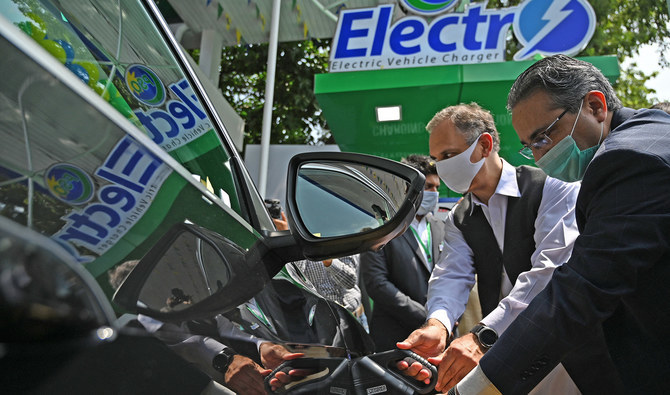

ISLAMABAD: Pakistani businessman Nawabzada Kalam Ullah Khan had been planning to swap his family’s petrol-powered cars for electric models for years.
But it wasn’t until a set of massive tax cuts came into effect in July that the 29-year-old from Pakistan’s capital Islamabad finally put in an order for two electric cars.
“Someone has to take the initiative to switch to these cost-efficient, environment-friendly vehicles in the face of increasing pollution in big cities — and we’ve done it,” Khan said.
His new cars, he said now cost about five times less to run day to day than his old vehicles, a major incentive to make the switch.
Major Pakistan and Indian cities are struggling with dangerous levels of air pollution, with Pakistan’s Lahore this week declared the most polluted city in the world.
Heavy use of fossil-fuel-powered vehicles for transport combined with smoke from seasonal crop burning make the problem particularly severe at this time of year.
But Pakistan’s electric vehicle push is picking up speed, nearly two years after the country launched its ambitious green policy, which envisions a shift to 30 percent electric cars and trucks nationwide by 2030, and 90 percent by 2040.
Key to the shift are hefty tax exemptions for both electric vehicles imports and imports of parts and equipment to build the cars in Pakistan.
That has helped make the vehicles more affordable, industry figures said, as Prime Minister Imran Khan’s government pushes ahead with its plan to cut carbon emissions and urban pollution.
FALLING TAXES
The general sales tax on locally manufactured electric cars — those with batteries holding less than 50-kilowatt hours (kWh) of power — has dropped from 17 percent to nearly zero, said Asim Ayaz, general manager of the government’s Engineering Development Board (EDB).
At the same time, the customs duty on imported electric car parts — such as batteries, controllers and inverters — is down to 1 percent.
The duty on importing fully built electric cars also has fallen from 25 percent to 10 percent for one year, Ayaz told the Thomson Reuters Foundation.
Officials say the tax relief is a big step toward implementing Pakistan’s National Electric Vehicle Policy, originally passed by the cabinet in November 2019.
It aims to put half a million electric motorcycles and rickshaws and 100,000 electric cars, vans and small trucks into the transportation system by 2025.
“Definitely the tax exemptions make the price point (on electric vehicles) competitive,” said Malik Amin Aslam, the special assistant to the prime minister on climate change.
“It makes it extremely attractive for the customer to go electric.”
Aslam said if about a third of new cars sold run on electricity by 2030, as envisioned, Pakistan could see a big drop in climate-changing emissions and pollution.
Electric vehicles currently produce 65 percent fewer planet-warming gases than those running on fossil fuels, he said.
Pakistan ranks second, behind Bangladesh, according to a list of nations with the worst air quality compiled last year by IQAir, a Swiss group that measures levels of lung-damaging airborne particles known as PM2.5.
In Punjab, Pakistan’s most populous province with Lahore as its capital, transport accounts for more than 40 percent of total air-polluting emissions, followed by industry and agriculture, according to a 2019 study by the United Nations’ Food and Agriculture Organization.
OVERCOMING DOUBTS
Shaukat Qureshi, general secretary of the Pakistan Electric Vehicles and Parts Manufacturers and Traders Association, said the new tax cuts mean savings of up to 500,000 rupees ($2,900) on imported small electric vehicles.
He said many members of the association have used the incentives to order them for the first time.
There are no reliable figures on how many electric cars local importers have ordered brought into the country since the government announced the exemptions.
But in his other role as chief operating officer of car company Zia Electromotive, which imports and manufactures electric vehicles, Qureshi said he has ordered 100 small electric cars from China and plans to import 100 more every month after that.
Pakistanis — like many other people around the world — have historically been reluctant to switch to electric vehicles for reasons ranging from higher costs to lack of charging infrastructure and “fear of the unknown,” said Ayaz at the EDB.
The tax cuts help remove the cost obstacle, he said — and could help create about 20,000 new jobs in the auto industry as Pakistani car companies start manufacturing electric cars, he predicted.
The charging infrastructure issue remains, though some companies have already established charging stations in big cities and along motorways.
Climate change and development expert Ali Tauqeer Sheikh said the government should encourage the private sector to install more charging stations near offices, homes and parking lots.
To overcome worries that electric vehicles may have no resale value, car manufacturers and dealers could offer buy-back guarantees, he added.
But, Sheikh said, simply selling more electric cars is not enough to tackle Pakistan’s emissions and air pollution, since the total number of vehicles being sold — mainly traditional cars — is still growing every year.
He said the government needs to push to completely phase out fuel-run and hybrid vehicles by increasing taxes on them and provide affordable bank loans for people looking to buy electric.
“Poor people who use motorbikes and rickshaws deserve to have more electric vehicles on the roads to cut air pollution,” he said.


