

Pakistan’s deaf-staffed beauty salon provides economic opportunity, empowers hearing impaired

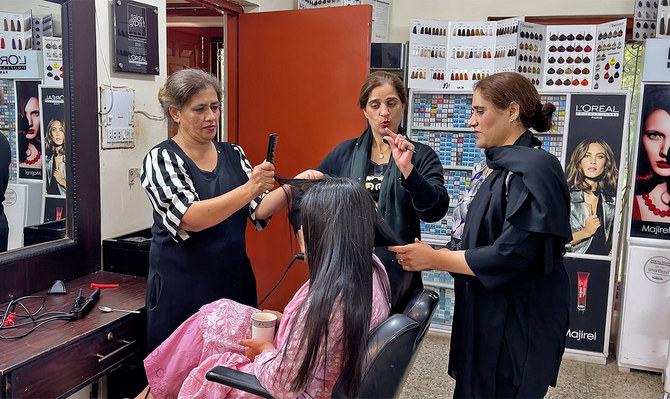
Staff at Options beauty salon interact with each other using sign language while styling a customer's hair on May 2, 2024, in Abbotabad, Pakistan. (AN Photo)
Short Url
Updated 07 May 2024
Follow

Pakistan’s deaf-staffed beauty salon provides economic opportunity, empowers hearing impaired

  • There are seven deaf beauticians out of a total of 12 employed at Options Salon in Abbottabad 
  • According to the World Health Organization, deaf population in Pakistan is around 10 million people

ABBOTTABAD: Eight years ago, while offering a training class at her Options beauty salon in the northwestern Pakistani city of Abbottabad, Nighat Aftab received an unlikely application: that from a deaf girl who wanted to attend the training and join her salon. 

“I didn’t have much experience working with such women and at first, I hesitated a little that how could I hire such a person whose language I don’t understand?” Aftab told Arab News in an interview earlier this month. “But then I said, ‘Come, join me’.”

Today, there are seven deaf beauticians out of a total of 12 employed at Options, which has since become a sanctuary for women with hearing and speech impairments, providing them economic opportunity, a chance to be financially independent and earn for their families, and a place where they can be part of a supportive, inclusive community.

According to the World Health Organization, the deaf population in Pakistan is around 10 million people. Pakistan has one of the lowest percentages of female labor force participation in South Asia and women with disabilities face even more impediments to employment.

“Previously, I used to work at a parlor in Islamabad where my salary wasn’t great, and I used to miss home a lot,” beautician Saima Mir told Arab News in sign language as Aftab translated for her. 

“Now I am very happy. I like working here. There are many here who cannot hear and speak, it makes me happy.”
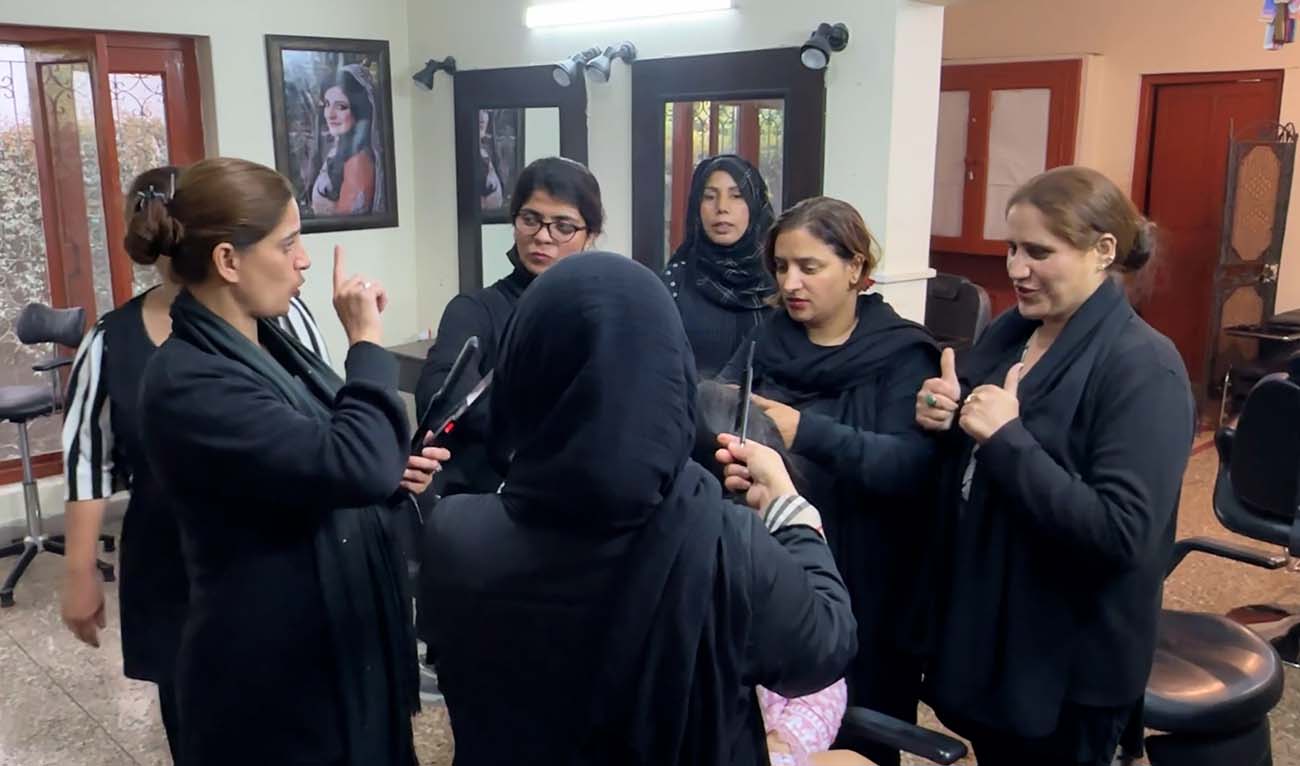


Staff at Options beauty salon interact with each other using sign language while styling a customer's hair on April 2, 2024, in Abbotabad, Pakistan. (AN Photo)

Others also said they felt a “sense of belonging” at the Options Salon.

“I have my mother and father. They are old. I feel frustrated at home as there is nobody with whom I can talk and share,” Isma Mushtaq told Arab News. “I come here and I spend time here happily.”

While many of the salon’s loyal customers are now used to communicating with the deaf staff members, that was not always the case, Aftab recalled, saying she faced criticism in the beginning by clients struggling to communicate with her workers. To bridge the gap, deaf workers were teamed up with those from the hearing community.

“The difficulties we faced [with communication] in the beginning got resolved over time,” said Sobia Khan, a beautician from the hearing community. 

And the troubles had been worth it, Aftab said.

“I might have closed down the salon by now because my daughters are now married and I want to enjoy my own life but I am committed because of these young women [deaf workers] and I am unable to quit because their employment is attached to me,” she said. 

“And because of them, Allah has blessed me with health. I am able to come to work daily, even though I am not that healthy, but I am happy here.”


Pakistan PM calls PIA privatization ‘vote of confidence’ as government pushes reforms

Updated 4 sec ago
Follow

Pakistan PM calls PIA privatization ‘vote of confidence’ as government pushes reforms

  • The loss-making national flag carrier was sold to a Pakistani consortium for $482 million after two failed attempts
  • Finance minister vows to continue economic reforms, engage international partners through trade and investment

KARACHI: Prime Minister Shehbaz Sharif said on Tuesday the privatization of state-owned Pakistan International Airlines marked a “vote of confidence” in the country’s economy, as the government presses ahead with structural reforms aimed at easing pressure on public finances and attracting investment.

The sale of the loss-making national carrier by a Pakistani consortium, which secured a 75 percent stake for Rs135 billion ($482 million), follows two previous attempts to privatize PIA. The development comes as Pakistan seeks to build on macroeconomic stabilization after a prolonged balance-of-payments crisis, with authorities trying to shift the economy toward export-led growth and policy continuity.

“It was our firm commitment to the people of Pakistan that speedy and concrete steps would be taken to privatize loss-making state-owned enterprises that have been a burden on the economy,” Sharif said in a post on X. “The successful completion of the transparent and highly competitive bidding process for the privatization of PIA marks an important milestone in fulfilling that commitment.”

“The strong participation of our leading business groups and some of Pakistan’s most seasoned and respected investors is a powerful vote of confidence in our economy and its future,” he added.

https://x.com/cmshehbaz/status/2003498418984128908?s=46&t=SApcAZAv0zK56lMSgiF_fg

The government has made privatization of state-owned enterprises a key pillar of its reform agenda, alongside changes to taxation, energy pricing and trade policy, as it seeks to stabilize the economy and restore investor confidence.

Meanwhile, Finance Minister Muhammad Aurangzeb told an international news outlet Pakistan had reached a critical turning point, with macroeconomic stability and sustained reforms helping shift the economy from stabilization toward growth.

“Macroeconomic stability, sustained reforms and policy continuity are restoring confidence, shifting the economy from stabilization to export-led growth,” he said in an interview with USA Today, according to a statement issued by the finance ministry, adding that the government was opening new opportunities for domestic and global investors.

Aurangzeb said inflation had eased sharply, external balances had improved and foreign exchange reserves had risen above $14.5 billion, while Pakistan had recorded both a primary fiscal surplus and a current account surplus for the first time in several years.

The finance minister noted that economic growth remained insufficient to meet the needs of a fast-growing population, pointing out the importance of continuing structural reforms and encouraging investment in sectors such as agriculture, minerals, information technology and climate resilience.

Despite ongoing risks from global commodity prices, debt pressures and political uncertainty, Aurangzeb said the government remained committed to staying the reform course and engaging international partners through trade and investment.