Advocacy group ‘alarmed’ as journalists shot at in West Bank

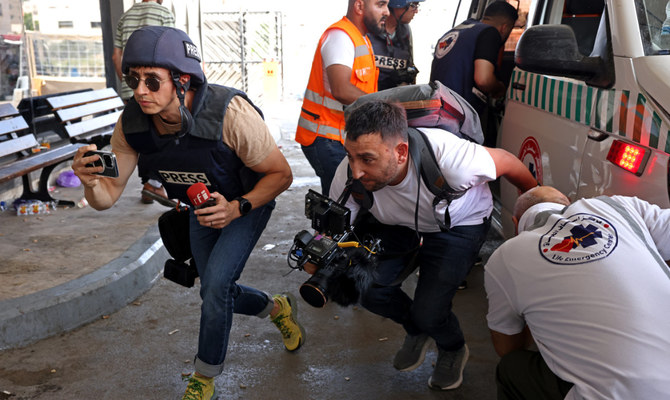
Journalists rush for cover inside a hospital in Jenin in the occupied West Bank amid an Israeli army raid. (AFP/File)
Short Url
Updated 06 May 2024
Follow

Advocacy group ‘alarmed’ as journalists shot at in West Bank

  • Al-Araby TV workers were not injured but their equipment was destroyed
  • Ameed Shehade, Rabih Al-Monayar were wearing ‘Press’ vests at time of attack

LONDON: American advocacy group the Committee to Protect Journalists says it is “extremely concerned” after hearing reports that two Al-Araby TV journalists were shot at by Israeli forces in the West Bank on Saturday.

Reporter Ameed Shehade and camera operator Rabih Al-Monayar came under fire while they were covering an Israeli raid on the village of Deir al-Ghusun in Tulkarm.

Neither of the men was injured in the attack but their equipment was destroyed.

The CPJ urged Israel to launch an investigation into whether the journalists were deliberately targeted.

“CPJ is alarmed by the Israeli soldiers’ shooting at two Al-Araby TV journalists, which hit their camera, while they were reporting in the West Bank,” the group’s Program Director Carlos Martinez de la Serna said.

Although he was “relieved” that the journalists had not been injured, he said he questioned whether the targeting was intentional as it was the second case of reporters being attacked while doing their jobs.

Al-Araby TV aired footage of the two men, who were wearing blue vests labeled “Press,” taking cover near their car.


Shehade said the shots were fired from a vehicle about 20 meters (22 yards) away and that they were clearly visible to the soldier.

Another journalist who was reporting on the raids confirmed that Shehade and Al-Monayar could be easily identified as members of the press.

According to The Guardian, Israeli forces killed five Palestinians in the overnight raid. Hamas confirmed that four of the men killed were from its al-Qassam armed wing.

Al-Monayar and Shehade suffered a similar attack in July last year while reporting on an Israeli operation against militants in the Jenin refugee camp in the West Bank. They again escaped personal injury but their video equipment was damaged.


Israel extends foreign media ban law until end of 2027

Updated 23 December 2025
Follow

Israel extends foreign media ban law until end of 2027

  • Order replaces temporary emergency legislation that allowed authorization of so-called ‘Al Jazeera bill’
  • Extension of temporary order empowers Communications Ministry to restrict foreign channels deemed to cause ‘real harm to state security’

LONDON: Israel’s Knesset approved late Monday an extension of the temporary order empowering the Communications Ministry to shut down foreign media outlets, pushing the measure through until Dec. 31, 2027.

The bill, proposed by Likud lawmaker Ariel Kallner, passed its second and third readings by a 22-10 vote, replacing wartime emergency legislation known as the “Al Jazeera Law.”

Under the extended order, the communications minister — with prime ministerial approval and security cabinet or government ratification — can restrict foreign channels deemed to cause “real harm to state security,” even outside states of emergency.

Measures include suspending broadcasts, closing offices, seizing equipment, blocking websites, and directing the defense minister to block satellite signals, including in the West Bank, without disrupting other channels.

Administrative orders last 90 days, with possible extensions. Unlike the temporary measure, the new law does not require court approval to shut down a media outlet.

The move has drawn sharp criticism from human rights and media groups, who warn it entrenches restrictions on Arab and foreign outlets amid a broader erosion of press freedoms.

“Israel is openly waging a battle against media outlets, both local and foreign, that criticize the government’s narrative; that is typical behavior of authoritarian regimes,” International Federation of Journalists General Secretary Anthony Bellanger said in November after the bill’s first reading.

“We are deeply concerned about the Israeli parliament passing this controversial bill, as it would be a serious blow to free speech and media freedom, and a direct attack on the public’s right to know.”

In a parallel development, the Israeli Cabinet unanimously approved on Monday the shutdown of Army Radio (Galei Tzahal) after 75 years, with operations ceasing on March 1, 2026.

In a statement, Attorney General Gali Baharav-Miara warned the decision “undermines public broadcasting in Israel and restricts freedom of expression,” lacking a legal basis.