LONDON: Britain announced on Thursday a public inquiry into the death of Dawn Sturgess, who was exposed to nerve agent Novichok after the poisoning of former double agent Sergei Skripal in 2018.
Sturgess, 44, died after spraying herself with what she thought was perfume from a discarded bottle which in fact contained the deadly chemical weapon.
The bottle was allegedly used to carry the poison used in the attack on Skripal in the small English city of Salisbury.
Skripal was found with his daughter Yulia, both unconscious, on a bench in the city. They survived after being taken to hospital and now live under protection.
Interior minister Priti Patel said she hoped the inquiry “will bring comfort” to Sturgess’ family “through a greater understanding of the circumstances” of her death.
Heather Hallett, a member of the upper chamber of parliament the House of Lords, will chair the probe, which is due to begin next year.
Hallett has been in charge of a coroner’s inquest into Sturgess’ death but in September wrote to Patel saying a “full, fair and effective” hearing could not be held without wider powers.
An inquest, which is limited in scope, “cannot make any finding of civil or criminal liability against a named person, and it cannot attribute blame or impose any sanction or punishment,” she added.
Britain blames the attack on two Russian security service officers who allegedly entered Britain using false passports.
In September, London warned the pair — and a third agent who allegedly led the operation — they faced arrest and prosecution if they ever leave Russia.
The Kremlin has vehemently denied any link to the Skripal attack.
The Skripals spent days in a coma before recovering but local resident Sturgess died after picking up the discarded bottle.
Her partner, Charlie Rowley, spent weeks in hospital and a police officer also received a non-lethal dose of the Soviet-era nerve agent.
The incident resulted in the largest ever expulsion of diplomats between Western powers and Russia.

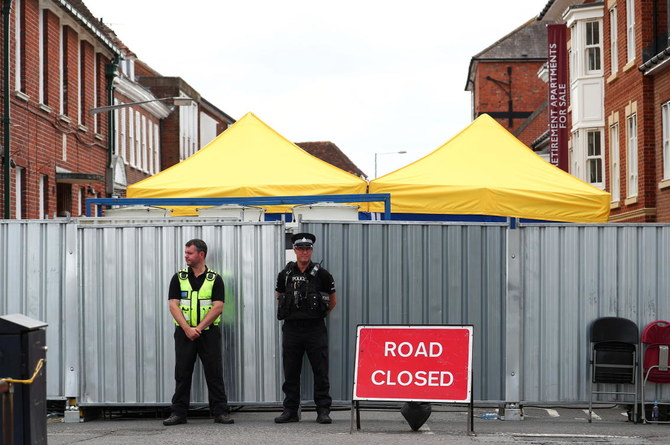
UK opens inquiry into death of woman caught up in Skripal attack
https://arab.news/jjm88
UK opens inquiry into death of woman caught up in Skripal attack
- Sturgess, 44, died after spraying herself with what she thought was perfume from a discarded bottle
- The bottle was allegedly used to carry the poison used in the attack on Skripal in the small English city of Salisbury
UN’s top court opens Myanmar Rohingya genocide case
- The Gambia filed a case against Myanmar at the UN’s top court in 2019
- Verdict expected to impact Israel’s genocide case over war on Gaza
DHAKA: The International Court of Justice on Monday opened a landmark case accusing Myanmar of genocide against its mostly Muslim Rohingya minority.
The Gambia filed a case against Myanmar at the UN’s top court in 2019, two years after a military offensive forced hundreds of thousands of Rohingya from their homes into neighboring Bangladesh.
The hearings will last three weeks and conclude on Jan. 29.
“The ICJ must secure justice for the persecuted Rohingya. This process should not take much longer, as we all know that justice delayed is justice denied,” said Asma Begum, who has been living in the Kutupalong refugee camp in Bangladesh’s Cox’s Bazar district since 2017.
A mostly Muslim ethnic minority, the Rohingya have lived for centuries in Myanmar’s western Rakhine state but were stripped of their citizenship in the 1980s and have faced systemic persecution ever since.
In 2017 alone, some 750,000 of them fled military atrocities and crossed to Bangladesh, in what the UN has called a textbook case of ethnic cleansing by Myanmar.
Today, about 1.3 million Rohingya shelter in 33 camps in Cox’s Bazar, turning the coastal district into the world’s largest refugee settlement.
“We experienced horrific acts such as arson, killings and rape in 2017, and fled to Bangladesh,” Begum told Arab News.
“I believe the ICJ verdict will pave the way for our repatriation to our homeland. The world should not forget us.”
A UN fact-finding mission has concluded that the Myanmar 2017 offensive included “genocidal acts” — an accusation rejected by Myanmar, which said it was a “clearance operation” against militants.
Now, there is hope for justice and a new future for those who have been displaced for years.
“We also have the right to live with dignity. I want to return to my homeland and live the rest of my life in my ancestral land. My children will reconnect with their roots and be able to build their own future,” said Syed Ahmed, who fled Myanmar in 2017 and has since been raising his four children in the Kutupalong camp.
“Despite the delay, I am optimistic that the perpetrators will be held accountable through the ICJ verdict. It will set a strong precedent for the world.”
The Myanmar trial is the first genocide case in more than a decade to be taken up by the ICJ. The outcome will also impact the genocide case that Israel is facing over its war on Gaza.
“The momentum of this case at the ICJ will send a strong message to all those (places) around the world where crimes against humanity have been committed,” Nur Khan, a Bangladeshi lawyer and human rights activist, told Arab News.
“The ICJ will play a significant role in ensuring justice regarding accusations of genocide in other parts of the world, such as the genocide and crimes against humanity committed by Israel against the people of Gaza.”