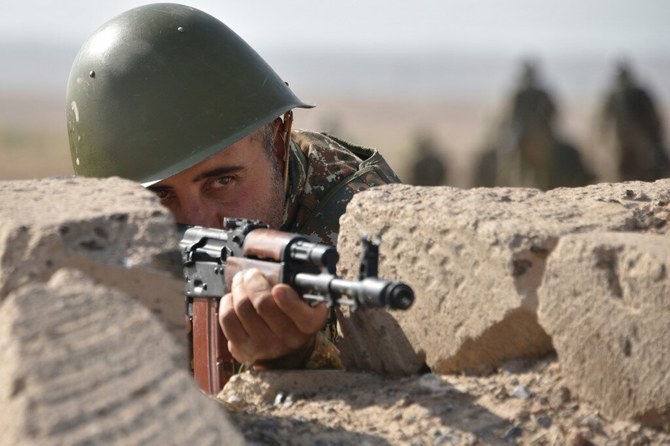
YEREVAN: Armenia on Tuesday reported deaths and the loss of military positions in border clashes with Azerbaijani troops, a year after the arch-foes fought a war over the disputed Nagorno-Karabakh region.
The six-week conflict, which left more than 6,500 dead, ended last November in a Russian-brokered deal that saw Armenia cede swathes of territory it had controlled for decades.
Armenia’s defense ministry said on Tuesday that “there are fatalities and wounded among Armenian troops as a result of fighting that erupted following an attack by Azerbaijani forces.”
It said the number of casualties was being verified and that Armenia had “lost control of two military positions.”
The ministry reported later in the evening that 12 Armenian servicemen were captured by the Azerbaijani military.
Earlier on Tuesday, the two sides accused each other of initiating fighting along their shared border.
“Armenian troops attacked Azerbaijani positions in the districts of Kelbajar and Lachin,” Azerbaijan’s defense ministry said in a statement, adding that two Azerbaijani troops were wounded.
The ministry said Azerbaijani troops “stopped the enemy’s advance, surrounded and detained Armenian servicemen.”
The country’s foreign ministry said Armenia “is deliberately mounting tensions and is not interested in ensuring peace and security in the region.”
Armenia’s defense ministry said Azerbaijani forces tried to “break through” the border before being repelled.
The European Union called on both sides to cease hostilities.
“Call for urgent de-escalation and full cease-fire,” European Council President Charles Michel said on Twitter.
“Challenging situation in region — EU is committed to work with partners to overcome tensions for a prosperous and stable South Caucasus,” he added.
Armenia appealed to ally Russia for military support under the Collective Security Treaty Organization pact, which obliges Moscow to protect it in the event of a foreign invasion.
“Given that there was an attack on Armenia’s sovereign territory, we appeal to the Russian Federation to protect Armenia’s territorial integrity,” said Security Council Secretary Armen Grigoryan.
Since last year’s war, both Armenia and Azerbaijan have reported occasional exchanges of fire, sparking fears of another flare-up in their territorial dispute.
Both Armenia and Azerbaijan said the situation along their border remained tense with clashes ongoing on Tuesday evening.
On Sunday, they traded accusations of opening fire at their border near Karabakh.
The day before, Nagorno-Karabakh authorities said the only road connecting Armenia to the separatist territory — the Lachin Corridor — was briefly closed due to an incident between the two sides.
Ethnic Armenian separatists in Nagorno-Karabakh broke away from Azerbaijan as the Soviet Union collapsed in 1991, and the ensuing conflict claimed around 30,000 lives.


Armenia reports deaths in Azerbaijan border clashes
https://arab.news/zv2ug
Armenia reports deaths in Azerbaijan border clashes

- Armenia's defence ministry said "there are fatalities and wounded among Armenian troops as a result of fighting that erupted following an attack by Azerbaijani forces"
- The ministry reported later in the evening that 12 Armenian servicemen were captured by the Azerbaijani military


Tunisia’s famed blue-and-white village threatened after record rains
SIDI BOU SAID, Tunisia: Perched on a hill overlooking Carthage, Tunisia’s famed blue-and-white village of Sidi Bou Said now faces the threat of landslides, after record rainfall tore through parts of its slopes.
Last week, Tunisia saw its heaviest downpour in more than 70 years. The storm killed at least five people, with others still missing.
Narrow streets of this village north of Tunis — famed for its pink bougainvillea and studded wooden doors — were cut off by fallen trees, rocks and thick clay. Even more worryingly for residents, parts of the hillside have broken loose.
“The situation is delicate” and “requires urgent intervention,” Mounir Riabi, the regional director of civil defense in Tunis, recently told AFP.
“Some homes are threatened by imminent danger,” he said.
Authorities have banned heavy vehicles from driving into the village and ordered some businesses and institutions to close, such as the Ennejma Ezzahra museum.
- Scared -
Fifty-year-old Maya, who did not give her full name, said she was forced to leave her century-old family villa after the storm.
“Everything happened very fast,” she recalled. “I was with my mother and, suddenly, extremely violent torrents poured down.”
“I saw a mass of mud rushing toward the house, then the electricity cut off. I was really scared.”
Her Moorish-style villa sustained significant damage.
One worker on site, Said Ben Farhat, said waterlogged earth sliding from the hillside destroyed part of a kitchen wall.
“Another rainstorm and it will be a catastrophe,” he said.
Shop owners said the ban on heavy vehicles was another blow to their businesses, as they usually rely on tourist buses to bring in traffic.
When President Kais Saied visited the village on Wednesday, vendors were heard shouting: “We want to work.”
One trader, Mohamed Fedi, told AFP afterwards there were “no more customers.”
“We have closed shop,” he said, adding that the shops provide a livelihood to some 200 families.
- Highly unstable -
Beyond its famous architecture, the village also bears historical and spiritual significance.
The village was named after a 12th-century Sufi saint, Abu Said Al-Baji, who had established a religious center there. His shrine still sits atop the hill.
The one-time home of French philosopher Michel Foucault and writer Andre Gide, the village is protected under Tunisian preservation law, pending a UNESCO decision on its bid for World Heritage status.
Experts say solutions to help preserve Sidi Bou Said could include restricting new development, building more retaining walls and improving drainage to prevent runoff from accumulating.
Chokri Yaich, a geologist speaking to Tunisian radio Mosaique FM, said climate change has made protecting the hill increasingly urgent, warning of more storms like last week’s.
The hill’s clay-rich soil loses up to two thirds of its cohesion when saturated with water, making it highly unstable, Yaich explained.
He also pointed to marine erosion and the growing weight of urbanization, saying that construction had increased by about 40 percent over the past three decades.
For now, authorities have yet to announce a protection plan, leaving home and shop owners anxious, as the weather remains unpredictable.


