

‘No magic wand’ to resolve Lebanon’s economic crisis

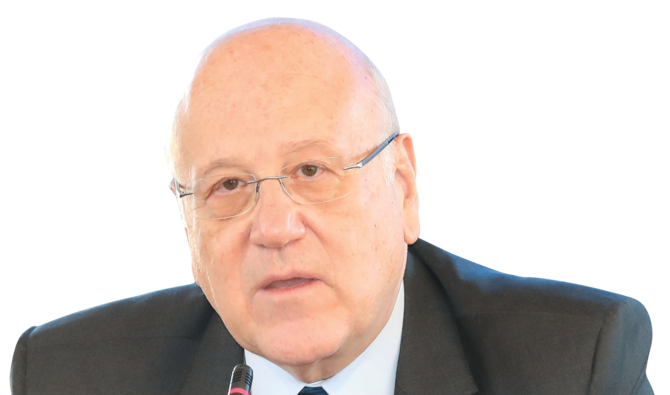
Najib Mikati. (Supplied)
Short Url
Updated 11 November 2021
Follow

‘No magic wand’ to resolve Lebanon’s economic crisis

  • Lebanon is also dealing with the ongoing diplomatic fallout resulting from the information minister’s comments about the war in Yemen

BEIRUT: The Lebanese government does not have a “magic wand” to resolve the country’s economic crisis, Prime Minister Najib Mikati said Wednesday, as he expressed sympathy for people’s hardships.
He made the remarks after visiting the Greek Orthodox Metropolitan Bishop of Beirut Elias Audi, also speaking about the problems dogging the probe into last year’s deadly port explosion.
There are demands from Hezbollah and the Amal Movement for Judge Tarek Bitar to be removed from the blast investigation, with both boycotting Cabinet sessions until he is dropped. The prime minister has replaced Cabinet sessions with mini-ministerial meetings to address vital issues.   
“We have no magic wand,” Mikati said, answering calls to activate the government’s role in saving Lebanon from the economic crisis. “We feel the citizens’ concerns and we seek to alleviate some burdens, especially the living conditions.”
He added that the Lebanese judiciary needed to assume its role fairly and adopt unified laws so that a result could be reached. “We support keeping Bitar in charge and we do not interfere in the judiciary.”
On Tuesday, a group of female activists stormed the Justice Palace in Beirut and sealed the office of Judge Habib Mezher in protest against his “illegal attempt to remove Bitar from the case and take over the confidential investigations.”
The Lebanese Judges Club urged politicians to stop interfering in the judiciary for the country’s sake, so that the judicial process could take its course without any abuse. “Otherwise, history will not be merciful,” it said.
Lebanon is also dealing with the ongoing diplomatic fallout resulting from the information minister’s comments about the war in Yemen.
The Arab League’s attempt to mend fences between Lebanon and Saudi Arabia has failed, after the body’s assistant secretary-general Hossam Zaki tried to mediate.

We have no magic wand. We feel the citizens’ concerns and we seek to alleviate some burdens, especially the living conditions.

Najib Mikati

Hezbollah insists that Information Minister George Kordahi should not resign over the remarks.
Mikati reiterated that the brotherly ties between Lebanon and the Gulf states were a priority and he once again called on the minister to resign, stressing that “supreme national interest, in political affairs and in international relations, must prevail over factional and personal interests.”
He met Lebanon’s ambassadors to Saudi Arabia and Bahrain, Fawzi Kabbara and Miled Nammour, on Wednesday. They returned to Lebanon after the two Gulf countries ordered them to leave.
The two ambassadors expressed their fear of this crisis affecting the future of bilateral relations with the Gulf states and its repercussions on the interests of Lebanese expat communities.
They told Mikati that, upon their departure, Saudi and Bahraini officials had assured them of their deep concern for the close ties with Lebanon and for the solid friendship that bound them to the Lebanese people.
Both stressed it would be harder to restore ties the more time that passed.
Al-Qabas newspaper, quoting a Kuwaiti security source on Wednesday, reported: “The Kuwaiti Ministry of Interior has stopped issuing all kinds of visas to the Lebanese, until further notice, against the backdrop of the recent diplomatic crisis between the Gulf Cooperation Council countries and Lebanon.”
The source told the newspaper: “Lebanese with Kuwaiti residency are not included in the decision, and they have the right to return to the country. Visitor visas for families, tourists, businessmen and government officials, as well as work visas, will no longer be granted.”


Trump says ‘hopefully’ no need for military action against Iran

Updated 2 sec ago
Follow

Trump says ‘hopefully’ no need for military action against Iran

  • US president said he is speaking with Iran and left open the possibility of avoiding a military operation
  • An Iranian military spokesman warned Tehran’s response to any US action would not be limited
PARIS: US President Donald Trump said on Thursday he hoped to avoid military action against Iran, which has threatened to strike American bases and aircraft carriers in response to any attack.
Trump said he is speaking with Iran and left open the possibility of avoiding a military operation after earlier warning time was “running out” for Tehran as the United States sends a large naval fleet to the region.
When asked if he would have talks with Iran, Trump told reporters: “I have had and I am planning on it.”
“We have a group headed out to a place called Iran, and hopefully we won’t have to use it,” the US president added, while speaking to media at the premiere of a documentary about his wife Melania.
As Brussels and Washington dialed up their rhetoric and Iran issued stark threats this week, UN chief Antonio Guterres has called for nuclear negotiations to “avoid a crisis that could have devastating consequences in the region.”
An Iranian military spokesman warned Tehran’s response to any US action would not be limited — as it was in June last year when American planes and missiles briefly joined Israel’s short air war against Iran — but would be a decisive response “delivered instantly.”
Brig. Gen. Mohammad Akraminia told state television US aircraft carriers have “serious vulnerabilities” and that numerous American bases in the Gulf region are “within the range of our medium-range missiles.”
“If such a miscalculation is made by the Americans, it will certainly not unfold the way Trump imagines — carrying out a quick operation and then, two hours later, tweeting that the operation is over,” he said.
An official in the Gulf, where states host US military sites, said that fears of a US strike on Iran are “very clear.”
“It would bring the region into chaos, it would hurt the economy not just in the region but in the US and cause oil and gas prices to skyrocket,” the official added.
‘Protests crushed in blood’
Qatar’s leader Sheikh Tamim bin Hamad Al-Thani and Iran’s President Masoud Pezeshkian held a call to discuss “efforts being made to de-escalate tensions and establish stability,” the Qatar News Agency (QNA) reported.
The European Union, meanwhile, piled on the pressure by designating the Islamic Revolutionary Guard Corps (IRGC) a “terrorist organization” over a deadly crackdown on recent mass protests.
“’Terrorist’ is indeed how you call a regime that crushes its own people’s protests in blood,” said EU chief Ursula von der Leyen, welcoming the “overdue” decision.
Though largely symbolic, the EU decision has already drawn a warning from Tehran.
Iran’s military slammed “the illogical, irresponsible and spite-driven action of the European Union,” alleging the bloc was acting out of “obedience” to Tehran’s arch-foes the United States and Israel.
Iranian officials have blamed the recent protest wave on the two countries, claiming their agents spurred “riots” and a “terrorist operation” that hijacked peaceful rallies sparked over economic grievances.
Rights groups have said thousands of people were killed during the protests by security forces, including the IRGC — the ideological arm of Tehran’s military.
In Tehran on Thursday, citizens expressed grim resignation.
“I think the war is inevitable and a change must happen. It can be for worse, or better. I am not sure,” said a 29-year-old waitress, speaking on condition of anonymity for fear of reprisals.
“I am not in favor of war. I just want something to happen that would result in something better.”
Another 29-year-old woman, an unemployed resident of an upscale neighborhood in northern Tehran, said: “I believe that life has highs and lows and we are now at the lowest point.”
Trump had threatened military action if protesters were killed in the anti-government demonstrations that erupted in late December and peaked on January 8 and 9.
But his more recent statements have turned to Iran’s nuclear program, which the West believes is aimed at making an atomic bomb.
On Wednesday, he said “time is running out” for Tehran to make a deal, warning the US naval strike group that arrived in Middle East waters on Monday was “ready, willing and able” to hit Iran.
Conflicting tolls
The US-based Human Rights Activists News Agency (HRANA) said it has confirmed 6,479 people were killed in the protests, as Internet restrictions imposed on January 8 continue to slow verification.
But rights groups warn the toll is likely far higher, with estimates in the tens of thousands.
Iranian authorities acknowledge that thousands were killed during the protests, giving a toll of more than 3,000 deaths, but say the majority were members of the security forces or bystanders killed by “rioters.”
Billboards and banners have gone up in the capital Tehran to bolster the authorities’ messages. One massive poster appears to show an American aircraft carrier being destroyed.