

Attempt to assassinate Iraqi PM draws global condemnation

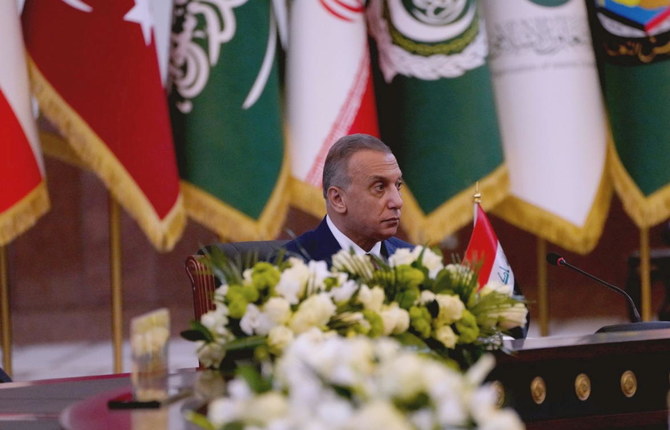
Iraqi Prime Minister Mustafa Al-Kadhimi attends the Baghdad summit in Baghdad, Iraq, August 28, 2021. (Reuters)
Short Url
Updated 08 November 2021
Follow

Attempt to assassinate Iraqi PM draws global condemnation

  • UAE, Kuwait, Qatar, Jordan and Arab League all echo Saudi Arabia’s statement
  • The Muslim World League also strongly condemned the failed assassination bid against Iraq’s prime minister

JEDDAH: Saudi Arabia joined a torrent of global condemnation on Sunday after an attempt to assassinate Iraqi Prime Minister Mustafa Al-Kadhimi.

Al-Kadhimi escaped unhurt after three explosives-laden drones targeted his residence inside the heavily fortified Green Zone in Baghdad. Two of the drones were intercepted and destroyed but a third hit the building and detonated, injuring six members of the prime minister’s personal protection force.

The Saudi Foreign Ministry said the attack was a “cowardly terrorist act,” and the US offered assistance with the investigation. “I strongly condemn the terrorist attack targeting the residence of Iraqi Prime Minister Kadhimi,” US President Joe Biden said.

“I am relieved the prime minister was not injured and commend the leadership he has shown in calling for calm, restraint, and dialogue to protect the institutions of the state and strengthen the democracy Iraqis so richly deserve.”

Al-Kadhimi appeared in a video footage published by his office on Sunday chairing a meeting with top security commanders to discuss the drone attack.

“The cowardly terrorist attack that targeted the home of the prime minister with the aim of assassinating him is a serious targeting of the Iraqi state by criminal armed groups,” Al-Kadhimi’s

office said.

No one admitted carrying out the attack, but the finger of blame was immediately pointed at Iran-backed armed groups who have been angered by Kadhimi’s rejection of Iranian interference in Iraq.

Opinion

This section contains relevant reference points, placed in (Opinion field)

The Hashd Al-Shaabi armed factions and their Fatah political bloc suffered a humiliating defeat in legislative elections in Iraq in October, and threatened violence unless the results were overturned.

The attack came two days after violent clashes in Baghdad between government forces and Hashd Al-Shaabi supporters. Protesters pelted police with stones near the Green Zone, injuring several officers. The police responded with tear gas and live gunfire, killing at least one demonstrator. Al-Kadhimi has ordered an investigation.

Independent analysts say the election results were a reflection of anger toward the Iran-backed armed groups, which are widely accused of involvement in the killing of at least 1,000 protesters who took to the streets in anti-government demonstrations that began in October 2019.

President Barham Salih condemned Sunday’s attack as a heinous crime against Iraq. “We cannot accept that Iraq will be dragged into chaos and a coup against its constitutional system,” he said.

The influential Shiite cleric Moqtada Al-Sadr, whose party was the biggest winner in last month’s election, called the attack a terrorist act against Iraq’s stability that aimed to “return Iraq to a state of chaos to be controlled by non-state forces.”

The Muslim World League also strongly condemned the failed assassination bid against Iraq’s prime minister on Sunday.

“Such terrorist acts that aim to destabilize Iraq, harm its security, and terrorize its people are destined to fail. With God’s help, the great and strong Iraq will continue to defeat such attempts and move forward with achieving progress and prosperity, and strengthening its national cohesion,” the secretary-general of the MWL Sheikh Mohammed bin Abdul Karim Al-Issa said.

Al-Issa expressed full support for the Iraqi government and people facing terrorism, in all its forms and manifestations.


UN chief visits Iraq to mark end of assistance mission set up after 2003 invasion

Updated 5 sec ago
Follow

UN chief visits Iraq to mark end of assistance mission set up after 2003 invasion

  • Sudani said his country “highly values” the mission’s work in a region “that has suffered for decades from dictatorship, wars, and terrorism”
  • Guterres praised “the courage, fortitude and determination of the Iraqi people”

BAGHDAD: United National Secretary-General Antonio Guterres was in Baghdad on Saturday to mark the end of the political mission set up in 2003 following the US-led invasion of Iraq that toppled Saddam Hussein.
The UN Security Council, at Iraq’s request, voted last year to wind down the mandate of the United Nations Assistance Mission in Iraq (UNAMI), by the end of 2025. The mission was set up to coordinate post-conflict humanitarian and reconstruction efforts and help restore a representative government in the country.
Iraqi caretaker Prime Minister Mohammed Shia Al-Sudani said his country “highly values” the mission’s work in a region “that has suffered for decades from dictatorship, wars, and terrorism.” He said its conclusion showed Iraq had reached a stage of “full self-reliance.”
“Iraq emerged victorious thanks to the sacrifices and courage of its people,” he said in a joint statement with Guterres.
The ending of UNAMI’s mandate “does not signify the end of the partnership between Iraq and the UN,” Sudani said, adding that it represents the beginning of a new chapter of cooperation focused on development and inclusive economic growth.
The prime minister said a street in Baghdad would be named “United Nations Street” in honor of the UN’s work and in recognition of 22 UN staff who were killed in an Aug. 19, 2003, truck bomb attack on the Canal Hotel in Baghdad, which housed the UN headquarters.
Guterres praised “the courage, fortitude and determination of the Iraqi people” and the country’s efforts to restore security and order after years of sectarian violence and the rise of extremist groups, including the Daesh group, in the years after the 2003 invasion.
“Iraqis have worked to overcome decades of violence, oppression, war, terrorism, sectarianism and foreign interference,” the secretary-general said. “And today’s Iraq is unrecognizable from those times.”
Iraq “is now a normal country, and relations between the UN and Iraq will become normal relations with the end of UNAMI,” Guterres added. He also expressed appreciation for Iraq’s commitment to returning its citizens from the Al-Hol camp, a sprawling tent camp in northeastern Syria housing thousands of people — mostly women and children — with alleged ties to the IS.
Guterres recently recommended former Iraqi President Barham Salih to become the next head of the UN refugee agency, the first nomination from the Middle East in half a century.
Salih’s presidential term, from 2018 to 2022, came in the immediate aftermath of the Daesh group’s rampage across Iraq and the battle to take back the territory seized by the extremist group, including the key northern city of Mosul.
At least 2.2 million Iraqis were displaced as they fled the IS offensive. Many, particularly members of the Yazidi minority from the northern Sinjar district, remain in displacement camps today.