

Drought gives rebirth to Kurdish village in northern Iraq

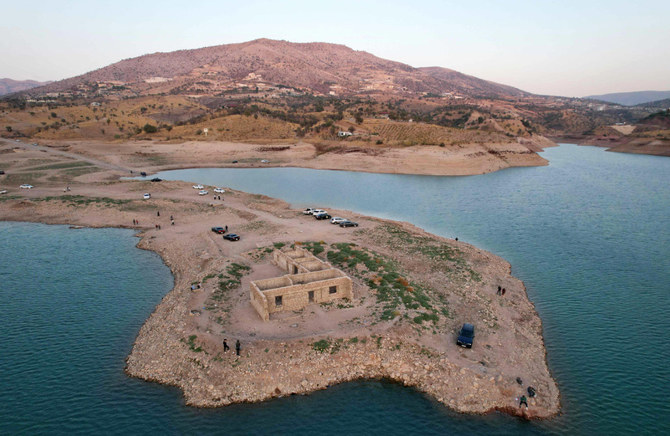
An aerial view shows the remains of the submerged Gary Qasruka village abandoned 36 years ago, which have resurfaced following a large drop in water level of the Dohuk Dam due to drought on November 4, 2021. (AFP)
Short Url
Updated 06 November 2021
Follow

Drought gives rebirth to Kurdish village in northern Iraq

  • Before the winter rains set in and the village goes under again, visitors on foot can now view the stone walls of a Guiri Qasrouka home that is still standing

DOHUK: The ruins of an Iraqi Kurdish village abandoned 36 years ago and submerged under the waters of a dam, have suddenly resurfaced thanks to sinking water levels in the drought-hit country.
The construction of the dam, 2 km north of the town of Dohuk, started in 1985 and prompted the resettlement of Guiri Qasrouka’s 50 families.
Guiri Qasrouka was then swallowed by the waters which serve to irrigate surrounding farmland.
“Because of the drought” caused by scant rainfall in Iraq, the Dohuk dam’s water level dropped by seven meters in September and brought the village back to the surface, explained the dam’s director, Farhad Taher.

BACKGROUND

The construction of the dam, 2 km north of the town of Dohuk, started in 1985 and prompted the resettlement of Guiri Qasrouka’s 50 families.

“This phenomenon is certainly linked to climate change,” Taher said, adding that the ruins had also reappeared in 2009, 1999 and 1992.
Before the winter rains set in and the village goes under again, visitors on foot can now view the stone walls of a Guiri Qasrouka home that is still standing.
The algae-splattered and shell-indented ruins are set against a backdrop of the towering Kurdish mountains of northern Iraq.
With financial compensation, villagers, who had also fled between 1974 and 1976 during a Kurdish uprising, built a new Guiri Qasrouka nearby.


Syrian authorities find Assad-era mass grave near Damascus

Updated 5 sec ago
Follow

Syrian authorities find Assad-era mass grave near Damascus

  • Authorities are identifying the victims and investigating a suspected mass grave linked to the former Assad regime
  • Nearly 177,000 people have been forcibly disappeared in Syria since March 2011

LONDON: The Syrian Civil Defense reported that the remains of 14 individuals were found in the Adra industrial area, northeast of Damascus, during excavation for mill foundations in the area.

Search teams coordinated recovery operations at the site with the National Commission for the Missing, the public prosecutor, and security authorities, according to the Syrian Arab News Agency.

The National Mine Action Center surveyed the area to ensure that it was clear of land mines and found the bones of four individuals scattered by prior digging. They later recovered the remains of 10 more individuals.

The remains were documented and collected in accordance with forensic procedures. Authorities are identifying the victims and investigating a suspected mass grave linked to the former Assad regime.

According to the Syrian Network for Human Rights, nearly 177,000 people have been forcibly disappeared in Syria since March 2011.