In Iraqi Kurdish city, women gain power without parity

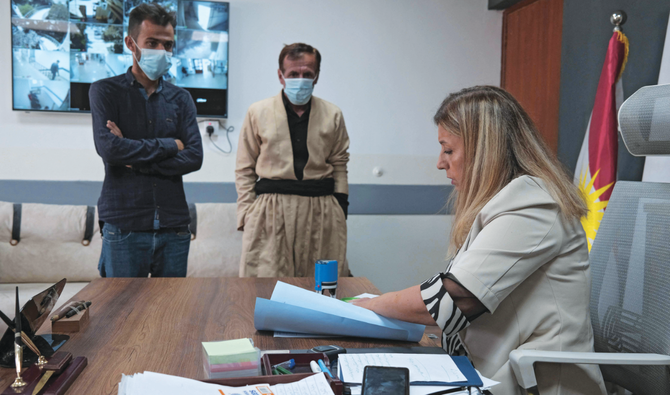
Kwestan Akram Faraj, head of Halabja municipality, in her office in the Kurdish Iraqi town of Halabja, 300 km from Baghdad. (AFP)
Short Url
Updated 22 October 2021
Follow

In Iraqi Kurdish city, women gain power without parity

HALABJA: In the Kurdish city of Halabja in northeastern Iraq, municipal director Kwestan Faraj recalls the day when being a woman saved her life.
Though equality may be a distant reality for many women in Iraq, in Halabja women have reached top levels of local government.
Mayor, university dean, director of the veterinary department, and health spokesperson are some of the senior posts held by women in the city of around 115,000 inhabitants.
It marks something of a departure for Iraqi Kurdistan, where public affairs have long been dominated by a handful of men. Tradition and conservative values have meant that women face routine discrimination and are largely confined to the private sphere.
“When you are a woman, climbing the ranks comes with a lot of sacrifices,” Faraj, 55, said.
A former deputy head of the municipality for 15 years, Faraj launched her political career many years earlier when as a student she handed out leaflets against Saddam Hussein’s regime, which carried out an infamous chemical attack on the city shortly before the end of the Iran-Iraq war in 1988.
She recalled one day when an armed man arrived demanding that she sign dubious paperwork. She refused.
“I thought he would pull out his gun and shoot,” she said.
“He got up and told me: ‘If you weren’t a woman, I know what I would have done’.”
She said that in her city the drive for gender equality was largely led by the Patriotic Union of Kurdistan (PUK), one of two historical parties in Iraqi Kurdistan.
Yet some residents complain that the advances are largely cosmetic and aimed at masking the shortcomings of public services.
A junior partner in the Kurdistan regional government in Irbil, the PUK holds the post of speaker in the regional parliament, which it also awarded to a woman, Rewaz Faiq.
The party “believes in equality between men and women in all domains,” Faraj said.
“This has allowed us to achieve gender balance in administrative posts in Halabja,” said the head of the municipality, who has held the post since 2016.
Halabja prides itself on having had a woman mayor, Adela Khanum, in the first decades of the 20th century. Now it has another, Nuxsha Nasih.
It also has Kurdistan’s first female university dean, Mahabad Kamil Abdullah. “The Islamist parties were among the first to congratulate me when I became the president of Halabja University,” she said.
But it is by no means representative of the situation of women in Kurdistan as a whole. A 2018 UN report found that women in the workforce represent barely 15 percent of the women of working age. About three quarters of those work in the public sector.
In Iraq’s Oct. 10 parliamentary election, more than 90 women were elected according to preliminary results, exceeding the minimum 83-seat quota established for women in the 329-seat chamber.
Though the Kurdistan region has cultivated an image of relative stability and tolerance, women’s rights activists say key issues like forced marriage and female genital mutilation have gone unaddressed.
“It is not enough to have women in high posts. There need to be more women in the lower ranks,” said Gulistan Ahmed, who heads the governmental commission for human rights in Halabja.
Many residents are more preoccupied with the failings of public services than with seeking gender equality.
“There have been no notable changes in the city under their mandate, whether at the level of public services or with the launch of new projects,” complained Wshyar Abdulkarim, a 45-year-old spice merchant.
Female market trader Mujda Ahmed said having women in top jobs had yet to lead to an improvement in services for women.
“I have worked in the market for six years and not a single person has built public toilets for women,” she said.
“I have the impression that they are being used by their parties, which simply want to improve their image on the issue of equality, nothing more.”


Syria moves military reinforcements east of Aleppo after telling Kurds to withdraw

Updated 3 sec ago
Follow

Syria moves military reinforcements east of Aleppo after telling Kurds to withdraw

ALEPPO: Syria’s army was moving reinforcements east of Aleppo city on Wednesday, a day after it told Kurdish forces to withdraw from the area following deadly clashes last week.
The deployment comes as Syria’s Islamist-led government seeks to extend its authority across the country, but progress has stalled on integrating the Kurds’ de facto autonomous administration and forces into the central government under a deal reached in March.
The United States, which for years has supported Kurdish fighters but also backs Syria’s new authorities, urged all parties to “avoid actions that could further escalate tensions” in a statement by the US military’s Central Command chief Admiral Brad Cooper.
On Tuesday, Syrian state television published an army statement with a map declaring a large area east of Aleppo city a “closed military zone” and said “all armed groups in this area must withdraw to east of the Euphrates” River.
The area, controlled by Kurdish forces, extends from near Deir Hafer, around 50 kilometers (30 miles) from Aleppo, to the Euphrates about 30 kilometers further east, as well as toward the south.
State news agency SANA published images on Wednesday showing military reinforcements en route from the coastal province of Latakia, while a military source on the ground, requesting anonymity, said reinforcements were arriving from both Latakia and the Damascus region.
Both sides reported limited skirmishes overnight.
An AFP correspondent on the outskirts of Deir Hafer reported hearing intermittent artillery shelling on Wednesday, which the military source said was due to government targeting of positions belonging to the US-backed, Kurdish-led Syrian Democratic Forces.

’Declaration of war’

The SDF controls swathes of the country’s oil-rich north and northeast, much of which it captured during Syria’s civil war and the fight against the Daesh group.
On Monday, Syria accused the SDF of sending reinforcements to Deir Hafer and said it would send its own personnel there in response.
Kurdish forces on Tuesday denied any build-up of their personnel and accused the government of attacking the town, while state television said SDF sniper fire there killed one person.
Cooper urged “a durable diplomatic resolution through dialogue.”
Elham Ahmad, a senior official in the Kurdish administration, said that government forces were “preparing themselves for another attack.”
“The real intention is a full-scale attack” against Kurdish-held areas, she told an online press conference, accusing the government of having made a “declaration of war” and breaking the March agreement on integrating Kurdish forces.
Syria’s government took full control of Aleppo city over the weekend after capturing its Kurdish-majority Sheikh Maqsud and Ashrafiyeh neighborhoods and evacuating fighters there to Kurdish-controlled areas in the northeast.
Both sides traded blame over who started the violence last week that killed dozens of people and displaced tens of thousands.

PKK, Turkiye

On Tuesday in Qamishli, the main Kurdish city in the country’s northeast, thousands of people demonstrated against the Aleppo violence, with some burning pictures of Syrian President Ahmed Al-Sharaa, an AFP correspondent said, while shops were shut in a general strike.
Some protesters carried Kurdish flags and banners in support of the SDF.
“Leave, Jolani!” they shouted, referring to President Sharaa by his former nom de guerre, Abu Mohammed Al-Jolani.
“This government has not honored its commitments toward any Syrians,” said cafe owner Joudi Ali.
Other protesters burned portraits of Turkish Foreign Minister Hakan Fidan, whose country has lauded the Syrian government’s Aleppo operation “against terrorist organizations.”
Turkiye has long been hostile to the SDF, seeing it as an extension of the Kurdistan Workers’ Party (PKK) and a major threat along its southern border.
Last year, the PKK announced an end to its long-running armed struggle against the Turkish state and began destroying its weapons, but Ankara has insisted that the move include armed Kurdish groups in Syria.
On Tuesday, the PKK called the “attack on the Kurdish neighborhoods in Aleppo” an attempt to sabotage peace efforts between it and Ankara.
A day earlier, Ankara’s ruling party levelled the same accusation against Kurdish fighters.
The Britain-based Syrian Observatory for Human Rights reported 45 civilians and 60 soldiers and fighters from both sides killed in the Aleppo violence.
Aleppo civil defense official Faysal Mohammad said Tuesday that 50 bodies had been recovered from the Kurdish-majority neighborhoods after the fighting.