

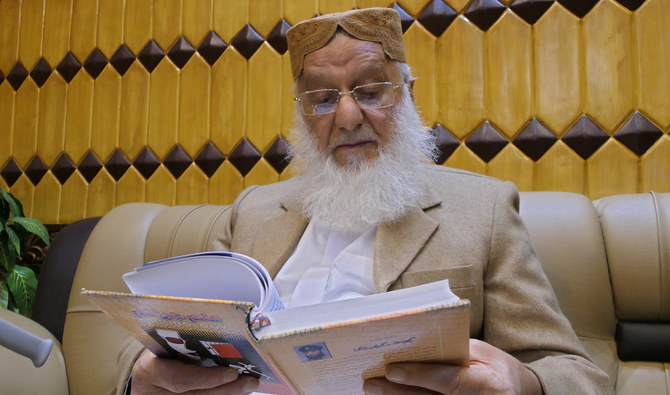

QUETTA: Haibat Khan Haleemi received his PhD in political science at a University of Balochistan convocation last month was not news; what landed him in the headlines was that the longtime retired policeman, who hails from the impoverished Mastung district in the southwestern province, is 80 years old.
This is no small feat in a country where life expectancy at birth is about 66.34 years on average for men and the official age of retirement is 65.
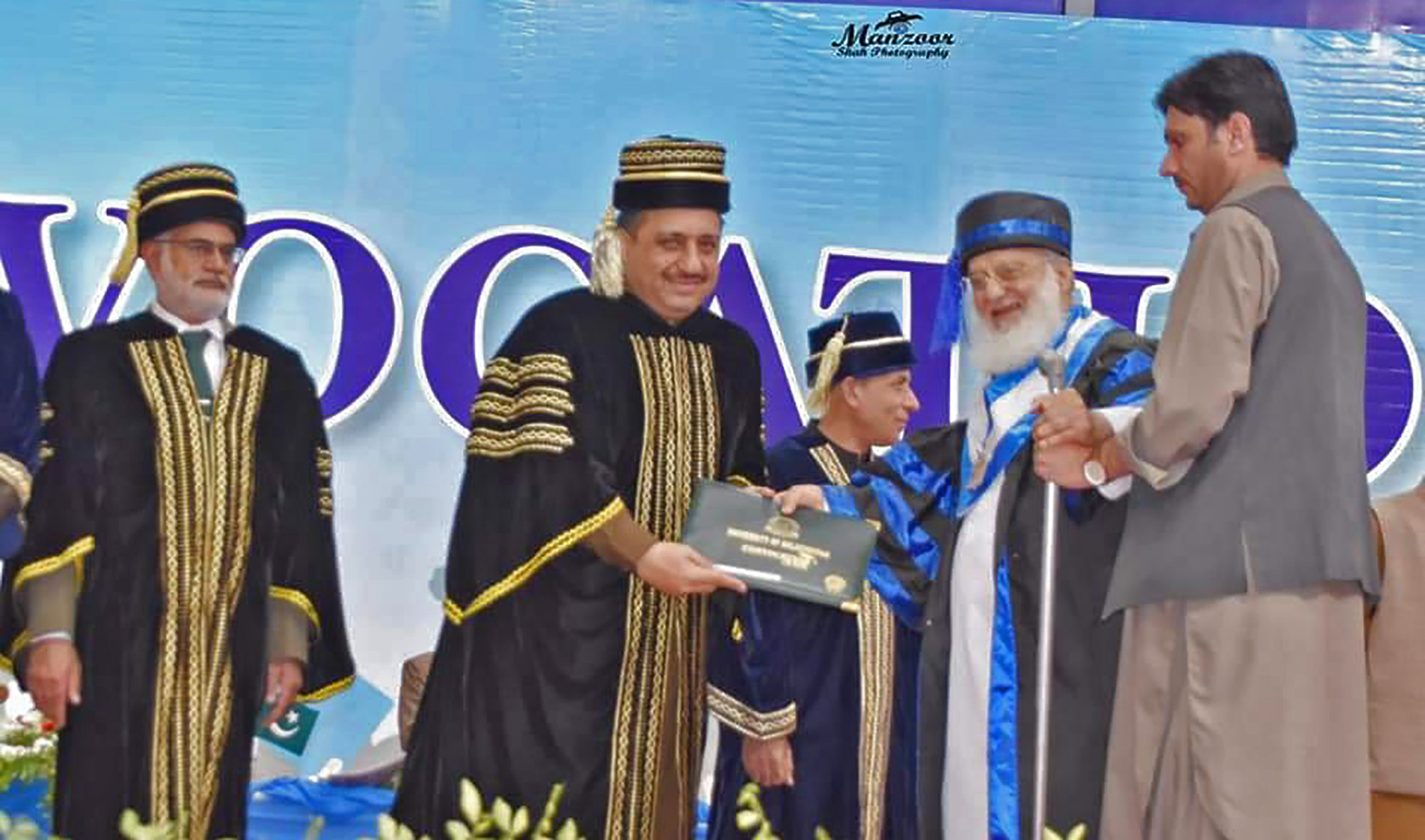
80-year-old Haibat Khan Haleemi receives his PhD degree from Governor Balochistan Syed Zahoor Agha at the University of Balochistan convocation held on October 26, 2021, in Quetta, Pakistan. (Photo courtesy: Haibat Khan Haleemi)
Haleemi served in Balochistan's police force for 40 years but was always driven by his passion for knowledge, he told Arab News in an interview this week. On October 26, he received his doctorate degree for a thesis on Balochistan’s geography and security challenges. The province has been long racked by a separatist insurgency, and army and paramilitary forces have launched several operations to quell it.
“I was appointed as a constable in Balochistan Police but decided to focus on my educational career after ten years in service,” Haleemi said. “What began several decades ago culminated in this doctorate degree in 2021.”
“I guess I am the first student in Balochistan’s history who got a standing ovation at the auditorium,” he said. “People stood up and clapped ... It was a proud moment which made me feel that I was rewarded for years of my educational struggle.”
Haleemi has 12 children who have all completed graduate degrees in various academic disciplines.
“We did not have any tutor until secondary school since our father used to teach us,” Haleemi’s 43-year-old son, Ali Haleemi, told Arab News. “He managed to take out time even during his regular police service and always remained our inspiration.”
“When he retired from the service in 2005, we requested him to rest and spend time with the family,” Ali added. “But he was determined to continue his education and we supported his decision.”
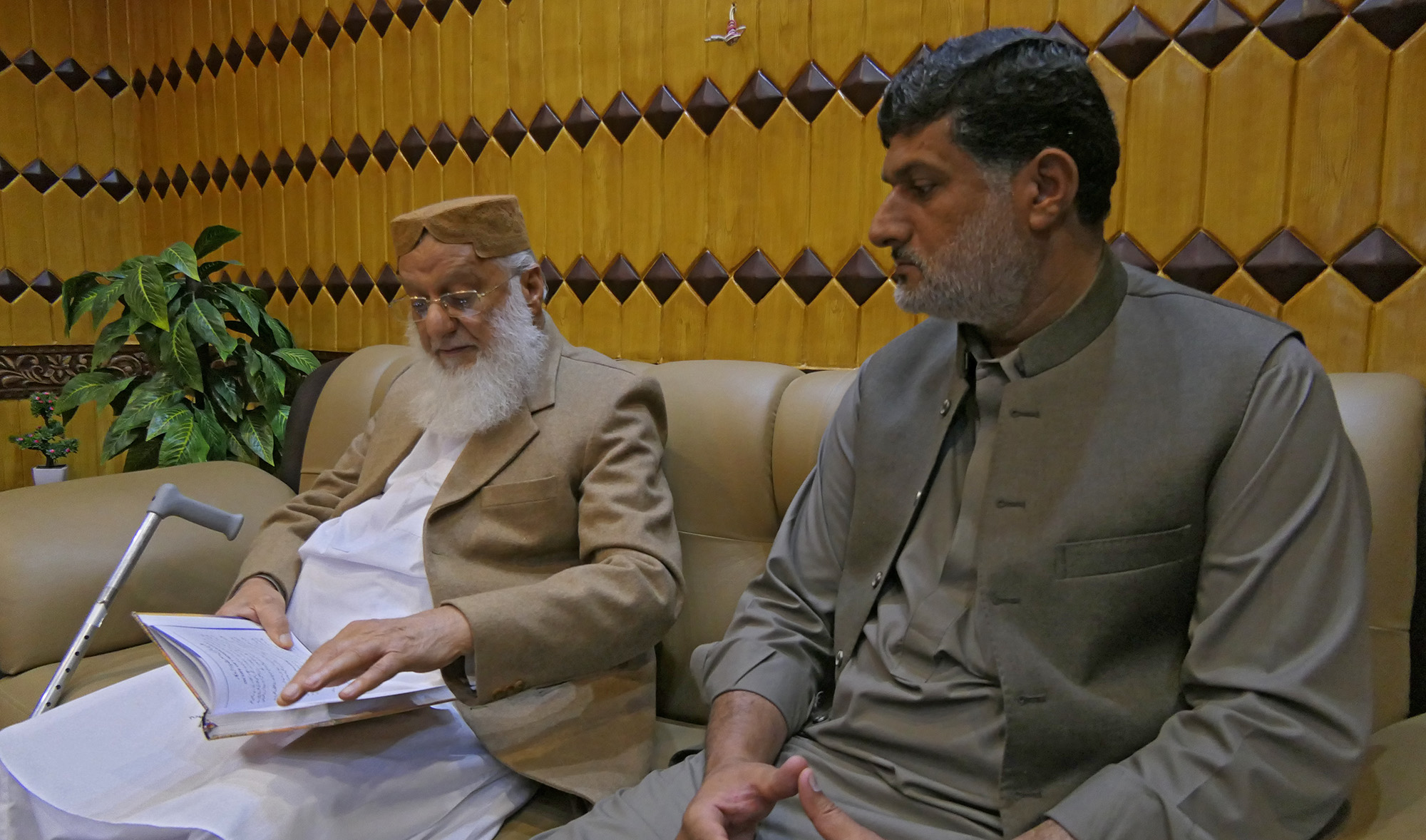
Haibat Khan Haleemi talks to his son, Ali Haleemi, at his residence in Quetta, Pakistan, on October, 31 2021. (AN Photo)
Haleemi also served as chief law instructor at the Police College of Quetta in the 1980s where he started teaching criminology. During his stint at the institute, he appeared in the competitive exams for the post of divisional superintendent police and passed.
“Several police officers asked me to turn my criminology lectures into a book,” the retired officer said. “The vice chancellor at the University of Balochistan asked me to start lecturing on the subject in 2005, saying the province did not have a criminology department and students were forced to travel to Karachi or Islamabad to study the subject. I decided to do MPhil before teaching students and then took the next step to do my PhD.”
Professor Dr. Kaleemullah, head of the university's history department who supervised Haleemi’s thesis, said the octogenarian student would serve as an inspiration to the younger generation of Pakistan.
“He worked very hard on the thesis and submitted a well-researched document based on his vast information and knowledge,” Kaleemullah said.
Speaking to Arab News, the province’s newly elected chief minister Mir Abdul Qudus Bizenjo called Haleemi an “asset” for the country.
“The government wants to support people like Haibat Khan Haleemi who have been promoting education,” he said. “We have been trying to utilize all resources to uplift education in the province and will add his research as part of our policy for the future.”
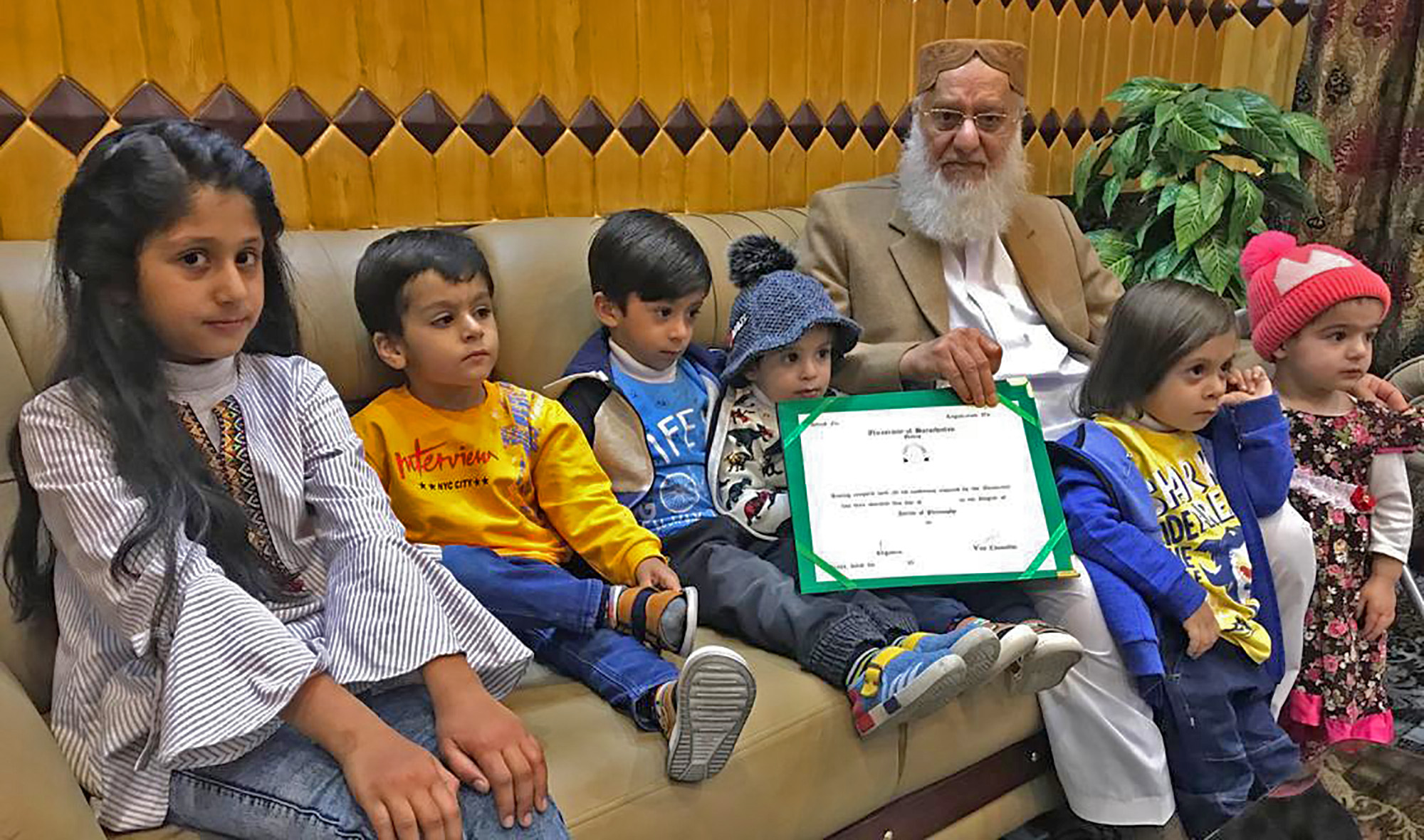
Haibat Khan Haleemi seen with his grandkids at his residence in Quetta, Pakistan, on October 31, 2021. (AN Photo)
Haleemi’s seven-year-old granddaughter, who studies in the second grade in Quetta, said she wanted to follow in his footsteps.
“I feel very proud of my grandfather who has done his PhD at such an old age and has become a motivation for so many people,” she told Arab News.
Haleemi said he studied for six hours a day while enrolled in the PhD program, which he described as a “tough experience” for someone as old as him.
But "our religion teaches us to seek knowledge from the lap of our mothers until we reach our graves,” said the retired officer who suffers from age-related stiffness of the neck and said he finally just wants to rest.


