Pakistan, Afghanistan open Chaman border crossing after nearly a month

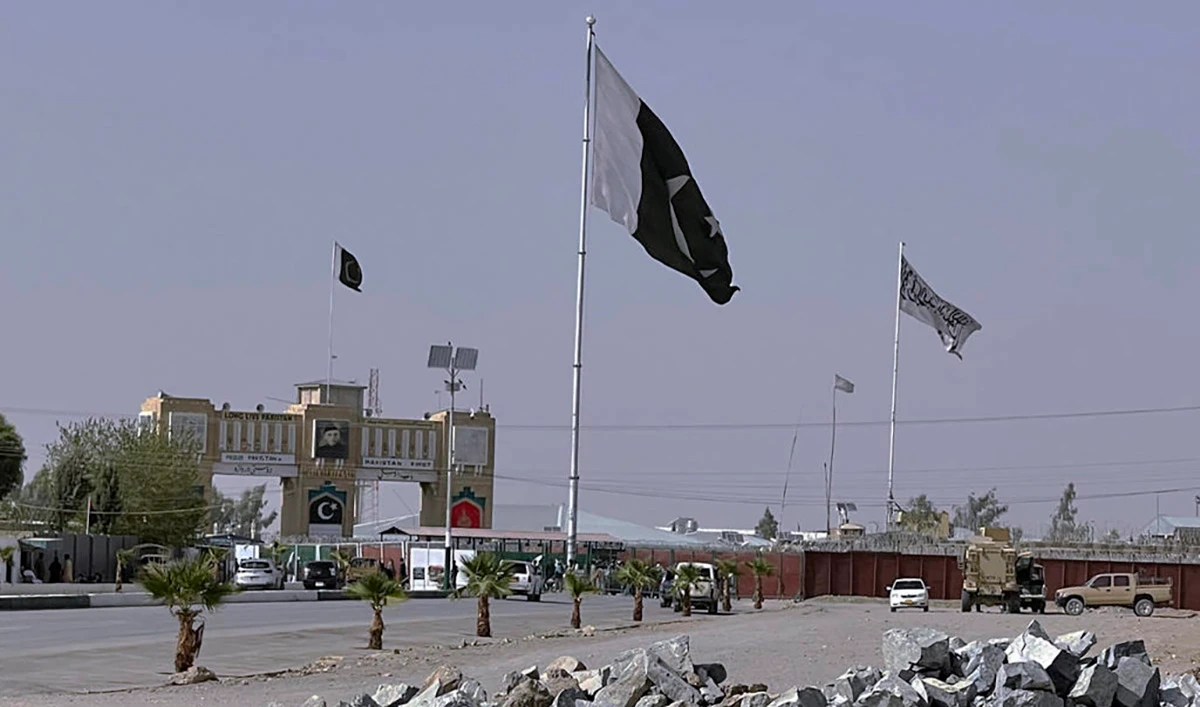
Pakistan and Taliban flags are seen on their respective sides near Friendship gate at a border crossing point in Chaman, Pakistan on August 27, 2021. (AP/File)
Short Url
Updated 02 November 2021
Follow

Pakistan, Afghanistan open Chaman border crossing after nearly a month

  • The Friendship Gate at Chaman is the second major border crossing between the two neighboring countries
  • Business community says the decision to close the border cost them about $857,000 in daily trade

ISLAMABAD: Pakistan and Afghanistan have opened the Friendship Gate at Chaman-Spin Boldak border crossing after about a month, Pakistan’s envoy to Kabul said on Tuesday.
The Chaman border crossing, which links Pakistan’s Balochistan province with Afghanistan’s Kandahar region, remained for nearly three weeks, though the authorities opened it for one day during this period to allow the movement of people on humanitarian grounds.
Local business community told Arab News last week the closure of Friendship Gate, one of Pakistan’s major border crossing points with Afghanistan, had cost them about Rs150 million ($857,942) per day due to the suspension of trade in the area.
The crossing is also a vital revenue source for Afghanistan’s cash-strapped government.
Pakistan’s ambassador to Afghanistan Mansoor Ahmed Khan announced in a Twitter post on Tuesday that Chaman-Boldak gate was now open and pedestrians and goods carrying vehicles had started crossing the border.
“We welcome Afghan fruit trucks moving to Pakistan,” he wrote. “Urge all concerned on both sides to devote their energies to ensure smooth movement of people & trucks.”


A day earlier, on Monday night, the ambassador said on the social media platform that “the two sides will ensure facilitative movement of people & trade/transit vehicles.”


The Pakistan-Afghanistan Joint Chamber of Commerce and Industry applauded the decision of the two countries in a statement after they opened the border to once again facilitate bilateral trade.
“The hiatus has caused huge financial losses and mental distress to border based businesses and farmers who witnessed ruining of their produce especially in this export season,” the trade body said, as it maintained “both sides must keep communication channels open to ensure that border remains open and a framework is developed to address routine as well as conditions arising out of force majeure closure of borders immediately.”
As Afghanistan sinks deeper into economic crisis, neighboring countries have become increasingly worried about a mass movement of refugees.
Pakistan’s foreign secretary Sohail Mahmood briefed Australia’s special representative on Afghanistan on urgent humanitarian and economic challenges facing Afghan people while stressing the need for immediate steps to alleviate their sufferings.
“The release of Afghanistan’s financial assets was another step that would be helpful in this regard,” the foreign office quoted him as saying in a statement.
The foreign secretary highlighted the measures taken by Pakistan to provide humanitarian assistance to the war-battered country, promote bilateral trade and economic cooperation, “regulate cross-border movement of people, foster further coordination among Afghanistan’s neighbors, and advance the regional connectivity projects.”
Pakistan parliament demands national response against ‘external sponsors’ of terror after Balochistan attacks

Updated 10 sec ago
Follow

Pakistan parliament demands national response against ‘external sponsors’ of terror after Balochistan attacks

ISLAMABAD: Pakistan’s National Assembly adopted a resolution on Tuesday condemning recent militant attacks in the southwestern Balochistan province, calling for an immediate national response against “external sponsors” of terror in the country. 

Separatist militants launched coordinated gun and bomb attacks across multiple districts in Balochistan on Friday and Saturday, targeting security installations and government facilities. Pakistan’s State Minister for Interior Tallal Chaudry said 50 people were killed in the attacks, which included 33 civilians and 17 law enforcement personnel. Meanwhile, Pakistan’s state media said on Monday that security forces have killed 177 militants since Friday. 

Pakistan’s Interior Minister Mohsin Naqvi said last week that the militant attacks, which were claimed by the separatist Baloch Liberation Army, were planned by India. New Delhi denied the allegations as “baseless,” saying it was an attempt by Islamabad to deflect from its internal failings. Pakistan regularly accuses India of funding militants in its Balochistan and northwestern Khyber Pakhtunkhwa provinces, charges New Delhi has always denied. 

The resolution, tabled by Minister for Parliamentary Affairs Dr. Tariq Fazal Chaudhry, said that in several militant attacks, evidence has shed light on the “external patronage” of militants and drawn attention to “serious concerns, particularly regarding the role of India.”

“This house demands that an immediate, comprehensive, coordinated and multi-dimensional national response be ensured against these external sponsors and internal facilitators, including funding, smuggling, and propaganda networks, bringing together the political, diplomatic, military, intelligence, legal and narrative fronts,” a copy of the resolution seen by Arab News stated. 


The resolution said “terrorism” in Pakistan is being facilitated through logistical and operational support, financial assistance, training, medical treatment and propaganda networks by certain neighboring countries. 

It expressed solidarity with the victims and relatives of the Balochistan attacks, praising Pakistan’s security forces for taking effective action against militants. The resolution also expressed concern over militant networks using women in the attacks. 

“This house expresses profound grief, sorrow, and concern over the fact that terrorist networks are attempting to exploit women and use them against the state and society through coercion, psychological pressure and blackmail,” it said. 

The resolution called for national unity and rising above political differences. It vowed that the state will not compromise on the protection of its people and national security. 

Balochistan, Pakistan’s largest province by land area, has long been gripped by a separatist insurgency that has intensified in recent years. Militants frequently target security forces, government officials, infrastructure projects, foreigners and non-local workers in the area.

Balochistan is home to vast reserves of minerals and hydrocarbons, and also to the multibillion-dollar China-Pakistan Economic Corridor (CPEC), a flagship component of China’s Belt and Road Initiative.

Separatist militant groups such as the BLA blame Islamabad for exploiting Balochistan’s natural resources and denying locals a share in them. The military and civilian government reject these allegations and say they are investing in the province’s development.