ISLAMABAD: The International Cricket Council (ICC) on Friday issued an apology to people with valid tickets for the Twenty20 World Cup match between Pakistan and Afghanistan who could not enter the stadium due to the ticketless fans who tried to force their way in the venue.
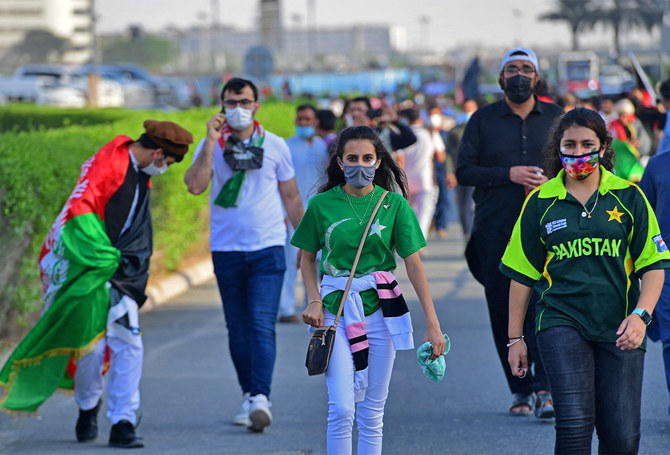
According to the Associated Press, several “ticketless fans, mostly carrying Afghan flags, tried to enter the Dubai International Cricket Stadium,” forcing the police to close all the gates an hour after the game had started.
The ICC said in its statement that more than 16,000 tickets had been issued for the World Cup game, though not all of the fans who got them managed to enter the stadium since Dubai police and security staff secured the stadium “to maintain a safe and controlled environment inside the venue.”
“The ICC, BCCI [Board of Control for Cricket in India] and ECB [Emirates Cricket Board] apologize to any fans with valid tickets who were unable to enter the stadium tonight and request they contact the ticket provider,” said the statement.
Afghanistan captain Mohammad Nabi also urged his country’s fans to “please buy tickets” after the game instead of forcing their way into stadiums.
The ICC also asked the Emirates Cricket Board to investigate the incident to see if any lessons could be learned and similar situations avoided in future.

International Cricket Council apologizes to fans after Pakistan, Afghanistan T20 match
https://arab.news/gbarw
International Cricket Council apologizes to fans after Pakistan, Afghanistan T20 match
- Several cricket fans with valid tickets could not enter the stadium since Dubai police had to shut the gates for security reasons
- ICC said more than 16,000 tickets had been issued for the World Cup game
Pakistan says repaid over $13.06 billion domestic debt early in last 14 months
- Finance adviser says repayment shows “decisive shift” toward fiscal discipline, responsible economic management
- Says Pakistan’s total public debt has declined from over $286.6 billion in June 2025 to $284.7 billion in November 2025
KARACHI: Pakistan has repaid Rs3,650 billion [$13.06 billion] in domestic debt before time during the last 14 months, Adviser to the Finance Minister Khurram Schehzad said on Thursday, adding that the achievement reflected a shift in the country’s approach toward fiscal discipline.
Schehzad said Pakistan has been repaying its debt before maturity, owed to the market as well as the State Bank of Pakistan (SBP), since December 2024. He said the government had repaid the central bank Rs300 billion [$1.08 billion] in its latest repayment on Thursday.
“This landmark achievement reflects a decisive shift toward fiscal discipline, credibility, and responsible economic management,” Schehzad wrote on social media platform X.
Giving a breakdown of what he said was Pakistan’s “early debt retirement journey,” the finance official said Pakistan retired Rs1,000 billion [$3.576 billion] in December 2024, Rs500 billion [$1.78 billion] in June 2025, Rs1,160 billion [$4.150 billion] in August 2025, Rs200 billion [$715 million] in October 2025, Rs494 billion [$1.76 billion] in December 2025 and $1.08 billion in January 2026.
He said with the latest debt repaid today, the July to January period of fiscal year 2026 alone recorded Rs2,150 billion [$7.69 billion] in early retirement, which was 44 percent higher than the debt retired in FY25.
He said of the total early repayments, the government has repaid 65 percent of the central bank’s debt, 30 percent of the treasury bills debt and five percent of the Pakistan Investment Bonds (PIBs) debt.
The official said Pakistan’s total public debt has declined from over Rs 80.5 trillion [$286.6 billion] in June 2025 to Rs80 trillion [$284.7 billion] in November 2025.
“Crucially, Pakistan’s debt-to-GDP ratio, around 74 percent in FY22, has declined to around 70 percent, reflecting a broader strengthening of fiscal fundamentals alongside disciplined debt management,” Schehzad wrote.
Pakistan’s government has said the country’s fragile economy is on an upward trajectory. The South Asian country has been trying to navigate a tricky path to economic recovery under a $7 billion loan from the International Monetary Fund.