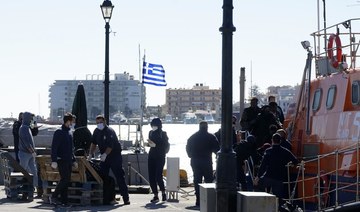
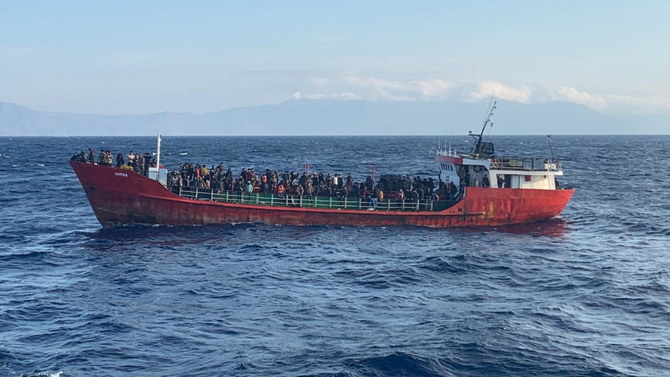
ATHENS: A Turkish-flagged cargo ship carrying about 400 migrants is sailing slowly off the island of Karpathos after sending out a distress signal on Friday and will dock at a Greek port to disembark the migrants, a Greek coast guard official said on Saturday.
The vessel could not sail independently and was being towed by a Greek coast guard vessel, the official said. It sent the distress signal near the island of Crete with the coast guard quoting passengers as saying it had sailed from Turkey.
“The ship is sailing very slowly off Karpathos island, carrying mostly Afghan migrants. It will dock at a Greek port which has not been decided yet,” the official told Reuters, declining to be named.
Karpathos is the second largest of the Dodecanese islands in the southeastern Aegean Sea.
On Friday Greece’s Shipping Ministry had asked Turkey to accept the vessel’s return to Turkey, a migration ministry official said. Greece’s migration minister had contacted Turkish authorities and the EU Commission to resolve the matter.
Greece is the main route into the European Union for asylum-seekers arriving from Turkey. The number of arrivals has fallen sharply since 2016 after the EU and Ankara agreed a deal to stop migrants from crossing to Greece.
Nearly 1 million people, mainly Syrian refugees, arrived in the EU in 2015 after crossing to Greek islands close to Turkey. Since the Taliban takeover of Afghanistan in August, many EU states fear a replay of that crisis.
On Tuesday, four migrants, three of them children, drowned after a boat in which they and 23 others were trying to cross from Turkey to Greece sank off the island of Chios.

Turkish-flagged cargo ship with migrants to dock at Greek port
https://arab.news/z7dqb
Turkish-flagged cargo ship with migrants to dock at Greek port
- The vessel, carrying about 400 migrants, could not sail independently and was being towed by a Greek coast guard vessel
- It sent the distress signal near the island of Crete with the coast guard quoting passengers as saying it had sailed from Turkey
Nestle acknowledges delay before baby milk recall
- The company in December recalled batches of its infant formula in 16 European countries
- Nestle said routine checks at its Dutch plant at the end of November 2025 had detected “very low levels” of cereulide
GENEVA: Swiss food giant Nestle has acknowledged that it waited days for a health-risk analysis before alerting authorities after detecting a toxin in its baby milk at a Dutch factory.
But in an open letter to campaign group Foodwatch France Friday it denied accusations of negligence.
The company in December recalled batches of its infant formula in 16 European countries after detecting cereulide, a bacterial toxin that can cause diarrhea and vomiting.
French newspaper Le Monde reported Friday that traces of cereulide had been found in late November — 10 days before the first recalls of the product — because the company waited for a “health?risk analysis” before informing regulators.
Nestle said in a statement online that routine checks at its Dutch plant at the end of November 2025 had detected “very low levels” of cereulide after new equipment was installed in a factory.
It said there was no maximum limit for cereulide indicated by regulations.
The company halted production and launched further tests, which in early December confirmed minute quantities in products that had yet to leave the warehouse.
Nestle said it informed Dutch, European and other national authorities on December 10 and began a precautionary recall of all products made since the new equipment was installed — 25 batches across 16 European countries.
- Response to Foodwatch -
Friday’s open letter responded to claims by Foodwatch France, which a day earlier announced it was filing a legal complaint in the French courts against Nestle on behalf of several families whose babies had fallen ill.
Nestle denied Foodwatch’s suggestions that its product recall had been late without any reasonable excuse and that it had displayed “alarming negligence.”
They said they had acted in December and January as soon as they had identified there was an issue, said the company.
“We recognize the stress and worry that the recall has caused for parents and caregivers,” it said.
“To date, we have not received any medical reports confirming a link to illness associated with our products,” it added.
The company has said from the start of the affair that the recall stemmed from a “quality issue” and that it had seen no evidence linking its products to illness.
French authorities launched an investigation into the deaths in December and January of two babies who were thought to have drunk possibly contaminated powdered milk.
Nestle said in its statement that “nothing indicates any link between these tragic events in these two instances and the consumption of our products.”