What’s in a name? Meta Materials soars after Facebook identity switch

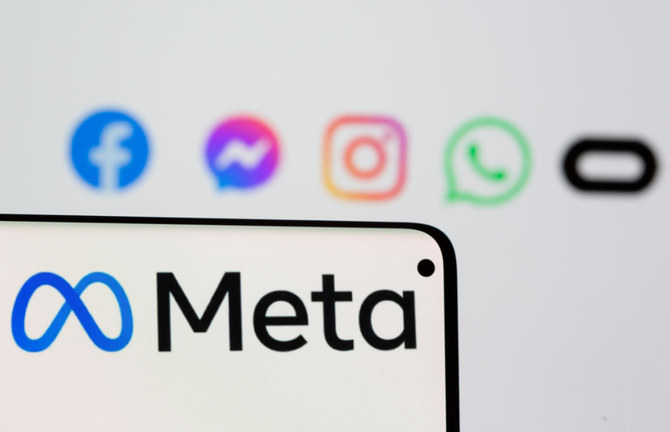
Facebook's new rebrand logo Meta is seen on smartphone in front of displayed logo of Facebook, Messenger, Intagram, Whatsapp and Oculus. (REUTERS/Illustration photo)
Short Url
Updated 30 October 2021
Follow

What’s in a name? Meta Materials soars after Facebook identity switch

  • As Facebook metamorphosed into Meta, shares of Halifax, Nova Scotia-based Meta Materials Inc. jumped 6 percent

BENGALURU, India: Facebook may have unveiled its new identity at a glitzy event on Thursday, but shares of a lesser-known Canadian industrial materials company surged in an apparent case of mistaken identity.
As Facebook metamorphosed into Meta, shares of Halifax, Nova Scotia-based Meta Materials Inc. jumped 6 percent in opening trades on the Nasdaq on Friday, following a 26 percent rise in after-hours trading. Facebook shares were up 1.6 percent.
Meta Materials’ stock has already been a favorite among retail investors using Reddit and social media, recording wild swings in recent months. It hit an all-time high of nearly $22 in June.

HIGHLIGHT

Meta Materials’ stock has already been a favorite among retail investors using Reddit and social media, recording wild swings in recent months. It hit an all-time high of nearly $22 in June.

The company, which specializes in designing materials used in a variety of industries including consumer electronics and aerospace, has a market value of $1.3 billion, according to Refinitiv.
This is not the frst instance of shares reacting because of mistaken identities — Zoom Technologies jumped at the height of the pandemic, when the world flocked to the simiarly named video conferencing service.
But it was unclear whether just the similarity in names or a coordinated push by “meme-stock” investors — or both — was driving Meta Materials’ shares higher.
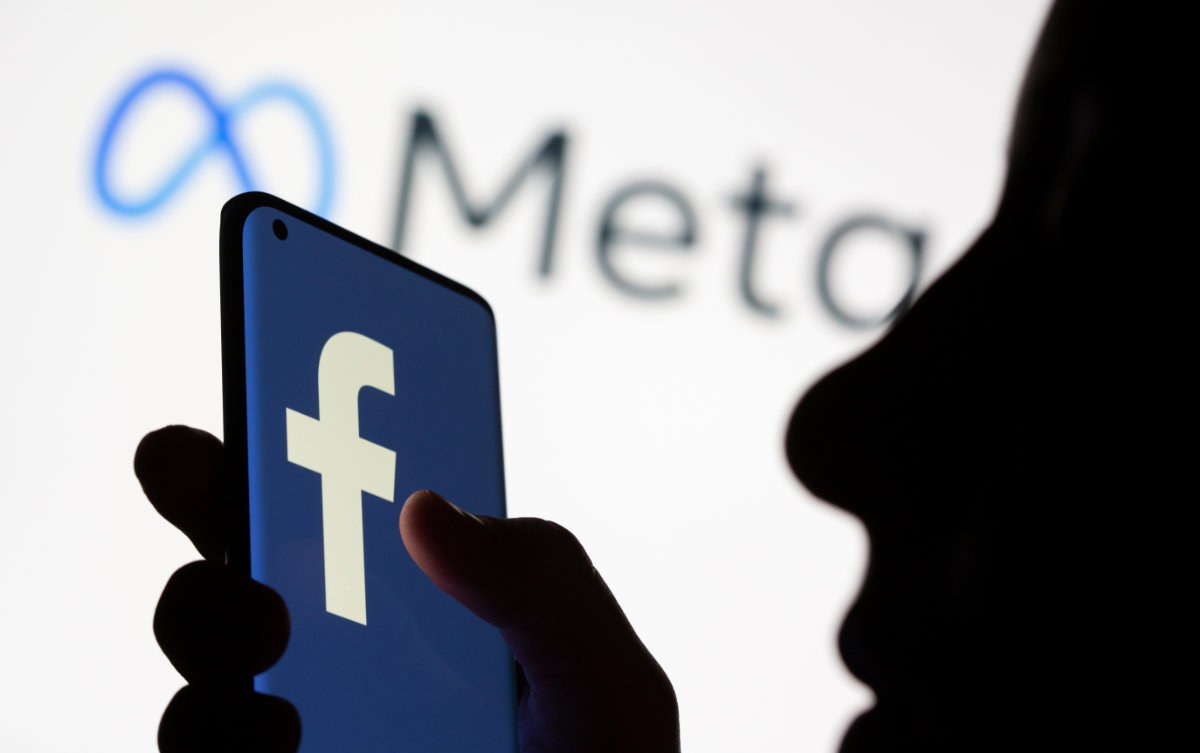


A woman holds a smartphone with Facebook logo in front of a displayed Facebook's new rebrand logo Meta. (REUTERS/Illustration)

“Is the (after-hours) price action real, or are people buying MMAT thinking they are getting Facebook for really cheap?” asked one user on a Reddit community dedicated to discussing Meta Materials’ stock, that was created this March.
Meta Materials CEO George Palikaras also appeared to get in on the fun on Thursday, tweeting: “On behalf of @Metamaterialtec I would like to cordially welcome @Facebook to the #metaverse.”
Palikaras pointed to a company announcement from Thursday about an upcoming online talk featuring executives from Meta Materials, Facebook’s virtual reality (VR) division and other companies, when Reuters emailed Meta Materials for comment.
Facebook’s name change was revealed at its virtual and augmented reality conference on Thursday.
Social media was abuzz with news of Facebook becoming Meta, with posts poking fun at the move receiving the most attention.
“Changing name to Meat,” burger chain Wendy’s said in a tweet liked by nearly 250,000 users. Twitter’s official handle wrote: “BIG NEWS lol jk still Twitter,” garnering some 226,000 likes. 


Saudi Media Forum urges ethical coverage as crises redefine Arab journalism

Updated 04 February 2026
Follow

Saudi Media Forum urges ethical coverage as crises redefine Arab journalism

  • Raw news without context can mislead audiences and distort credibility, experts say

RIYADH: Arab media was born in crisis and shaped by conflict rather than stability, Malik Al-Rougi, general manager of Thaqafeyah Channel, said during the Saudi Media Forum in Riyadh on Wednesday.

Al-Rougi was speaking during a panel titled “Media and Crises: The Battle for Awareness and the Challenges of Responsible Coverage,” which examined how news organizations across the region navigated credibility and professional standards amid fast-moving regional developments.

“Today, when you build a media organization and invest in it for many years, a single crisis can destroy it,” he said.

Referring to recent events, Al-Rougi said that he had witnessed news channels whose credibility “collapsed overnight.”

“In journalistic and political terms, this is not a process of news production. It is a process of propaganda production,” he said. “The damage caused by such a post … is enormous for an institution in which millions, perhaps billions, have been invested.”

When a media outlet shifts from professionalism and credibility toward “propaganda,” he added, it moves away from its core role. 

Saudi media leaders, journalists, and experts gathered at the Saudi Media Forum in Riyadh to discuss credibility, ethics, and innovation. (AN photo by Huda Bashatah/Supplied)

“A crisis can work for you or against you,” Al-Rougi added. “When, in the heart of a crisis, you demonstrate high credibility and composure, you move light-years ahead. When you fail to adhere to ethical standards, you lose light-years as well.”

Abdullah Al-Assaf, professor of political media studies at Imam Muhammad bin Saud Islamic University, said that in many crises across the Arab world, agendas and directives had often prevailed over professionalism.

“Credibility was buried,” he added.

Hasan Al-Mustafa, writer and researcher at Al-Arabiya channel, said that raw information could be subject to multiple interpretations if not placed within a proper political, security, historical or geographical context.

He added that such an approach was urgently needed during periods of political and security volatility in the Middle East. 

When, in the heart of a crisis, you demonstrate high credibility and composure, you move light-years ahead. When you fail to adhere to ethical standards, you lose light-years as well.

Malik Al-Rougi Thaqafeyah, Channel general manager

“This objectivity, or this reliability, is a great responsibility,” Al-Mustafa said. “It is reflected not only in its impact on the audience, but also on the credibility of the content creator.”

Al-Mustafa warned against populism and haste in coverage, saying that they risked deepening crises rather than providing informed public perspectives.

He also said that competition with social media influencers had pushed some traditional outlets to imitate influencer-driven models instead of strengthening their own professional standards.

“Our media has been crisis-driven for decades,” he said, describing much of the region’s coverage as reactive rather than proactive.

During a separate panel titled “The Official Voice in the Digital Age: Strategies of Influence,” speakers discussed how rapid technological and social changes were reshaping the role of institutional spokespersons.

Abdulrahman Alhusain, official spokesperson of the Saudi Ministry of Commerce, said that the role was no longer limited to delivering statements or reacting to events.

“Today, the spokesperson must be the director of the scene — the director of the media narrative,” he said.

Audiences, he added, no longer accept isolated pieces of information unless they were presented within a clear narrative and structure.

“In the past, a spokesperson was expected to deliver formal presentations. Today, what is required is dialogue. The role may once required defense, but now it must involve discussion, the exchange of views, and open, candid conversation aimed at development — regardless of how harsh the criticism may be.”

He said that spokespersons must also be guided by data, digital indicators and artificial intelligence to understand public opinion before speaking.

“You must choose the right timing, the right method and the right vocabulary. You must anticipate a crisis before it happens. That is your role.”

Abdullah Aloraij, general manager of media at the Riyadh Region Municipality, said that the most important skill for a spokesperson today was the ability to analyze and monitor public discourse.

“The challenge is not in transferring words, but in transferring understanding and impact in the right way,” he said.