Singapore probes unusual surge in COVID-19 cases after record

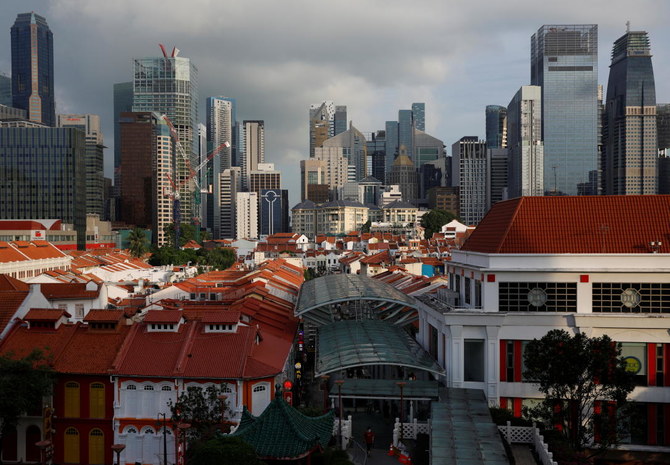
Singapore authorities reinstated curbs limiting social interactions and dining out to two people, so as to slow infections. (Reuters)
Short Url
Updated 28 October 2021
Follow

Singapore probes unusual surge in COVID-19 cases after record

  • Last week, Singapore extended some social curbs for about a month, to rein in the spread of COVID-19

SINGAPORE: Singapore is looking into an “unusual surge” of 5,324 new infections of COVID-19, the city-state’s health ministry said, its highest such figure since the beginning of the pandemic, as beds in intensive care units fill up.
Ten new deaths on Wednesday carried the toll to 349, after 3,277 infections the previous day, while the ICU utilization rate is nearing 80 percent, despite a population that is 84 percent fully vaccinated, with 14 percent receiving booster doses.
“The infection numbers are unusually high today, mostly due to many COVID-positive cases detected by the testing laboratories within a few hours in the afternoon,” the health ministry said in a statement.
“The Ministry of Health is looking into this unusual surge in cases within a relatively short window, and closely monitoring the trends for the next few days,” it added in Wednesday’s statement.
While nearly 98.7 percent of the past month’s 90,203 cases had no symptoms, or only mild ones, about 0.2 percent of those had died, and 0.1 percent each were being monitored closely in intensive care units (ICU) or were critically ill and intubated there.
About 72 ICU beds were vacant by Wednesday, at an overall ICU use rate of 79.8 percent, with 142 coronavirus sufferers accounting for about half of occupied beds.
The ministry said it was adding more ICU beds. The Asian city-state, which has set aside 200 ICU beds to be used by COVID-19 patients, can add 100 more at short notice.
Last week, it extended some social curbs for about a month, to rein in the spread of COVID-19 and ease pressure on health care facilities.
Authorities reinstated curbs limiting social interactions and dining out to two people, so as to slow infections.


Blacklisted naphtha tanker from Russia enters Venezuelan waters while another diverts, ship data shows

Updated 56 min 28 sec ago
Follow

Blacklisted naphtha tanker from Russia enters Venezuelan waters while another diverts, ship data shows

  • Under U.S. sanctions related to Russia, the ship has a different sanctions profile than Skipper, the tanker that was seized by the U.S. on December 10

HOUSTON: A tanker subject to U.S. sanctions carrying some 300,000 barrels of naphtha from Russia entered Venezuelan waters late ​on Thursday, while another began redirecting course in the Atlantic Ocean, ship tracking data showed, a reflection of diverging last-minute decisions by ship owners after President Donald Trump ordered a "blockade" of oil tankers under sanctions bound for the OPEC country earlier this week.
The move ramped up pressure on Venezuelan president Nicolas Maduro by targeting the country's main source of income and followed the seizure by the U.S. of an oil tanker off the coast of Venezuela earlier in December.
Vessels that were not subject to sanctions began setting sail on Wednesday from Venezuelan waters after a week's pause, helping drain the country's mounting crude stocks.

HIGHLIGHTS

• Trump's 'blockade' aims to halt sanctioned oil tankers to Venezuela

• Hyperion's sanctions profile differs from seized Skipper tanker

• Venezuela condemns US actions as violating international law

Gambia-flagged medium tanker Hyperion docked on Friday at Amuay ‌Bay on Venezuela's ‌western coast, according to LSEG ship tracking data. It loaded near ‌Murmansk ⁠in ​Russia in ‌late November.
Under U.S. sanctions related to Russia, the ship has a different sanctions profile than Skipper, the tanker that was seized by the U.S. on December 10.
The U.S. can only seize vessels outside of its jurisdiction, or vessels that aren't heading to or from the country, if Washington has placed them under sanctions for links to groups it designates as terrorist, said David Tannenbaum, a director at consulting firm Blackstone Compliance Services that specializes in sanctions and anti-money laundering compliance.
Skipper, formerly called the Adisa, was under sanctions for what the U.S. says was involvement in Iranian oil trading that generated ⁠revenue for Iranian groups it has designated as foreign terrorist organizations.
With the Hyperion, though, sanctions were imposed to reduce Russian revenues from energy because of ‌its war with Ukraine.
"The Hyperion doesn't have known ties to ‍terrorism, and therefore unless they can prove it's subject ‍to the jurisdiction of the U.S., Washington can't grab it extraterritorially," said Tannenbaum, who previously worked with the ‍U.S. Treasury's Office of Foreign Assets Control that administers and enforces economic and trade sanctions.

REDIRECTS AND U-TURNS
The Angola-flagged Agate, another medium tanker under sanctions that loaded in Russia and had been sailing toward the Caribbean, was seen redirecting on Friday, according to LSEG ship tracking. The vessel was pointing towards Africa, but had not yet signaled a new destination.
Oman-flagged Garnet, also under sanctions ​and loaded in Russia, continued on its track, signaling the Caribbean as its destination on Friday.
Benin-flagged tanker Boltaris, under sanctions and carrying some 300,000 barrels of Russian naphtha bound for Venezuela, made ⁠a U-turn earlier this month and was heading for Europe without having discharged, according to LSEG vessel monitoring data.
Two very large crude carriers not subject to sanctions set sail for China on Thursday from Venezuela, according to sources familiar with Venezuela's oil export operations, marking only the second and third tankers unrelated to Chevron to depart the country since the U.S. seized Skipper.
The American oil major, which has continued to ship Venezuelan crude under a U.S. authorization, exported a crude cargo on Thursday bound for the U.S., LSEG data showed.
Secretary of State Marco Rubio on Friday said the U.S. was not concerned about the four vessels that sailed from Venezuela on Thursday, as those were not ships under sanctions.
"Sanctioned boats, we have the capabilities necessary to enforce our laws. We'll have a judicial order, we'll execute on those orders and there's nothing that will impede us from being able to do that," Rubio said.
Venezuela's government ‌called Trump's blockade a "grotesque threat" in a statement on Tuesday, saying it violates international law, free commerce and the right of free navigation.