SINGAPORE: Some health experts in Singapore are calling for mandatory vaccination against the coronavirus with a growing toll of severe COVID-19 among unvaccinated people as infections surge and with vaccine take-up plateauing at 82 percent of the population.
The government has linked reopening to vaccination targets but it paused the easing of restrictions this month to watch for signs that severe infections could overwhelm the health system.
“I would love to see vaccine mandates in over 60s, they are the group most likely to die,” said Dale Fisher, an infectious disease expert at the National University Hospital in Singapore.
“It’s the same reason that age group was selected early for vaccines, the same reason that age group has been selected for booster jabs.”
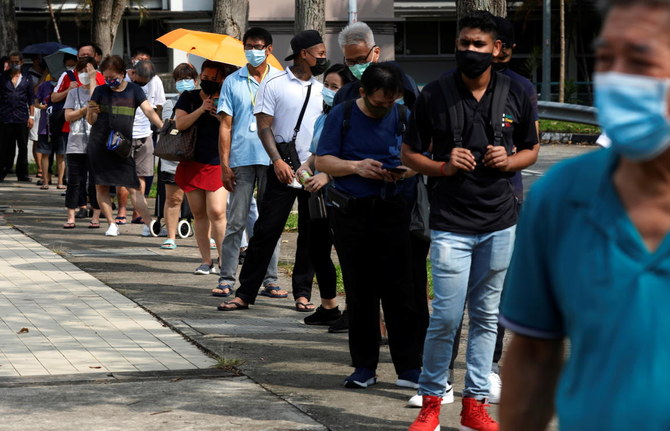
Singapore has been a model for coronavirus mitigation since the pandemic began with mandatory masks, effective contact tracing and a closed border.
In all, 62 of its 5.7 million people have died and new daily infections were for months no more than a handful.
But, as elsewhere in Southeast Asia, the Delta variant has in recent months been spreading and new daily cases have risen to about 1,000.
Several countries including the United States, France and Italy have announced mandatory vaccination programs, concerned the Delta variant and a slowdown in vaccinations will thwart plans to get back to normal.
Of vaccinated people in Singapore who caught the virus from May 1 to Sept. 16, only 0.09 percent of them had to go into intensive care or died. The rate for the unvaccinated was 1.7 percent.
Data for the elderly is particularly striking.
Of infected unvaccinated people aged 80 or older, 15 percent of them had to be treated in intensive care or died. Only 1.79 percent of the vaccinated in that age group needed intensive care or died.
Singapore has not made vaccination compulsory because the Pfizer and Moderna shots only have emergency approval in the country although it has limited activities such as eating out for the unvaccinated.
Neither company responded to a query on whether it had applied for full approval in Singapore.
With about 87,000 seniors still unvaccinated, some experts say full approval could pave the way for a mandate.
“Vaccination is much more protective than the other measures we have in place, and less economically and socially damaging,” said Alex Cook, an infectious disease modelling expert at the National University of Singapore.
“If we are not to enforce vaccination, it seems odd to enforce weaker and more costly measures.”
The number of patients requiring oxygen support or intensive care jumped more than five-fold this month to 146, including 18 in ICU.
The government is worried the numbers in ICU could grow quickly on an exponentially rising base of infected people, especially if they are elderly and unvaccinated.
Singapore has about 100 ICU beds for COVID-19 patients, and it can increase that to nearly 300 at short notice.
A vaccine mandate could take the form of curtailing activities for unvaccinated people related to their work, leisure and use of public transport, said infectious diseases doctor Leong Hoe Nam.
“You cannot go to the malls or take public transport or eat out unless vaccinated,” he said, giving examples of possible restrictions.
Only vaccinations against diphtheria and measles are mandated by law in Singapore.
The government has been offering the Pfizer and Moderna vaccines for free and it has also approved payouts to 144 people who suffered serious side effects, media reported.
Singapore has a long record of imposing rules, including a famous 1992 ban on the sale of chewing gum to prevent littering, but nevertheless compulsory vaccines would be a significant step.
“It will take political courage, there’s no doubt about that, but the science would say you will save hundreds of lives if you vaccinate the last 100,000 seniors,” said Fisher.


![]()

Calls grow among experts in Singapore for a vaccine mandate as COVID-19 spikes
Short Url
https://arab.news/ydyjm
Calls grow among experts in Singapore for a vaccine mandate as COVID-19 spikes
- Singapore has been a model for coronavirus mitigation since the pandemic began with mandatory masks, effective contact tracing and a closed border
- Singapore has not made vaccination compulsory because the Pfizer and Moderna shots only have emergency approval in the country


Latest updates


© 2026 SAUDI RESEARCH & PUBLISHING COMPANY, All Rights Reserved And subject to Terms of Use Agreement.