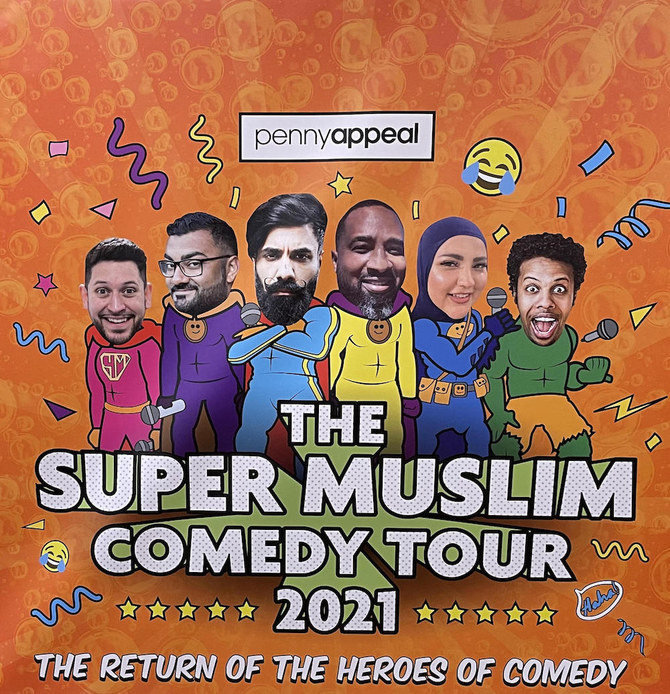


LONDON: After almost two years of lockdowns, restrictions, isolation, and highly contagious variants, could laughter be the best medicine?
The UK Super Muslim Comedy Tour hopes to prove just that, while celebrating the powers of Muslim comedy in aid of charity.
“We weren’t able to do the tour last year because of the COVID-19 pandemic and it was difficult for a lot of people because they couldn’t get their entertainment fix that they would normally get — their therapy,” the show’s host, British-Pakistani actor and comedian Abdullah Afzal told Arab News on the sidelines of the tour in Wembley.
“Also for us comedians, because we’re so used to being on stage and performing and suddenly, that was taken away from us, so all the energy that we missed out on last year, we’re bringing it forward into this year, so double the amount of energy, and hopefully we can entertain the crowd double the amount as well.”
Afzal, who is 32 and from Manchester, has hosted the show, which is in its sixth year, but it was canceled in 2020, much like everything else, due to the pandemic.

(L-R) Comedians Salman Malik, Prince Abdi, Abdullah Afzal, and Fatiha El-Ghorri performed for crowds in east and west London. (Supplied)
Starting in London, the tour heads north and stops in 10 locations, including Manchester, Birmingham and Glasgow — with all tickets sold out.
“We really hope people come out and really celebrate the diversity in our routine, in our stand up, and the people that come on the stage as well,” said Afzal, who features heavy audience participation in his sets and uses his origin to blend jokes about conventional marriage and modern romance.
This year’s lineup brings back some of the old favorites, along with some new performers, but none of them were interested in centering their jokes around the pandemic.
British-born Fatiha El-Ghorri, originally from Morocco, was back for the second time. Her career has taken off since 2019. She has performed on the Jonathan Ross show “Comedy Club” and on Comedy Central at the Edinburgh Fringe. And then, when the pandemic hit, she took on Zoom.
“The pandemic has been really difficult, but during that time, I was doing a lot of Zoom and online gigs,” she said. “It’s a completely different format, the stage is different, the audience is not in front of you, so it’s really odd when you first do it.”
Relieved and excited to be back to performing physical shows, the 40 year-old from east London is known for pushing the boundaries with her comedy and jokes about her experiences and observations of marriage, relationships, dating, and wearing the hijab.
“I do like to challenge people in my comedy and I like to break stereotypes, but obviously they’re halal jokes because it’s a Muslim tour,” she said, adding that she decided she was not going to use coronavirus as a basis for her jokes during the tour “because it was quite a difficult time for everybody, so I couldn’t see any humor in anything that was happening and I’m just glad it’s starting to get better.”
However, she admitted it was really nerve-wracking because they had not been performing live for a long time.
“You’ll always have nerves because we care about what we do so I’m always nervous on stage, but now I feel like we are all quite nervous being back on stage, but it’s nice to see that it’s packed out, lots of people are here, people have come to laugh.”
Salman Malik, from south London, was relieved that Zoom shows were now reverting back to live ones, and he was happy to see audiences come out in “great numbers.”
In his first time participating in the tour, the 35 year-old Bahraini-Pakistani, who moved to the UK in 2004, uses his Arab-Asian background as a base for most of his material, along with his immigration experience, interracial marriage, and fathering three children.
“I perform comedy in four languages. I do Urdu, English, Punjabi, Hindi and it’s really nice to see that the opportunities are endless and working on my craft, (so) my comedy is basically about my journey coming into the UK, legally.”

This is the first time that Bahraini-Pakistani comedian Salman Malik, from south London, joined the Super Muslim Comedy Tour. (AN Photo/Sarah Glubb)
Organized by the UK-based Penny Appeal, this year’s proceeds and funds raised will go toward the international humanitarian charity’s Thirst Relief campaign, which helps to provide safe and clean drinking water for deprived communities around the world.
Comedian Prince Abdi, 32, who is known for working with some of the biggest names in the game including Dave Chappelle, Trevor Noah and Chris Rock, wowed the crowd with his impressions and anecdotes of his pranks and antics.
“I’m Somali-British, so I talk about growing up in the ghetto of south London, which is not really a ghetto because I’m from Somalia, you know,” he said.
Abdi came into comedy as part of a bet with friends and, after several failed attempts at the same brutal comedy club, he finally got his first laugh and then “never looked back.”
He has toured Africa, including Nigeria, South Africa and Kenya, and has also performed in the UAE, and said he would love to go all around the Middle East and tell some Arab jokes one day.
“Nothing is easy in life, you have got to work for it, and even now, comedy is still hard and you’re only as good as your last show,” he said.
Abdi joked about his experience of being bored during the pandemic and playing pranks on people to test their racial and cultural curiosity, including walking around town with a picture of himself and asking white people if “they had seen this man?”

Headliner Azeem Muhammad, from St. Louis in Missouri, joined the Penny Appeal tour in 2018 and has been a growing success since. (AN Photo/Sarah Glubb)
“Everyone’s coming together, which is good because laughter is the best medicine. We all need to laugh, especially with all that’s going on around the world.”
Headliner Azeem Muhammad, from St. Louis in Missouri, joined the Penny Appeal tour in 2018 to see if his comedy would “transcend” from the US to Britain, and he has been a growing success ever since.
The fast-talking father-of-seven had the audience in stitches with his family-orientated jokes and audience interactions — and those “who could not keep up (it) was their own fault as they should have gone to university.”
Muhammad, 48, converted to Islam at the age of 17 and, nine years, later embarked on his comedic career.
In 2004, he became one of the founding members of the very first Muslim comedy tour in the world called “Allah Made Me Funny,” which also featured Preacher Bryant Moss and Azhar Usman.
He said that, throughout the years with the tour, he had developed nuances to better translate to the UK’s predominantly Muslim audiences about what it’s like to be a Muslim from the US.
“And then to realize that no matter where we are from, the things that I talk about, which are marriage, divorce, children, jobs, health, the Sunnah (traditions and practices of Prophet Muhammad), those particular things are relatable, they’re universal, and so what normally would separate us now brings us that much closer together.”

Organized by the UK-based Penny Appeal, this year’s proceeds and funds raised will go toward the international humanitarian charity’s Thirst Relief campaign. (AN Photo/Sarah Glubb)
Keyaan Hussain, who is 13 and from London, said he found the show really enjoyable, very funny, and quite entertaining, adding his favorite was Muhammad “because of how he interacted more with the audience.”
Ifrah Quraishi, also from London, said it was the first comedy show she had ever been to and was already inquiring about next year’s tour.
“I thought it was amazing, genuinely, my cheeks are hurting (because) I couldn’t stop laughing,” Quraishi, 26, said. “For sure I am definitely up for going to more comedy events like this (and) definitely hoping to come to the next one.”