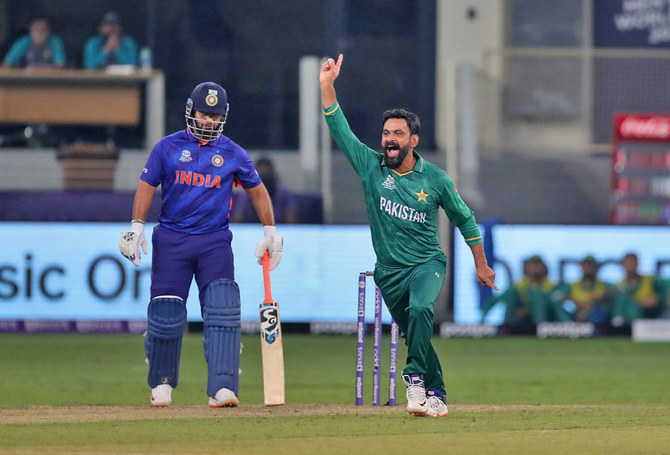
DUBAI: India and Pakistan renewed their high-profile but one-sided cricket rivalry on Sunday in a T20 World Cup blockbuster watched by hundreds of millions of fans across the globe.
Virat Kohli’s India have beaten Pakistan in all of their 12 matches at the T20 and 50-over World Cups.
Pakistan, however, went into the contest with 10 wins in a row in the United Arab Emirates, their home away from home for most of the last decade.
It was the first time the two nations had clashed since the 50-over World Cup in 2019.
Of the 12 World Cup losses for Pakistan, five have been at the T20 tournament.
Two were at the inaugural event in 2007 — a tied group game decided by a ‘bowl-out’ and a five-run loss in the final.
“To be honest, what has passed is beyond us,” said Pakistan captain Babar Azam on Saturday. “Records are meant to be broken.”
His team got the dream start with Shaheen Shah Afridi dismissing Rohit Sharma first ball.
Tickets for Sunday’s contest — where the stadium crowd numbered around 20,000 — were sold out just hours after they went online and many private online channels were offering resale of the entry passes at inflated prices.
Some resale tickets were being advertised for $250 with $6,000 for corporate boxes.
The South Asian nuclear rivals have only played in multi-national events like World Cups and the Champions Trophy as strained relations have stalled bilateral cricket since 2007.
Pakistan did tour India in 2012 for five limited-over matches but ties were not fully resumed as the two nations continued to be at loggerheads over multiple issues, with the disputed region of Kashmir and terrorism heading the list.
“The matches between Pakistan and India are always full of intensity so we need to perform well in all three departments of the game,” said Babar, who has two T20 International centuries to his name in 2021.
Kohli, who steps down as India T20 skipper at the end of the World Cup, described Pakistan as “very strong.”
He also shrugged off the significance of his side’s dominance.
“These things create distractions. What matters is how we prepare and execute on any particular day, regardless of the opposition,” he said.
“You have to play your best cricket against them, because they have lots of talent and players who can change the game.”
Expatriate fans of both Pakistan and India gathered at the Dubai International Stadium desperate to witness what has become a rare sporting clash.
“We should play each other more often. It is such a treat to see these two teams on the cricket field,” Mohammad Ashraf, a Pakistan national working in the United Arab Emirates, told AFP.
Pankhuri Raj Mehta, an Indian who has worked in Abu Dhabi since 2017, added: “I brought a ticket for the game as soon as it went online. I mean you look forward to these contests, especially when you are far away from home.”
India and 2009 champions Pakistan are placed in Group 2 of the Super 12 stage of the tournament along with New Zealand, Afghanistan, Scotland and Namibia.
The top two in each of the two pools progress to the semifinals.
Despite the anticipation ahead of the game, the political soundtrack is also playing in the background.
During the week, there were protests in India with calls to boycott the match in the wake of recent killings of 11 migrant workers and minority Hindus and Sikhs in Indian-administered Kashmir.
Before India took on Pakistan, the World Cup schedule on Sunday got underway with another all-South Asian clash seeing 2014 champions Sri Lanka defeat Bangladesh by five wickets in Sharjah.


![]()

Pakistan look to end India losing streak in T20 World Cup blockbuster
Short Url
https://arab.news/gk6ng
Pakistan look to end India losing streak in T20 World Cup blockbuster
- It was the first time the two nations had clashed since the 50-over World Cup in 2019
- India have beaten Pakistan in all of their 12 matches at the T20 and 50-over World Cups
Latest updates


© 2026 SAUDI RESEARCH & PUBLISHING COMPANY, All Rights Reserved And subject to Terms of Use Agreement.