

In Islamabad, a cafe serves up the ‘language of love’ for Arabs: traditional qahwah

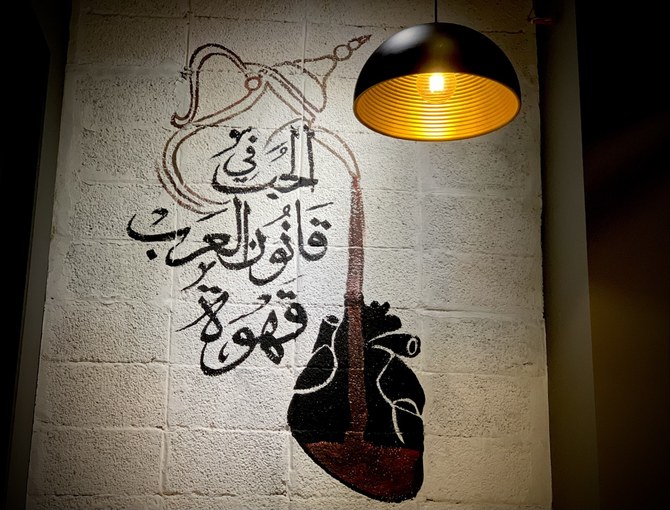
In this photo taken at the KAF coffee shop in Islamabad, Pakistan, on October 14, 2021, a mural features the calligraphed Arabic words: "For the Arabs, the law of love is coffee." (AN photo)
Short Url
Updated 24 October 2021
Follow

In Islamabad, a cafe serves up the ‘language of love’ for Arabs: traditional qahwah

  • Abdulmalik Abdullah and Wail Wasil from Saudi Arabia, Fahim Hassan Khan from UAE got stuck in Pakistan because of COVID-19
  • They decided to bring their love for Arabic coffee to residents of capital and opened KAF on ground floor of an Islamabad hotel

ISLAMABAD: When Brothers Abdulmalik Abdullah and Wail Wasil met Fahim Hassan Khan for the first time in Islamabad earlier this year, they instantly realized they had three things in common: they were all born and raised in Gulf countries, they all got stuck in Pakistan because of coronavirus travel restrictions and they all loved Arabic coffee. 
Now there is one more thing that brings the three young men together. They are co-owners of a small cafe called KAF that opened in the capital last week to serve up what they described as a taste of home: authentic Arabic coffee. 
In the outdoor seating area of the coffee shop, customers are greeted with a mural showing a beverage being poured from a curvaceous pot into a heart next to the calligraphed words: “For the Arabs, the law of love is coffee.”
“We’ve missed home, we’ve had this bad homesickness for a while,” Abdullah, 30, a fourth-generation Pakistani living in Saudi Arabia, told Arab News at KAF, which is located on the ground floor of Islamabad’s Roomy hotel. 
“Arabic coffee is like our daily routine. To us it is like roti,” he added, referring to a type of bread that is a staple of Pakistani diets. 
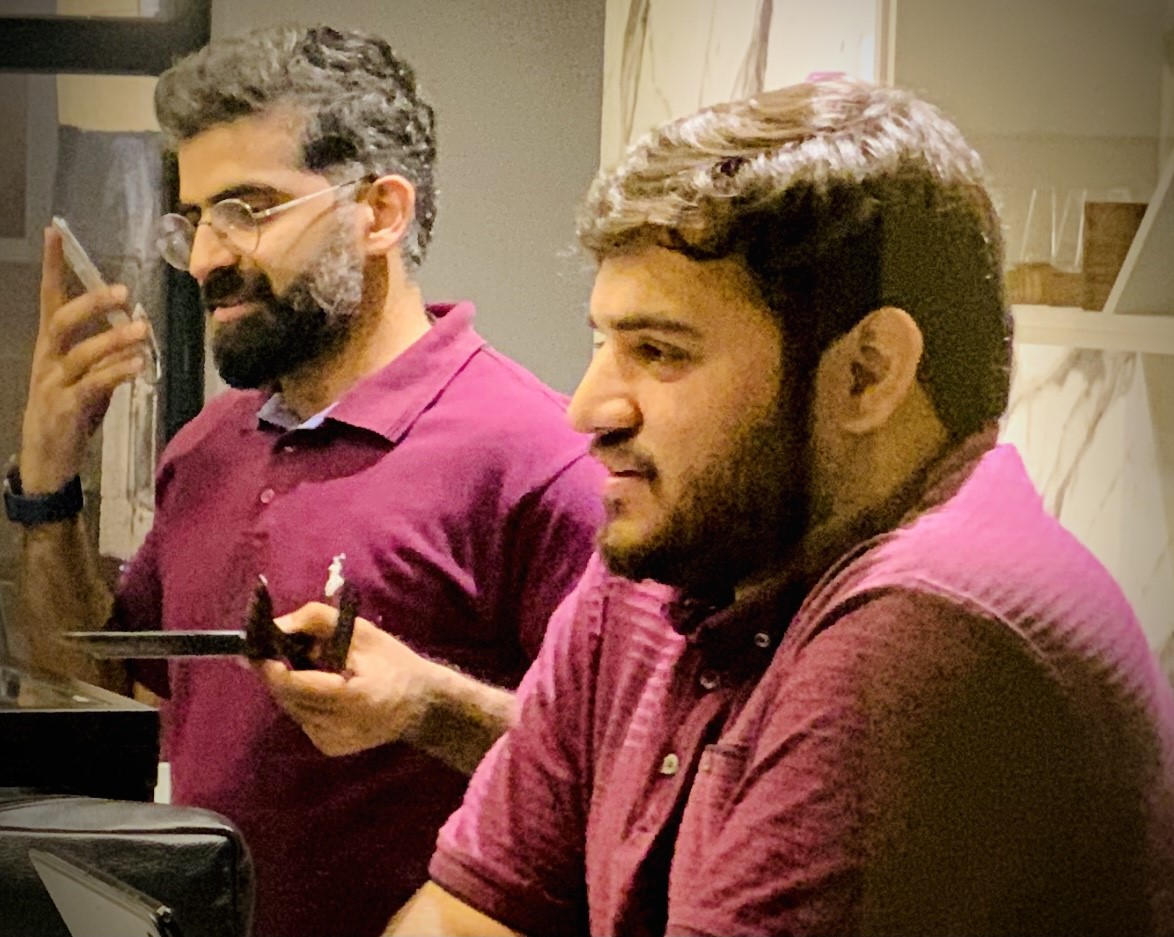


Pakistani brothers Abdulmalik Abdullah (Left) and Wail Wasil, fourth generation residents of Saudi Arabia, stand behind the bar at the KAF coffee shop in Islamabad, Pakistan, on October 14, 2021. (AN photo)

The golden, cardamom-infused Arabic coffee, or qahwah, is the most popular kind brewed in the Middle East. Abdullah and Wasil said they used varieties imported from Saudi Arabia, Brazil and Ethiopia, and serve them up at KAF just as they would at home: in ceramic shot glasses with a side of Saudi dates. 
“It’s authentic Arabic coffee,” said Wasil, 27, who like his brother came to Pakistan in 2019 to pursue higher education but got stranded in Islamabad due to the pandemic. “We drink it day and night, it’s a part of us.”
“We are sharing it with our customers, and we are making sure it is how we like it also,” he added. “The dates I serve here, I eat at home.”
The idea to launch KAF was born when Abdullah and Wasil met Fahim Hassan Khan at a local coffee shop and they decided to go into business together. At the time, Khan, whose parents moved to the UAE at least four decades ago, was on a visit to Pakistan that got indefinitely extended due to coronavirus travel bans. 
“We became brothers fast and all had a common goal to start something of our own. And, boom, there it was, the idea to bring authentic Arabic qahwah, culture and music to Islamabad,” Khan told Arab News.
He said his love for qahwah grew from time spent around the nomadic Bedouin people of UAE. 
“On our weekends we would drink Arabic qahwah and listen to old folk music,” said Khan, who now ensures traditional Arabic music plays at the cafe “to give it a feel of home.”
“Even till date, when you visit an Arab residence, they greet you with authentic Arabic coffee and dates,” he said. “They say: ‘the language of love in the Arab land is qahwah.’”


IMF board approves $1.3 billion disbursement for Pakistan after completing loan reviews

Updated 4 sec ago
Follow

IMF board approves $1.3 billion disbursement for Pakistan after completing loan reviews

  • The approval comes after an October staff-level deal that awaited the board’s formal endorsement
  • Economists say the money will boost Pakistan’s forex reserves, send positive signals to investors

KARACHI: The International Monetary Fund’s (IMF) executive board approved the release of $1.3 billion for Pakistan under two of its loan facilities, the Pakistani state media reported on Monday.

The board meeting was scheduled to take place during the day to decide on the Fund’s second review under the $7 billion Extended Fund Facility (EFF) and first review under the $1.4 billion Resilience and Sustainability Facility (RSF), a financing tool that provides long-term, low-cost loans to help countries address climate risks.

“The IMF executive board meeting has approved the third tranche of the loan program amounting to $1.3 billion,” the state-owned Pakistan Television reported.

It described the development as a major boost for Pakistan’s economy.

The IMF executive board’s meeting came nearly two months after a staff-level agreement (SLA) was signed between the two sides in October.

Procedurally, the SLAs are subject to approval by the executive board, though it is largely viewed as a formality.

A senior finance ministry official also confirmed to Arab News on condition of anonymity that the IMF had approved the tranche.

Economic experts said earlier in the day that the IMF disbursements would help Pakistan strengthen its balance of payments position.

Samiullah Tariq, group head of research at Pakistan Kuwait Investment Company Limited, said the IMF board’s approval would be an indication that Pakistan’s economy is on the right path.

“It obviously will help strengthen [the country’s] external sector, the balance of payments,” he told Arab News.

Until recently, Pakistan grappled with a macroeconomic crisis that drained its financial resources and triggered a balance of payments crisis.

However, the country witnessed financial gains in the last two years, recording current account surpluses and taming inflation that touched unprecedented levels in mid-2023.

Economists also viewed the IMF’s bailout packages as crucial for cash-strapped Pakistan, which has relied heavily on financing from bilateral partners such as Saudi Arabia, China and the United Arab Emirates, as well as multilateral lenders.

Saudi Arabia, through the Saudi Fund for Development, last week extended the term of its $3 billion deposit for another year to help Pakistan boost its foreign exchange reserves, which stood at $14.5 billion as of November 28, according to State Bank of Pakistan statements.

“In our view this [IMF tranche] will be approved,” said Shankar Talreja, head of research at Karachi-based brokerage Topline Securities Limited.

“This will help strengthen reserves and will eventually help a rating upgrade going forward,” he said.

The IMF board’s nod, Talreja said, would also send a signal to international and local investors regarding the continuation of the reform agenda by Pakistan’s government.