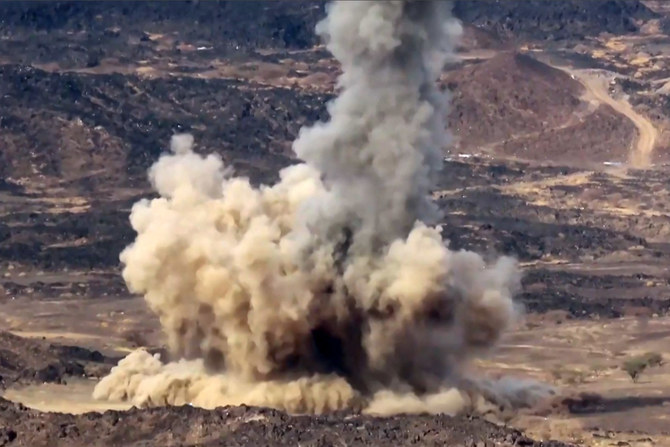
More than 90 Houthis killed, 16 military vehicles destroyed in coalition strikes on Jubah and Al-Kassarah

The Arab coalition said on Friday it had killed 92 Houthis and destroyed 16 military vehicles in air strikes on two districts near Marib. (File/AFP)
Short Url
Updated 23 October 2021
Follow

More than 90 Houthis killed, 16 military vehicles destroyed in coalition strikes on Jubah and Al-Kassarah

  • The coalition said it had carried out 31 air strikes on the districts of Juba and Al-Kasarah over the past 24 hours
  • UN says 10,000 were displaced last month alone by fighting in Marib governorate

JEDDAH: The Saudi-led coalition fighting in Yemen said on Friday it had killed at least 92 Houthi rebels in airstrikes on two districts near the strategic city of Marib.

The deaths are the latest among hundreds that the coalition says have been killed in recent fighting around Marib, and come during a second week of reported intense bombing.

“Operations targeted 16 military vehicles and killed more than 92 terrorist elements” in the past 24 hours, the coalition said in a statement, carried by the official Saudi Press Agency. The coalition has for the past two weeks reported almost daily strikes around Marib.

Most of the previously announced strikes were in Abedia, about 100 km from Marib — the internationally recognized government’s last bastion in northern Yemen.

The latest airstrikes reported were in the districts of Al-Jubah, some 50 km south of Marib, and Al-Kassarah, 30 km northwest.

The Houthis began a major push to seize Marib in February, and have renewed their offensive since September after a lull. Several Yemenis are waiting for help after fleeing fighting in Marib, according to Reuters.

Iman Saleh Ali and her family left Al-Jubah in the dead of night with only the clothes on their back to escape fighting, the second time they have been forced to do so.

The UN says some 10,000 people were displaced last month alone by the fighting in Marib governorate. It is calling for a humanitarian corridor for aid.

UN humanitarian coordinator in Yemen David Gressly told Reuters that access has been most restricted to Abedia, but that they have now been given authorization though security concerns remain.

Luckily, he said, food was distributed in coordination with the World Food Programme just before the fighting, which is exacerbating a humanitarian crisis in Yemen that has left millions on the verge of famine and 20 million needing help.



UN rights chief Shocked by 'unbearable' Darfur atrocities

Updated 6 sec ago
Follow

UN rights chief Shocked by 'unbearable' Darfur atrocities

  • Mediation efforts have failed to produce a ceasefire, even after international outrage intensified last year with reports of mass killings, rape, and abductions during the RSF’s takeover of El-Fasher in Darfur

PORT SUDAN: Nearly three years of war have put the Sudanese people through “hell,” the UN’s rights chief said on Sunday, blasting the vast sums spent on advanced weaponry at the expense of humanitarian aid and the recruitment of child soldiers.
Since April 2023, Sudan has been gripped by a conflict between the army and the paramilitary Rapid Support Forces that has left tens of thousands of people dead and around 11 million displaced.
Speaking in Port Sudan during his first wartime visit, UN Human Rights commissioner Volker Turk said the population had endured “horror and hell,” calling it “despicable” that funds that “should be used to alleviate the suffering of the population” are instead spent on advanced weapons, particularly drones.
More than 21 million people are facing acute food insecurity, and two-thirds of Sudan’s population is in urgent need of humanitarian aid, according to the UN.
In addition to the world’s largest hunger and displacement crisis, Sudan is also facing “the increasing militarization of society by all parties to the conflict, including through the arming of civilians and recruitment and use of children,” Turk added.
He said he had heard testimony of “unbearable” atrocities from survivors of attacks in Darfur, and warned of similar crimes unfolding in the Kordofan region — the current epicenter of the fighting.
Testimony of these atrocities must be heard by “the commanders of this conflict and those who are arming, funding and profiting from this war,” he said.
Mediation efforts have failed to produce a ceasefire, even after international outrage intensified last year with reports of mass killings, rape, and abductions during the RSF’s takeover of El-Fasher in Darfur.
“We must ensure that the perpetrators of these horrific violations face justice regardless of the affiliation,” Turk said on Sunday, adding that repeated attacks on civilian infrastructure could constitute “war crimes.”
He called on both sides to “cease intolerable attacks against civilian objects that are indispensable to the civilian population, including markets, health facilities, schools and shelters.”
Turk again warned on Sunday that crimes similar to those seen in El-Fasher could recur in volatile Kordofan, where the RSF has advanced, besieging and attacking several key cities.
Hundreds of thousands face starvation across the region, where more than 65,000 people have been displaced since October, according to the latest UN figures.