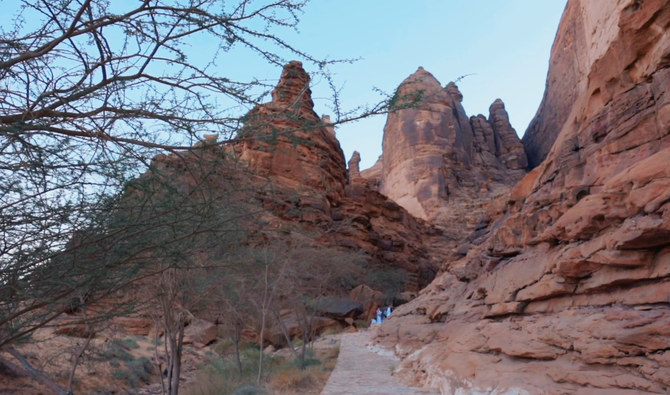
‘Open library’: Tourists in AlUla glimpse distant past in Ikmah’s ancient inscriptions

Short Url
Updated 22 October 2021
Follow

‘Open library’: Tourists in AlUla glimpse distant past in Ikmah’s ancient inscriptions

ALULA: Imagine stepping back into a time before cell phones, emails, or even paper. During this era, documenting important moments was simplified to sketching on rocks.
This is Ikmah mountain, or the “open library” as it is referred to by AlUla’s locals. AlUla was a highlight on the trading route many took through the Arabian Peninsula. Travelers stopped at the mountain to document their stories or carve their names for those who came after them.
“We call Ikmah the ‘open library.’ If you want to know why it has this name, have a look around for a few seconds and you will see inscriptions all over the mountain,” Amal Aljahani, an expert Rawi storyteller, told Arab News.
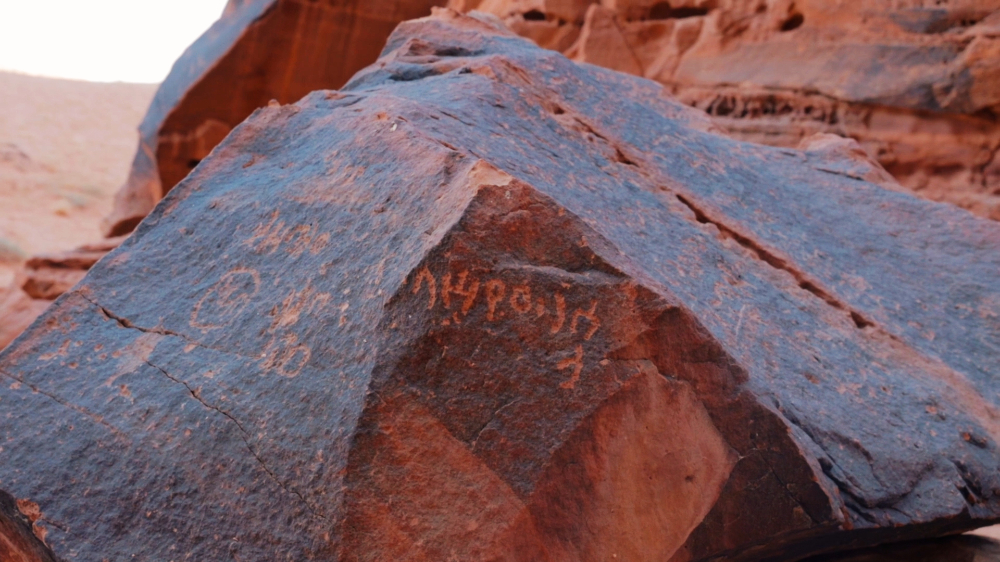
Ikmah has over 500 inscriptions from the Dadan and Lihyan civilization. The earliest texts from the mountain have been studied and translated by historians and archeologists and have been dated back to the ninth and 10th century B.C. 
The languages in the mountain include Aramaic, Thamudic, Dadanitic, Minaen, Nabatean, Greek, Latin, and Arabic. An important area for historians, Arabic linguistics experts, and archaeologists, the mountain offers a look back into the pre-Arabic era.
Tourists from the Kingdom and international visitors gather for hours to sit in front of the high peaks and observe the delicate techniques of the ancient language that turned into the modern Arabic letters we know today.

Some inscriptions were written by the region’s professional scribes while others were merely sketches by travellers and locals passing by years ago.
Many of these messages differed in meaning, some surviving inscriptions are names written in the ancient Arabic text, but many involve tales of the ongoing events of the local community.
These inscriptions described the kings who ruled the land, the religious beliefs of the people, and sometimes notes for other visitors.
Ikmah held a high place in the hearts of the locals and travelers. It was a sacred ground for pagan worship and sacrifice along with documentation.  One of the inscriptions on the mountains was written by a woman named “Mirwa,” who carved her name into the rocks and detailed an offering she made to her deity.

“The woman used to come here and give her deity offerings to bless her and her children. The inscription says the deity blessed her and her children. Those are the kinds of things the people wrote here on this beautiful mountain,” Aljahani said.
Mirwa returned to add another inscription that her prayers were answered and her sons were blessed.
Some of these inscriptions are personal, while others are names or drawings of animals and musical instruments.
The oldest inscription in the Islamic era — known as the Naqsh Zuhayr — and the earliest glimpses into the Arabic language are documented on the east side. The inscriptions date back to 644 A.D.
The mountain hosts different inscription methods, Aljahani said, such as “carving inside the alphabet to be clearer.”
He added: “The second way is what we call the 3D way. It is the hardest method. They beautifully carved in between the alphabet letters using sand stones for the message to be clearer.”
In 2017, the Royal Commission of AlUla closed the mountain to begin preparation for the public to visit. Ikmah is now prepared and open to the public under the commission’s supervision.


The rebirth of AlUla
Hegra, ancient city of the Nabataeans in Saudi Arabia’s historic AlUla Valley, is emerging from the mists of time to take its rightful place as one of the wonders of the world

Enter


keywords


Threat to Kingdom’s security is ‘red line’ that will be ‘addressed and neutralized,’ Saudi envoy says

Updated 56 min 29 sec ago
Follow

Threat to Kingdom’s security is ‘red line’ that will be ‘addressed and neutralized,’ Saudi envoy says

  • Abdulaziz Alwasil tells UN Security Council the situation in southern Yemen is ‘a just cause with social and historic dimensions’ that can only be resolved through dialogue
  • Recent military activity in the south was unilateral, resulting in an escalation that harms the interests of Yemeni people and undermines efforts to address issues in the south, he said

NEW YORK CITY: Any attempt to threaten Saudi Arabia’s national security is a “red line” and will be met with decisive action, the Kingdom’s ambassador to the UN told the Security Council on Wednesday.

Speaking during a meeting of the council to discuss Yemen, Abdulaziz Alwasil said the situation in the south of the country is “a just cause with social and historic dimensions” that can only be resolved through dialogue.

“We stress that any attempt to threaten our national security is a red line, and we will not hesitate to take the necessary actions and steps to address it and neutralize it,” he added.

Alwasil reaffirmed Saudi Arabia’s support for Yemeni President Rashad Al-Alimi, the Presidential Leadership Council, and the Yemeni government in their efforts to achieve security, stability, development and peace while preserving national unity.

He said military activity by Southern Transitional Council forces in Hadramout and Al-Mahra on Dec. 2, 2025, was unilateral, did not have the approval of the Presidential Leadership Council, and was not carried out in coordination with the Coalition to Restore Legitimacy in Yemen.

It had resulted in an unjustified escalation that harmed the interests of the Yemeni people, undermined efforts to address the issues in the south, and ran counter to the coalition’s objectives, Alwasil added.

The Kingdom, working with its coalition partners, the Presidential Leadership Council and the Yemeni government, had moved to contain the situation by dispatching a military force to coordinate arrangements with the Southern Transitional Council in Aden, he said.

The aim was to ensure the return of the southern council’s forces to their previous positions outside of Hadramout and Al-Mahra, and the handover of camps to legitimate government forces and local authorities in line with agreed procedures, Alwasil added.

He expressed regret over the military operations that took place in Hadramout and Al-Mahra, close to Saudi Arabia’s southern border, which he said posed a direct threat to the Kingdom’s national security, as well as the security of Yemen and regional stability. Such steps were extremely dangerous, he added, and contradicted the principles on which the Coalition to Restore Legitimacy in Yemen had been founded.

Alwasil welcomed a prisoner and detainee exchange agreement signed in Muscat on Dec. 23, which he described as an important humanitarian measure to alleviate suffering and build confidence.

He praised Oman for hosting and sponsoring the consultations and supporting negotiations, and commended the efforts of UN’s special envoy for Yemen, Hans Grundberg, the International Committee of the Red Cross and all others that has played a part.

Regarding the political efforts to resolve the crisis, Alwasil said Saudi Arabia welcomed President Al-Alimi’s call for an inclusive conference in Riyadh to bring together all stakeholders to discuss just solutions to the situation in southern Yemen.

Preparations for the conference have begun, he added, in cooperation with the Yemeni government and southern representatives, reflecting the close ties between the two countries and their shared interests in stabilizing Yemen.

He urged all southern stakeholders to participate actively and constructively in the talks, to help find comprehensive and just solutions that meet the legitimate aspirations of the people of southern Yemen.

Alwasil called on all Yemeni forces and stakeholders to cooperate and intensify their efforts to reach a lasting political settlement that would ensure security and stability.

He described the southern issue as “a just cause with social and historic dimensions,” adding that “the only way to address it is through dialogue that leads to a comprehensive political solution” based on nationally and internationally agreed terms of reference.