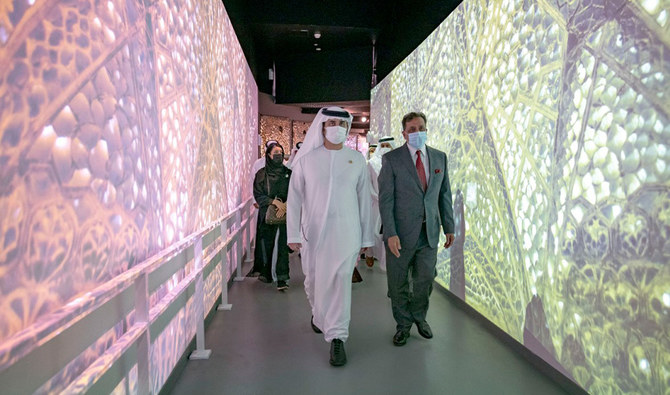
ISLAMABAD: Deputy Ruler of Dubai, Sheikh Maktoum bin Mohammed bin Rashid Al Maktoum, this week toured the Pakistan pavilion at Expo 2020 Dubai, Emirates News Agency (WAM) said.
The Expo is the first world fair to be held in the Middle East, and Dubai, the region’s tourism, trade and business hub, is hoping to boost its economy by attracting 25 million business and tourist visits to the exhibition, which has been built from scratch on 4.3 sq km (1.7 sq mile) of desert at a cost of around $6.8 billion.
Exhibitors from almost 200 countries, including Pakistan, are participating, with many countries and companies looking to the expo — the first major global event open to visitors since the coronavirus pandemic — to boost trade and investment.
The Pakistan pavilion was officially inaugurated by President Dr. Arif Alvi on October 9. Last week, the commerce ministry said over 55,000 people had visited the site only in its first week since launching.
“Sheikh Maktoum also visited the Pakistan Pavilion located at the Opportunity District, which showcases the country’s diverse environmental beauty,” WAM reported.
“The pavilion offers a one-of-a-kind tour of the nation’s towering ‘peaks of progress’ in sustainability, sports, technology and much more. With a history spanning 7,000 years, ever-evolving with art, culture and diversity, Pakistan is one of the world’s best-kept secrets.
“During the tour, H.H. was briefed on the main highlights in Pakistan’s journey toward the future through the pavilion’s huge interactive screens.”
Built from scratch on 4.3 square km of desert, the Expo is divided into three sub-theme districts: Opportunity, Mobility, and Sustainability.
The Pakistani pavilion, themed “The Hidden Treasure,” is located in the Opportunity area.


Deputy ruler of Dubai visits Pakistan pavilion at Expo 2020
https://arab.news/6qrey
Deputy ruler of Dubai visits Pakistan pavilion at Expo 2020

- Exhibitors from 200 countries are participating in Expo with aim to boost trade and investment
- The Pakistan pavilion was officially inaugurated by President Arif Alvi on October 9

Pakistan IT minister in Kuwait to attend digital cooperation body meeting on AI risks
- Shaza Fatima Khawaja to attend event themed ‘Inclusive Prosperity in the Age of AI’
- Pakistan approved National AI Policy last year, launched first locally hosted AI cloud
KARACHI: Pakistan’s Information Technology (IT) Minister Shaza Fatima Khawaja on Wednesday arrived in Kuwait on a two-day visit to hold discussions on artificial intelligence (AI) and its risks at the fifth Digital Cooperation Organization General Assembly (DCOGA), her office said.
The annual gathering brings together representatives of various states and international organizations to discuss the digital economy and the challenges associated with its growth. This year’s theme is “Inclusive Prosperity in the Age of AI.”
Pakistan has been actively developing its AI landscape, marked by the approval of the National AI Policy in July last year and the subsequent launch of its first locally hosted AI cloud in a bid to integrate AI for economic growth.
“The federal minister will participate in the General Assembly of the Digital Cooperation Organization (DCO) and hold meetings with representatives of member states,” the IT ministry said in a statement on Wednesday.
“Discussions will be held on artificial intelligence and its risks, with meetings scheduled with global policymakers.”
Khawaja will hold high-level meetings with global leaders at the event and participate in the DCO thematic ministerial roundtable comprising ministers from various countries, it added.
The development comes as Pakistan seeks to position itself as a credible participant in the global AI economy to harness AI for productivity, skills development and innovation while managing regulatory risks.
Pakistan has mainly been engaging with Gulf countries on AI. In October last year, Pakistan’s Prime Minister Shehbaz Sharif announced that Saudi Arabia has offered free training in IT and AI for Pakistani youth. Last November, Pakistan and the United Arab Emirates agreed to deepen cooperation in AI, digital governance and data innovation.
Pakistan is also hosting a week-long national AI initiative, “AI Indus Week 2026,” from Feb. 9-15 to promote the responsible use of technology and accelerate the adoption of AI across the public and private sectors.


