Pakistan confirms India’s invitation for meeting on Afghanistan, says no decision yet on participation

Pakistani Rangers (wearing black uniforms) and Indian Border Security Force officers lower their national flags at the Pakistan-India joint check-post at Wagah border, near Lahore, Pakistan August 14, 2018. (REUTERS/ File photo)
Short Url
Updated 19 October 2021
Follow

Pakistan confirms India’s invitation for meeting on Afghanistan, says no decision yet on participation

  • India has proposed to host a meeting of national security advisers in Delhi in November
  • Key stakeholders in the region, including Russia, Iran, China, and Pakistan, have been invited

ISLAMABAD: Pakistan’s foreign office has said Islamabad had received an invitation from India to attend a national security advisers’ meeting on Afghanistan in New Delhi next month, but had not taken a decision yet on whether it would participate.
India’s invitation to Pakistani NSA Dr. Moeed Yusuf, first reported by Indian media this week, comes at a time of high tensions between the nuclear-armed neighbors and longtime arch-foes.
This will be the first meeting on Afghanistan to be convened by India since the Taliban captured power in August. Pakistan, China, Iran, Russia and Tajikistan are reportedly invited to the meeting planned for November 10-11.
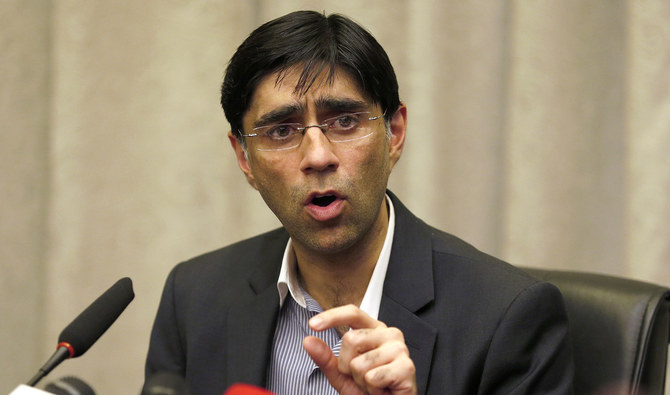


Pakistan's National Security Advisor Moeed Yusuf gives a news conference, in Islamabad, Pakistan, on September 15, 2021. (AP)

“There is the invitation,” Pakistani foreign office spokesperson Asim Iftikhar said in a statement on Monday, confirming that India had invited Pakistan to the NSA meeting. “There is no decision yet.”
Pakistan and India have a longstanding dispute over the Himalayan region of Kashmir, which they both rule in part but claim in full. They have fought two wars over the region.
India was a key supporter of the ousted regime in Kabul and as both Pakistan and China become key players in a Taliban-ruled Afghanistan, its nervousness has increased, analysts say.
Indeed, India has bitter memories of the previous Taliban stint in power from 1996 to 2001 and the group’s links to Pakistan.
An Indian Airlines plane was hijacked in 1999 and ultimately landed in Kandahar in southern Afghanistan. New Delhi freed three senior Pakistani militants in its jails in exchange for the return of the passengers and the Taliban allowed the hijackers and the released prisoners to go to Pakistan.
But over the past year as the Taliban emerged as a dominant force in Afghanistan and US-brokered negotiations began in Doha, Indian diplomats had opened a line with the group. But Pakistan has long insisted India has no role in Afghanistan, with which it does not share a border, and has consistently accused India of using Afghan soil to mastermind militant attacks inside Pakistan — an accusation New Delhi denies.


Pakistan issues over $7 billion sukuk in 2025, nears 20 percent Shariah-compliant debt target

Updated 29 December 2025
Follow

Pakistan issues over $7 billion sukuk in 2025, nears 20 percent Shariah-compliant debt target

  • Finance Adviser Khurram Schehzad says this was the highest-ever Sukuk issuance in a single calendar year since 2008
  • Pakistan’s Federal Shariat Court ordered in 2022 the entire banking system to transition to Islamic principles by 2027

ISLAMABAD: Pakistan’s Finance Adviser Khurram Schehzad on Monday said the country achieved a landmark breakthrough in Islamic finance by issuing over Rs2 trillion ($7 billion) sukuk this year, bringing it closer to its 20 percent Shariah-compliant debt target by Fiscal Year 2027-28.

A sukuk is an Islamic financial certificate, similar to a bond, but it complies with Shariah law, which forbids interest. Pakistan’s Federal Shariat Court (FSC) had directed the government in April 2022 to eliminate interest and align the country’s entire banking system with Islamic principles by 2027.

Following the ruling, the government and the State Bank of Pakistan (SBP) have undertaken a series of measures, including legal reforms and the issuance of sukuk to replace interest-based treasury bills and investment bonds.

“In 2025, the Ministry of Finance (MoF) through its Debt Management Office, together with its Joint Financial Advisers (JFAs), successfully issued over PKR 2 trillion in Sukuk,” Schehzad said on X, describing it as “the highest-ever Sukuk issuance in a single calendar year since 2008 by Pakistan.”

Pakistan made a total of 61 issuances across one-, three-, five- and 10-year tenors, according to the finance adviser. The country also successfully launched its first Green Sukuk, a Shariah-compliant bond designed to fund environment-friendly projects.

He said the Green Sukuk was 5.4 times oversubscribed, indicating investor demand was more than five times higher than the amount the government planned to raise, which showed strong market confidence.

“The rising share of Islamic instruments in the government’s domestic securities portfolio (domestic debt) underscores strong momentum, growing from 12.6 percent in June 2025 to around 14.5 percent by December 2025, clearly positioning the MoF to achieve its 20 percent Shariah-compliant debt target by FY28,” Schehzad said.

“This milestone also reflects the structural deepening of Pakistan’s Islamic capital market, sustained investor confidence, and the strengthening of sovereign debt management.”

He said Pakistan was strengthening its government securities market by making it more resilient, diversified, and future-ready, supported by a stabilizing macroeconomic environment, a disciplined debt strategy, and a clear roadmap for Islamic finance.