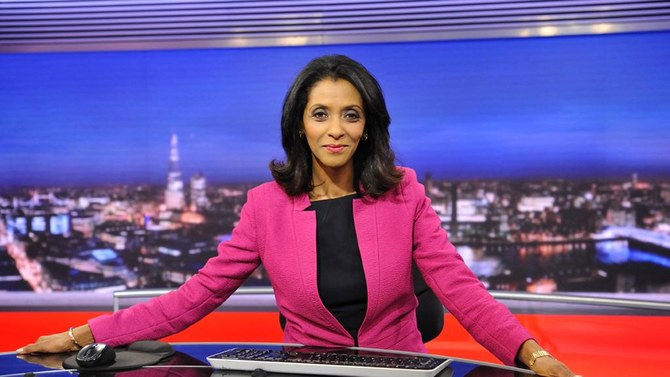

London: The School of Oriental and African Studies in London appointed award-winning broadcaster and journalist Zeinab Badawi as the university’s newest president.
Badawi is a Sudanese-British television and radio journalist who is best known for hosting BBC’s “Hardtalk” and various other notable programs across the network, namely “The World” on BBC Four.
Badawi’s extensive ties with SOAS’ community stretch back to 1988, when she obtained a master’s degree in Middle East history and anthropology, graduating with distinction. In 2011, Badawi was awarded an honorary doctorate by SOAS for her services to international broadcasting.
“I’ve always maintained my ties with SOAS,” Badawi told Arab News. “I’ve attended meetings, receptions and talks. The Royal African society, of which I was chair, had very close links with the university. So, it wasn’t as though I had broken the umbilical cord of my connections with SOAS after I’d been there. I had maintained close ties.
“It was a no-brainer for me when I was asked to become president. It was something I accepted with great delight and honor,” she added.
Born in Sudan, Badawi moved to England when she was 2 years old. She recounted how, despite moving at a very young age, speaking Arabic in the house with her parents when she was growing up helped her stay connected to her Arab and African roots.
“My identity with the African and Arab in me is not necessarily linked to a territory or having to occupy a place or a space in time,” Badawi highlighted. “It’s very much a connection through people, my parents, and my extended family, and I think that is why I have such an emotional connection with both Africa and the Arab world.”
Throughout her successful journalistic career, Badawi interviewed some of the world’s most notable personalities and politicians, including former Sudanese President Omar Al-Bashir, who was the first Sudanese president to be charged with war crimes.
“Al-Bashir had not spoken on the record in the international media at all, nor for that matter had he given an interview at length to anybody about this,” Badawi highlighted.
“I was particularly proud to get that interview in 2009 because the events that unfolded later — the Sudanese revolution of 2019 that ousted Al-Bashir — had revived my interview with him, and I can see that my career had come full circle,” she added.
On other influential interviews she conducted, Badawi revealed that her interview on BBC’s “Hardtalk” with former Archbishop of Cape Town Desmond Tutu had stuck with her throughout her journalistic career.
“Tutu is a great South African, a great African and a great global humanitarian icon,” she said. “What I loved about interviewing him on ‘Hardtalk’ was that he took what he did very seriously without taking himself very seriously. And he was a man of immense humor. He often used humor to diffuse criticisms against him.”
Regarding the school, Badawi says that SOAS has robust structures in place to deal with controversies it had faced in the past and that “if situations arise where people feel that they have grievances, such grievances should be dealt with in the appropriate way with full transparency, using all the proper governance structures at hand.”
Despite the bumps in the road, Badawi demonstrates that SOAS is increasingly asserting itself with great confidence in the UK and on the global stage. She looks forward to “strengthening current ties and forging new partnerships that will strengthen the foundations of SOAS.”