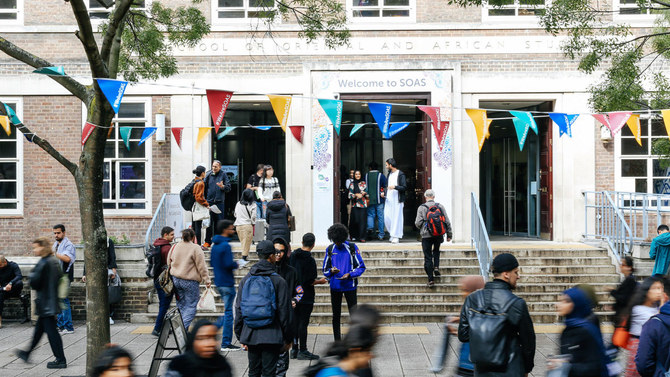
LONDON: A UK university specializing in the study of Asia, Africa and the Middle East has been forced to slash costs and implement drastic staff cuts after the coronavirus disease (COVID-19) pandemic exacerbated its financial problems.
Staff at the School of Oriental and African Studies (SOAS), part of the University of London, said they feared that management was cutting costs to make the college an attractive takeover target for an overseas institution or one of its London rivals, UK newspaper the Guardian reported.
Latest figures show that the internationally renowned higher education institution has multi-million pound deficits and risks running out of cash next year.
The effects of the pandemic on student recruitment meant “a material uncertainty exists that may cast significant doubt on the school’s ability to continue as a going concern” over the next 12 months, SOAS’s auditors warned.
One academic at SOAS told the Guardian that the college’s senior managers had “been unable to make significant changes over the last few years, and now it has ended in a big crisis. This is a serious failure of management.”
Its senior academics were ordered to identify staff cuts that were to be submitted on Friday, and departments were asked to balance their budgets while expecting a 50 percent drop in new international students, the report said.
SOAS’s International Foundation Courses and English Language Studies Center, which provides courses to international students, has reportedly been told to make so many cuts that it will effectively disappear, along with its 55 staff.
The college’s highly regarded international development department, which is ranked eighth in the world, will also suffer from major cuts. Its famed anthropology and sociology department is likely to lose between a third and half of its academic staff.
“I think people are in shock,” a staff member said. “This all happened while we are still coping with COVID-19.”
SOAS released a statement on Friday saying the coronavirus pandemic had affected all British universities and that it was “taking decisive action now so that we can continue to ensure we provide an excellent student experience to our new and returning students.”
It acknowledged that although its “accounts show that SOAS has already taken steps to reduce its deficit position,” the “impact of COVID-19 has put finances across the HE sector under even greater pressure than before.”
It added that it had taken short term action to reduce costs including “pausing capital spend, line by line scrutiny of non-pay budgets” and reducing the use of building space in the Bloomsbury area in London, outside its core campus.
SOAS also said that additional proposals for change were being considered and would be implemented ahead of the start of the new academic year in September.
SOAS, University of London, has been ranked in the UK’s top 20 universities for Arts and Humanities, according to the 2020 Times Higher Education World University Ranking.
The rankings place SOAS 13th in the UK and 57th in the world.


![]()

UK university SOAS to cut costs over COVID-19 and financial problems
Short Url
https://arab.news/9ps7u
UK university SOAS to cut costs over COVID-19 and financial problems
- Latest figures show that the internationally renowned higher education institution has multi-million pound deficits and risks running out of cash next year
- SOAS said that it had taken short term action to reduce costs


Latest updates


© 2026 SAUDI RESEARCH & PUBLISHING COMPANY, All Rights Reserved And subject to Terms of Use Agreement.