


QUETTA: When Barishna Reki was thinking of ideas for her senior thesis as she completed a fine arts degree in 2019, she knew she wanted to work on a project that would one day help transform her passion for painting into a financially viable career.
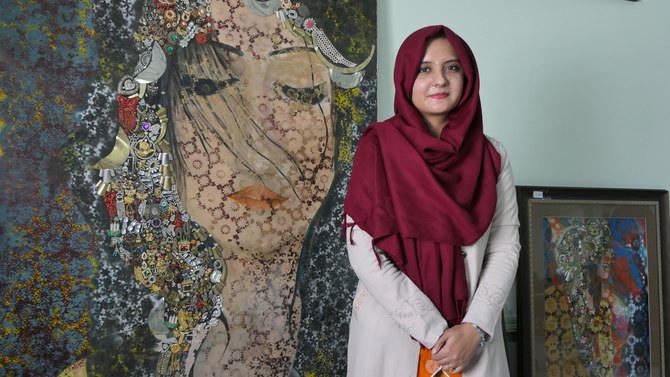
Reki, now 25, who hails from the remote town of Mashkail in southwestern Balochistan province and graduated from Sardar Bahadur Khan Women University two years ago, came up with a unique idea: using traditional Baloch jewelry to add an extra sparkle to her canvases.
A project that she submitted as part of her coursework has now become her life’s work. Reki’s creations, which combine painting and jewelry like a sumptuous, gilded embrace in a Gustav Klimt painting, are already a subject of discussion and awe on social media. Not just that, she recently sold four pieces, one of them for Rs1,75,000 ($1,026) to leading Pakistani actress Zeba Bakhtiyar. Another fresh creation is on sale for Rs2,75,000 ($1,612) at a mall in Quetta, the capital of Balochistan.
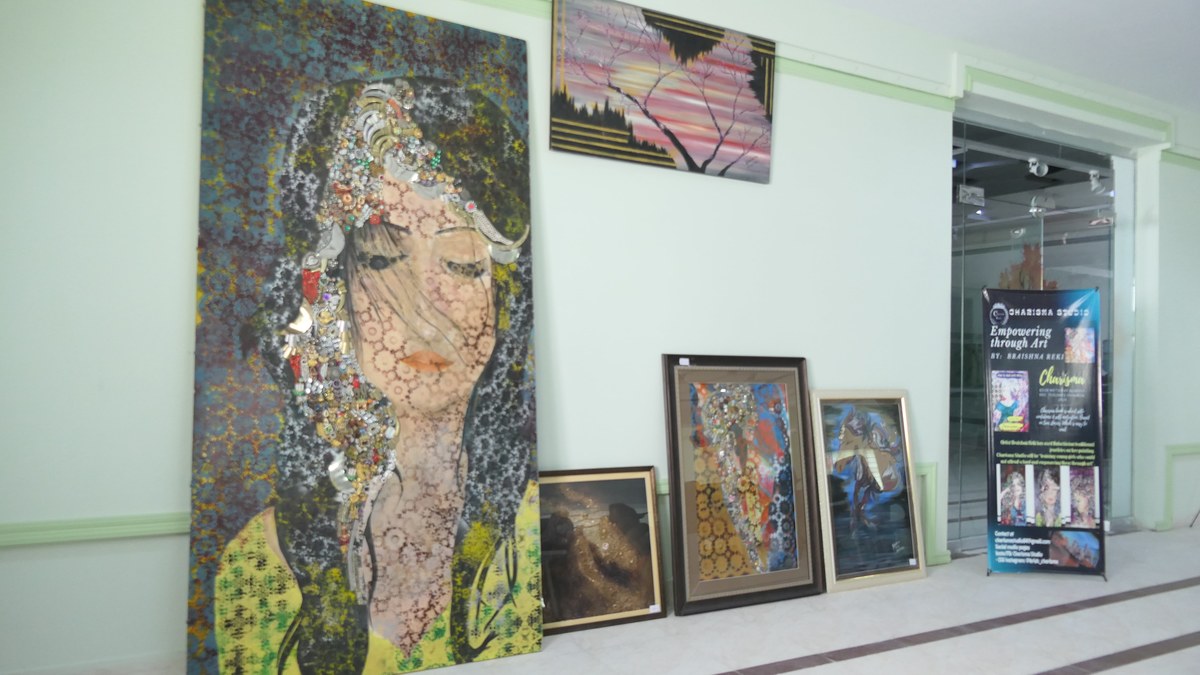
Art designed by Barishna Reki displayed at the University of Balochistan, Quetta, Pakistan, on October 11, 2021. (AN Photo)
Last year, Reki also set up her own shop, Charisma Studios, which has become a space of passion and business for other women artists from Balochistan who want to pursue art for a living.
In the impoverished Balochistan province — Pakistan’s largest in terms of land area but its least populous and underdeveloped — this is no small achievement for a 25-year-old woman. Less than 10 percent women in the region currently own their own businesses, according to the Balochistan Women Business Association.
“I was creative since my childhood but I never intended to become an artist because my parents wanted me to become a doctor or an engineer,” she told Arab News.
And though Reki knew how hard the journey ahead would be and the few opportunities a career in art offered, she was not deterred: “When I was doing my thesis, I resolved to do something different and creative for the people of Balochistan.”
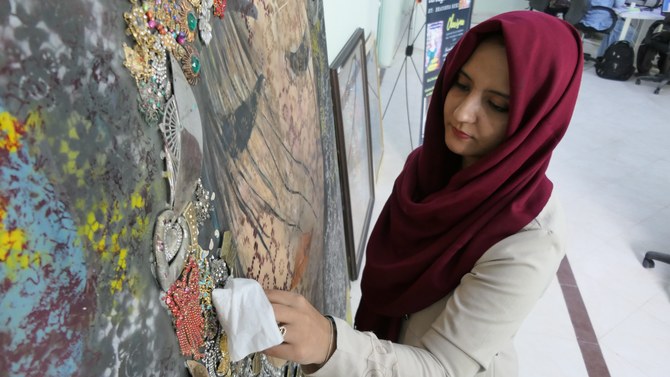
Barishna Reki (center) works on a piece at the University of Balochistan, Quetta, Pakistan, on October 11, 2021. (AN Photo)
Reki recently completed 15 pieces in different sizes, the largest 8X4 feet, using natural precious and semi-precious stones and ornamental buttons combined with watercolor and oil painting. Some pieces use old jewelry gifted by her mother. Others employ ornamental artificial pieces purchased from friends or local junkyards in Quetta.
“From the beginning I wanted to work on a massive scale,” Reki said. “Hence my first mixed-media art piece was more than 8 feet tall and took three months to complete.”
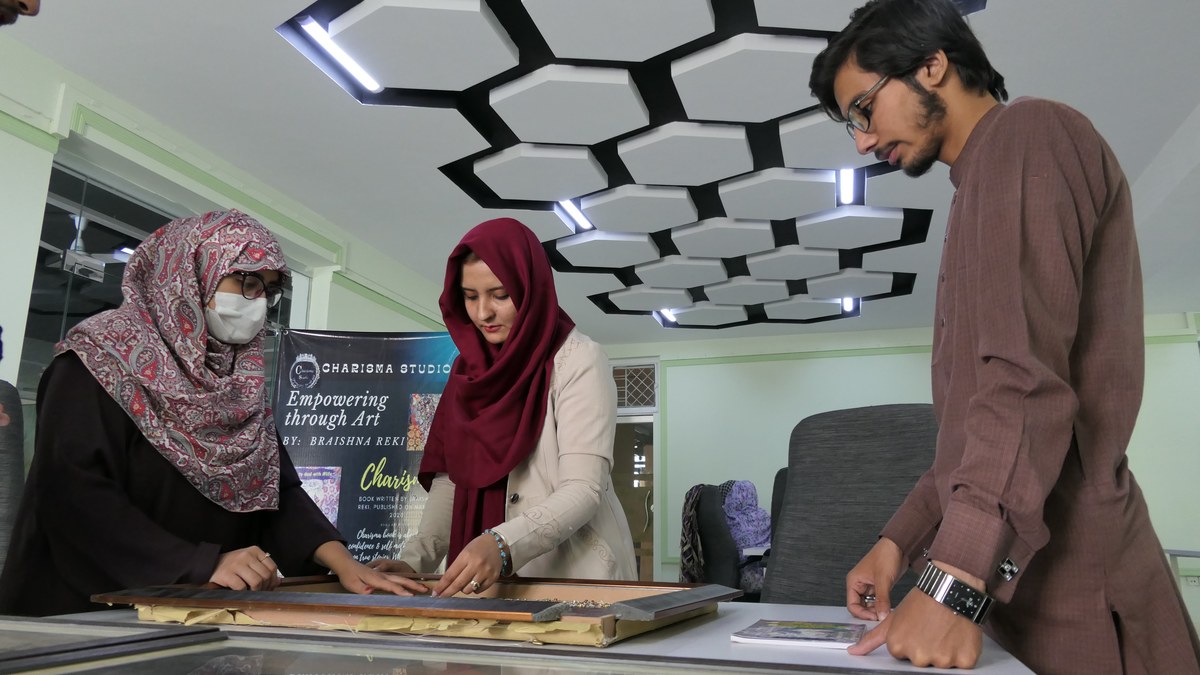
Aiman Islam, 28, a design consultant at Charisma Studio, said she saw Reki’s work on a social media website three months ago and was inspired to contact her.
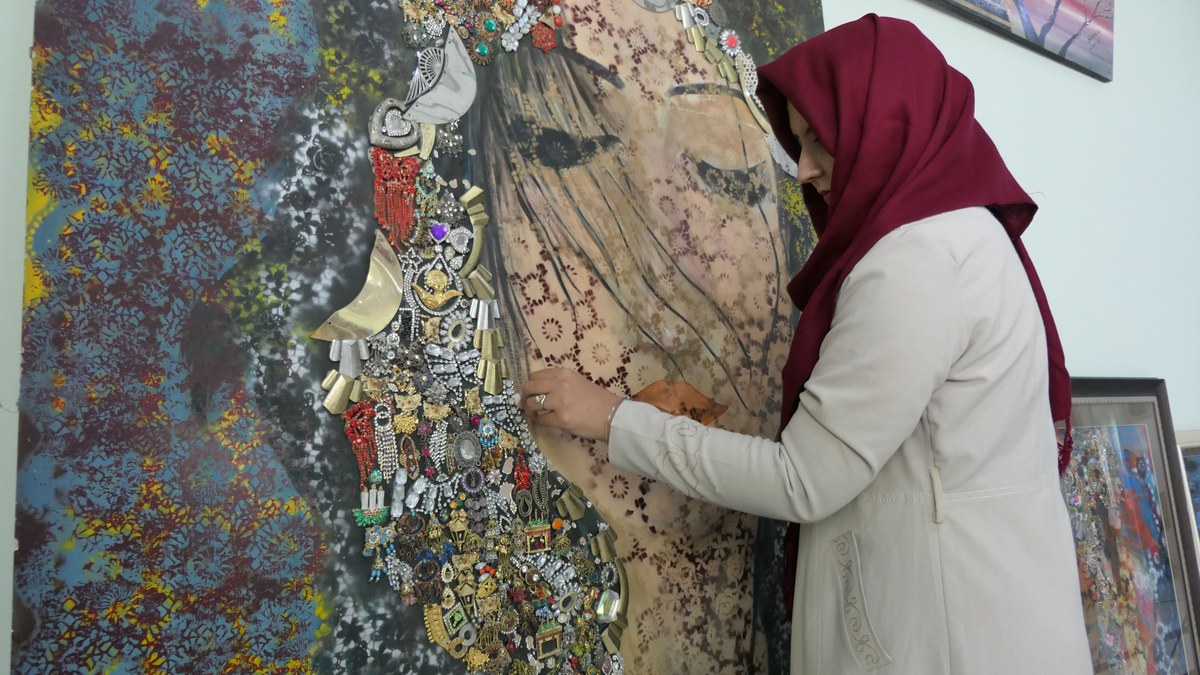
Barishna Reki at work at the University of Balochistan, Quetta, Pakistan on October 11, 2021. (AN Photo)
“I had expertise in design consultancy but didn’t get a proper job in Quetta but now under Charisma Studio’s umbrella, I have been working on three projects which I hope will be beneficial for jobless artists in the province,” Islam said.
Amina Malik Mengal, 24, a gold medalist in biochemistry, said she used to practice calligraphy at school but abandoned the idea of becoming a professional artist because of a lack of professional prospects.
“But after meeting Barishna Reki and getting to know about Charisma Studio, now I am reviving my passion along with other artists,” Mengal told Arab News. “There are many versatile artists in Balochistan who are looking for assistance and appreciation.”
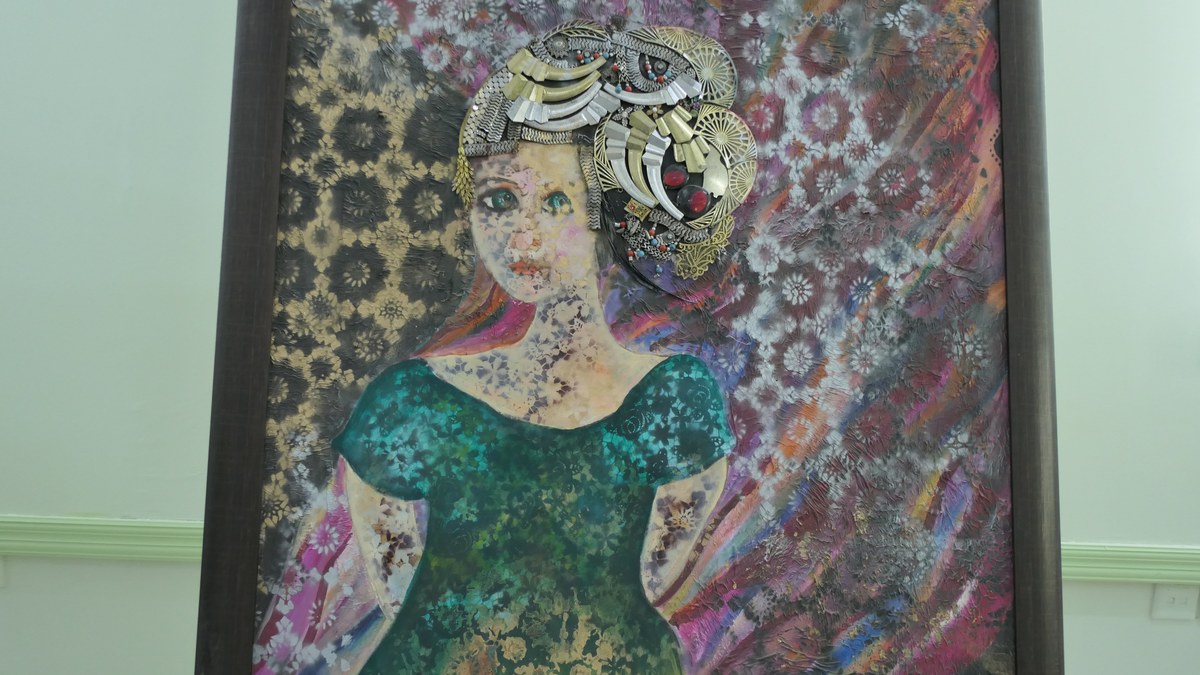
A piece completed by young female artists displayed at the University of Balochistan, Quetta, Pakistan, on October 11, 2021. (AN Photo)
Muhaddisa Batool, 30, also completed her graduation in fine arts in 2015 but never got an opportunity to pursue her passion.
Through Charisma Studios, however, she said she had gotten two orders for pencil sketches, which she sold in September.
“Now I am looking for more orders,” Batool said.
Reki said she was grateful and happy to be able to help struggling artists in Balochistan. In this spirit, she recently published a book titled “Charismas” that she described as a self-help guide for young people in Balochistan losing hope due to a lack of creative opportunities.
Muhammad Asif Kasi, a painter and sculptor in Balochistan with over 24 years of experience, said Reki’s craft was “rare.”
“Instead of using more colors on canvas, Barishna has used jewelry, which is an exclusive idea,” Kasi said, adding that he hoped that Reki would keep pursuing her passion and inspire other women in Balochistan to do so also.


