

PIA suspends operations from Kabul citing Taliban interference 

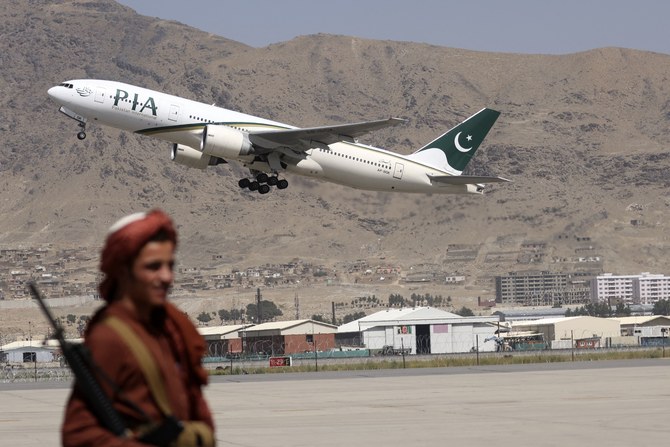
A Taliban fighter stands guard as a Pakistan International Airlines plane, the first commercial international flight to land since the Taliban retook power last month, takes off with passengers onboard at the airport in Kabul on September 13, 2021. (AFP)
Short Url
Updated 14 October 2021
Follow

PIA suspends operations from Kabul citing Taliban interference 

  • Decision came as Taliban government ordered airline to cut ticket prices
  • PIA called this "heavy handed" interference by Taliban authorities

ISLAMABAD: Pakistan International Airlines (PIA) suspended flights to the Afghan capital, Kabul, on Thursday after what it called "heavy handed" interference by Taliban authorities, including arbitrary rule changes and intimidation of staff. 
The suspension came as the Taliban government ordered the airline, the only international company operating regularly out of Kabul, to cut ticket prices to levels seen before the fall of the Western-backed Afghan government in August.

"We are suspending our flight operations to Kabul from today because of the heavy handedness of the authorities," a spokesman said.

Earlier, the Taliban warned PIA and Afghan carrier Kam Air that their Afghan operations risked being blocked unless they agreed to cut ticket prices, which have reached levels increasingly out of reach for most Afghans.

With most international airlines no longer flying to Afghanistan, tickets for flights to the Pakistani capital, Islamabad, have been selling for as much as $2,500 on PIA, according to travel agents in Kabul, compared with $120-$150 before. 
The Afghan transport ministry said in a statement prices on the route should "be adjusted to correspond with the conditions of a ticket before the victory of the Islamic Emirate" or the flights would be stopped.
It urged passengers and others to report any violations. 
Flights between Afghanistan and Pakistan have been severely limited since Kabul airport was reopened last month in the wake of the chaotic evacuation of more than 100,000 Westerners and vulnerable Afghans following the Taliban victory. 
PIA said that ever since the new Taliban government was formed, its staff in Kabul had faced last-minute changes in regulations and flight permissions and "highly intimidating behaviour" from Taliban commanders.

It said its country representative had been held at gunpoint for hours at one point and was only freed after the Pakistan embassy in Kabul intervened.

With a mounting economic crisis adding to worries about Afghanistan's future under the Taliban, there has been heavy demand for flights out and the main passport office in Kabul has been besieged by people trying to get travel documents since it reopened this month.

Demand for flights has been further pushed by repeated difficulties at land border crossings into Pakistan. 


Pakistan president meets UAE counterpart, explores trade, investment opportunities

Updated 27 January 2026
Follow

Pakistan president meets UAE counterpart, explores trade, investment opportunities

  • Asif Ali Zardari is in UAE on four-day visit to strengthen bilateral ties, review bilateral cooperation
  • Both sides discuss regional, international developments, reaffirm commitment to promote peace

ISLAMABAD: President Asif Ali Zardari met his UAE counterpart Sheikh Mohammed bin Zayed Al-Nahyan in Abu Dhabi on Tuesday during which both sides explored new opportunities in trade, investment, energy and other sectors, Zardari's office said. 

Zardari arrived in Abu Dhabi on Monday evening with a high-level delegation on a four-day official visit to the UAE to review trade, economic and security cooperation. 

"The leaders discussed ways to further deepen the longstanding and brotherly relations between Pakistan and the UAE," a statement from Zardari's office said about his meeting with the UAE president. 

"They reviewed the full spectrum of bilateral cooperation and explored new opportunities in trade, investment, energy, infrastructure, technology, and people-to-people exchanges, highlighting the significant potential for expanding economic and strategic partnership.

Zardari highlighted the significance of Al-Nayhan's visit to Pakistan last month, the statement said, expressing appreciation for the UAE's continued support for strengthening bilateral ties.

It said both sides also exchanged views on a range of regional and international developments, reaffirming their commitment to promoting peace, stability and sustainable development.

The meeting was also attended by Pakistan's First Lady Aseefa Bhutto-Zardari, the Pakistani president's son Bilawal Bhutto-Zardari, who is also the chairman of the Pakistan Peoples Party, Interior Minister Mohsin Naqvi and Pakistan's ambassador to the UAE. 

ZARDARI MEETS AD PORTS CEO

Zardari earlier met AD Ports Group CEO Captain Mohamed Juma Al-Shamisi to discuss the group's investment initiatives in Karachi. 

"Both sides agreed that the expansion and modernization of port infrastructure would strengthen trade flows and support Pakistan’s broader economic development and country’s seaborne trade," the President's Secretariat said in a statement.

It added that Zardari described the AD Ports Group's long-term investment and expanding role in Pakistan's maritime and logistics sector as a key pillar of Pakistan–UAE economic cooperation.

Pakistan and the UAE maintain close political and economic relations, with Abu Dhabi playing a pivotal role in supporting Islamabad during periods of financial stress through deposits, oil facilities and investment commitments. 

The UAE is Pakistan's third-largest trading partner, after China and the United States, and a key destination for Pakistani exports, particularly food, textiles and construction services.

The Gulf state is also home to more than 1.5 million Pakistani expatriates, one of the largest overseas Pakistani communities in the world, who contribute billions of dollars annually in remittances, a crucial source of foreign exchange for Pakistan’s economy.

Beyond trade and labor ties, Pakistan and the UAE have steadily expanded defense and security cooperation over the years, including military training, joint exercises and collaboration in counter-terrorism and regional security matters.