

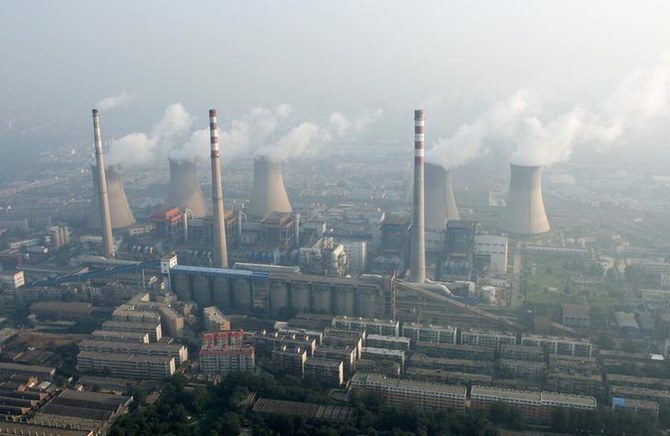
China liberalizes coal-fired power pricing to tackle energy crisis

Short Url
Updated 12 October 2021
Follow

China liberalizes coal-fired power pricing to tackle energy crisis

BEIJING: China said on Tuesday it will allow coal-fired power plants to charge some customers market-driven prices for electricity, as a worsening energy crisis persuaded authorities to rush through their boldest reform of the power sector in decades.

Responding to shortfalls in power generation brought on by shortages and record high prices for coal, the government has taken a range of steps to boost coal production and manage electricity demand at industrial plants.

To help power companies pass on the high costs of coal, the National Development and Reform Commission said that all electricity generated by coal-fired plants would be priced via market trading “in an orderly manner” from Oct. 15.

It also instructed commercial and industrial users to buy direct from the market or via agents over the grid “as soon as possible.”

A worsening power crunch has forced production curbs across industries such as cement, steel and aluminum, dampening the outlook for China’s economy.

Utilities have struggled to keep up with post-pandemic demand for electricity, and power plants generated less as rising price of coal rendered operations uneconomic.

Pushing all industrial and commercial users to the power exchanges and allowing prices to be set by the market is expected to encourage loss-making generators to increase output.

Addressing a press briefing, NDRC official Peng Shaozong said the reform was “designed to reflect power demand and consumption, and to some extent to ease operation difficulties of power firms and encourage plants to increase power supply.”

The most-active China thermal coal futures contract soared 11 percent to a record high 1,507.8 yuan ($233.55) a ton on Tuesday.

“The relaxation of thermal power pricing is a positive for growth by reducing power outages,” Frederic Neumann, co-head of Asian Economic Research at HSBC told Reuters.

“However, this comes with a further rise in price pressures, as power companies can now pass on higher input costs to their commercial and industrial customers.”


Saudi Arabia leads outcome-based education to prepare future-ready generations: Harvard Business Review

A Harvard sign is seen at the Harvard University campus in Boston, Massachusetts, on May 27, 2025. (AFP)
Updated 10 February 2026
Follow

Saudi Arabia leads outcome-based education to prepare future-ready generations: Harvard Business Review

  • The Riyadh-based school group developed a strategy that links every classroom activity to measurable student competencies, aiming to graduate learners equipped for the digital economy and real-world contexts

RIYADH: Saudi Arabia’s education system is undergoing a sweeping transformation aligned with Vision 2030, shifting from traditional, input-focused methods to outcome-based education designed to equip students with future-ready skills, Harvard Business Review Arabic reported.

The transformation is being adopted and spearheaded by institutions such as Al-Nobala Private Schools, which introduced the Kingdom’s first national “learning outcomes framework,” aimed at preparing a generation of leaders and innovators for an AI-driven future, the report said.

Al-Nobala has leveraged international expertise to localize advanced learning methodologies.

The Riyadh-based school group developed a strategy that links every classroom activity to measurable student competencies, aiming to graduate learners equipped for the digital economy and real-world contexts. The school’s group approach combines traditional values with 21st-century skills such as critical thinking, communication, innovation and digital fluency.

According to the report, the shift addresses the growing gap between outdated models built for low-tech, resource-constrained environments and today’s dynamic world, where learners must navigate real-time information, virtual platforms, and smart technologies.

“This is not just about teaching content, it’s about creating impact,” the report noted, citing how Al-Nobala’s model prepares students to thrive in an AI-driven world while aligning with national priorities.

The report noted that Saudi Arabia’s Ministry of Education has paved the way for this shift by transitioning from a centralized controller to a strategic enabler, allowing schools such as Al-Nobala to tailor their curriculum to meet evolving market and societal needs. This is part of the long-term goal to place the Kingdom among the top 20 global education systems.

Al-Nobala’s work, the report stated, has succeeded in serving the broader national effort to link education outcomes directly to labor market demands, helping to fulfill the Vision 2030 pillar of building a vibrant society with a thriving economy driven by knowledge and innovation.

Last February, Yousef bin Abdullah Al-Benyan, Saudi Arabia’s minister of education, said that the Kingdom was making “an unprecedented investment in education,” with spending aligned to the needs of growth and development. He said that in 2025, education received the second-largest share of the state budget, totaling $53.5 billion.