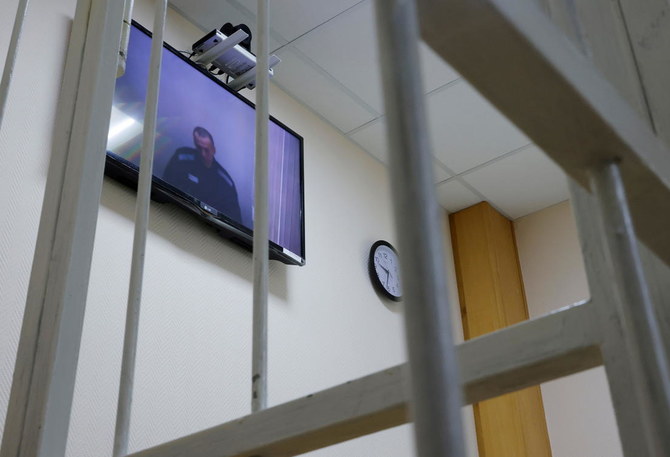
MOSCOW: Jailed Kremlin critic Alexei Navalny said on Monday that a prison commission had designated him an extremist and a terrorist, but officially no longer regarded him as a flight risk.
Navalny said on Instagram that he had been summoned before a commission which voted unanimously in favor of the change of status.
The designation marks a further escalation of official pressure against President Vladimir Putin’s most prominent domestic critic, currently serving two-and-a-half years in prison for parole violations he says were trumped up to thwart his political ambitions.
Navalny made light of the announcement, saying that he welcomed the fact he was no longer designated as prone to escape and so would be subjected to less frequent and stringent night time checks by guards.
“It’s just that there is now a sign over my bunk that I am a terrorist,” said Navalny in the post, which was published with the help of his lawyers.
There was no immediate confirmation from Russian authorities of the change in Navalny’s status, and the Federal Penitentiary Service (FSIN) did not immediately reply to a request for comment.
Navalny, 45, was jailed after returning to Russia at the start of this year from Germany, where he underwent months of treatment to recover from being poisoned with a rare nerve agent in Siberia in August 2020.
The Kremlin denied any involvement in poisoning him and has repeatedly said that his treatment is a matter for the prison service. Putin takes pains to avoid even mentioning his name.
Navalny’s movement suffered a new blow in June when a court ruled its activities to be extremist. Many of his allies have had their homes raided or their freedom of movement restricted, and some have fled abroad. Last month Russia opened a new criminal case against Navalny that could keep him in jail for a further decade.
Some of his supporters have criticized last week’s award of the Nobel Peace Prize to Russian journalist Dmitry Muratov, saying Navalny would have been a more deserving recipient.


![]()

Kremlin critic Alexei Navalny says his prison has designated him a terrorist
Short Url
https://arab.news/4vbw4
Kremlin critic Alexei Navalny says his prison has designated him a terrorist
- No immediate confirmation from Russian authorities of the change in Navalny’s status


Latest updates


Recommended


© 2026 SAUDI RESEARCH & PUBLISHING COMPANY, All Rights Reserved And subject to Terms of Use Agreement.