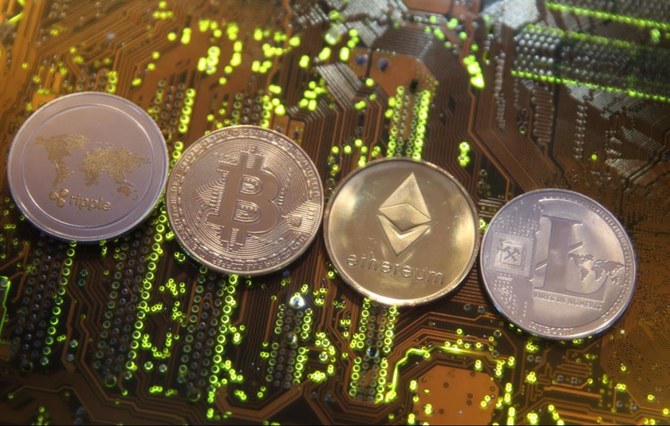
Can the White House stop cryptocurrencies being used for cybercrime?

There were 304 million ransomware attacks globally last year, according to Statistica. (Reuters)
Short Url
Updated 09 October 2021
Follow

Can the White House stop cryptocurrencies being used for cybercrime?

  • Cryptocurrency transactions can be traced on public blockchains, but the identity of the owner is not always clear

LONDON: The White House is considering how it can regulate cryptocurrencies so they are not used to facilitate ransomware attacks and other cybercrime.

The National Security Council and the National Economic Council, forums through which the president consults and makes policy decisions, are working with other agencies to “ensure that cryptocurrency and other digital assets are not used to prop up bad actors,” a White House spokeswoman said on Saturday.

The oversight could include an executive order, Bloomberg News reported on Thursday, although that was not confirmed by the spokeswoman.

Cyber criminals often demand that ransoms are paid in cryptocurrencies, so they are harder to trace. There were an estimated 304 million ransomware attacks globally in 2020, with 68.5 percent of companies the subject of an attack, according to data from Statistica.

The FBI was informed of almost 2,500 ransomware attacks last year, which cost the victims about $29.1 million, up more than 200 percent from the previous year.

It is not the first rumblings of firmer action from the US. In September, the Treasury Department’s Office of Foreign Assets Control sanctioned a crypto exchange in a first as part of its response to a spate of ransomware attacks.

However, there are limits to what the White House, or anyone else, can do to stop cryptocurrencies being used for cybercrime.

Despite rumors to the contrary, cryptocurrencies are more traceable than cash. Every transaction involving a crypto asset is stored on a public blockchain. However, the identity of those carrying out the transactions is not always clear.

Scammers tend to move bitcoins or their crypto of choice through hundreds or thousands of transactions and may control dozens of wallets, making it a huge job for law enforcement to track. They even use software called a “mixer” to break it up into many smaller transactions and complicate tracing it even further.

So, if there is a really large ransom that the FBI, or another national law enforcement agency, wants to track down, they may be able to do it after investing a lot of time and expertise, but smaller amounts will usually fall between the cracks.

What the White House may be able to do is improve know-your-customer rules for exchanges and wallets that are allowed to operate in their jurisdiction. Banks have to do this kind of thing before taking on new customers; if cryptocurrency intermediaries were forced to do the same, it would make it harder for cyber criminals to hide their ill-gotten gains. But not impossible.


Closing Bell: Saudi equities continue 4-day upward trend 

Updated 14 January 2026
Follow

Closing Bell: Saudi equities continue 4-day upward trend 

RIYADH: Saudi equities closed higher on Wednesday, with the Tadawul All Share Index rising 51.52 points, or 0.47 percent, to finish at 10,945.15. 

Trading activity was robust, with 373.9 million shares exchanged and total turnover reaching SR6.81 billion. 

The MT30 Index also ended the session in positive territory, advancing 11.93 points, or 0.82 percent, to 1,472.82, while the Nomu Parallel Market Index declined 116.82 points, or 0.49 percent, to 23,551.47, reflecting continued volatility in the parallel market.

The main market saw 90 gainers against 171 decliners, indicating selective buying. 

On the upside, Al Kathiri Holding Co. led gainers, closing at SR2.18, up SR0.12, or 5.83 percent. Wafrah for Industry and Development Co. advanced to SR23, gaining SR0.99, or 4.5 percent, while Al Ramz Real Estate Co. rose 4.35 percent to close at SR60.

SABIC Agri-Nutrients Co. added 4.21 percent to SR118.70, and Al Jouf Agricultural Development Co. climbed 4.12 percent to SR45. 

Meanwhile, losses were led by Saudi Industrial Export Co., which fell 9.73 percent to SR2.69. United Cooperative Assurance Co. declined 5.08 percent to SR3.74, while Thimar Development Holding Co. dropped 4.54 percent to SR35.30.  

Abdullah Saad Mohammed Abo Moati for Bookstores Co. retreated 4.15 percent to SR48.50, and Gulf Union Alahlia Cooperative Insurance Co. slipped 3.96 percent to SR10.44. 

On the announcement front, Saudi National Bank announced its intention to issue US dollar-denominated Additional Tier 1 capital notes under its existing international capital programe, with the final size and terms to be determined subject to market conditions and regulatory approvals.  

The planned issuance aims to strengthen Tier 1 capital and support the bank’s broader financial and strategic objectives.  

The stock closed at SR42.70, gaining SR0.70, or 1.67 percent, reflecting positive investor reaction to the capital management move. 

Separately, Almasane Alkobra Mining Co. said its board approved the establishment of a wholly owned simplified joint stock company to provide drilling, exploration and related support services, with a share capital of SR100 million and headquarters in Najran, subject to regulatory approvals.  

The new subsidiary aligns with the company’s strategy to enhance operational efficiency and expand its role in the Kingdom’s mining sector.

Shares of Almasane Alkobra Mining closed at SR98.70, up SR0.30, or 0.3 percent, by the end of the session.