British industry warns of factory closures without help on fuel costs

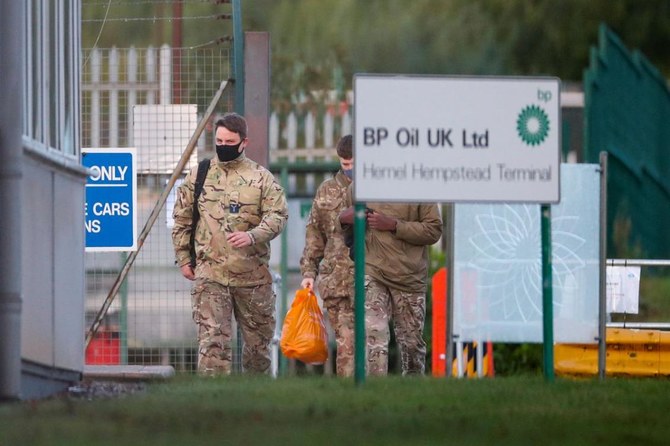
The British military has been helping with fuel deliveries because of a shortage of truck drivers. (Reuters)
Short Url
Updated 09 October 2021
Follow

British industry warns of factory closures without help on fuel costs

  • Wholesale gas prices have increased 400 percent this year in Europe

LONDON: Britain’s most energy intensive manufacturers, including producers of steel, glass, ceramics and paper, have warned the government that unless something is done about soaring wholesale gas prices they could be forced to shut down production.
Wholesale gas prices have increased 400 percent this year in Europe, partly due to low stocks and strong demand from Asia, putting particular pressure on energy intensive industries.
Industry bosses held talks on Friday with business minister Kwasi Kwarteng but said these ended with no immediate solutions.
“If the government doesn’t take any action then basically what we’ll see for the steel sector is more and more pauses of production in certain times of the day and those pauses will become longer,” Gareth Stace, director general of UK Steel told ITV News.
Similarly, Andrew Large, director general of the Confederation of Paper Industries, told the same broadcaster that he could not rule out factories having to suspend production due to increased energy costs.
David Dalton of the British Glass Manufacturers Association said some companies were days away from halting production.
After meeting the industry leaders on Friday, Kwarteng’s department said he was determined to secure a competitive future for Britain’s energy intensive industries.
It said he “promised to continue to work closely with companies over the coming days to further understand and help mitigate the impacts of any cost increases faced by businesses.”
However, some lawmakers within the ruling Conservative Party want more to be done for energy intensive industries.
“I would like to see more government support for these industries in the short term to ensure that we don’t lose them from the UK and we don’t deter further investment,” Andrew Bridgen told the BBC.
“I think they’d like to see a cap on the prices they’re going to pay for gas.”
Britain’s economy is already struggling with a supply chain crisis.
A post-Brexit shortage of workers, exacerbated by the global strains of the COVID-19 pandemic, has hobbled Britain’s supply chains for everything from fuel and pork to poultry and bottled water, putting any recovery from the pandemic under threat.


First EU–Saudi roundtable on critical raw materials reflects shared policy commitment

Updated 16 January 2026
Follow

First EU–Saudi roundtable on critical raw materials reflects shared policy commitment

RIYADH: The EU–Saudi Arabia Business and Investment Dialogue on Advancing Critical Raw Materials Value Chains, held in Riyadh as part of the Future Minerals Forum, brought together senior policymakers, industry leaders, and investors to advance strategic cooperation across critical raw materials value chains.

Organized under a Team Europe approach by the EU–GCC Cooperation on Green Transition Project, in coordination with the EU Delegation to Saudi Arabia, the European Chamber of Commerce in the Kingdom and in close cooperation with FMF, the dialogue provided a high-level platform to explore European actions under the EU Critical Raw Materials Act and ResourceEU alongside the Kingdom’s aspirations for minerals, industrial, and investment priorities.

This is in line with Saudi Vision 2030 and broader regional ambitions across the GCC, MENA, and Africa.

ResourceEU is the EU’s new strategic action plan, launched in late 2025, to secure a reliable supply of critical raw materials like lithium, rare earths, and cobalt, reducing dependency on single suppliers, such as China, by boosting domestic extraction, processing, recycling, stockpiling, and strategic partnerships with resource-rich nations.

The first ever EU–Saudi roundtable on critical raw materials was opened by the bloc’s Ambassador to the Kingdom, Christophe Farnaud, together with Saudi Deputy Minister for Mining Development Turki Al-Babtain, turning policy alignment into concrete cooperation.

Farnaud underlined the central role of international cooperation in the implementation of the EU’s critical raw materials policy framework.

“As the European Union advances the implementation of its Critical Raw Materials policy, international cooperation is indispensable to building secure, diversified, and sustainable value chains. Saudi Arabia is a key partner in this effort. This dialogue reflects our shared commitment to translate policy alignment into concrete business and investment cooperation that supports the green and digital transitions,” said the ambassador.

Discussions focused on strengthening resilient, diversified, and responsible CRM supply chains that are essential to the green and digital transitions.

Participants explored concrete opportunities for EU–Saudi cooperation across the full value chain, including exploration, mining, and processing and refining, as well as recycling, downstream manufacturing, and the mobilization of private investment and sustainable finance, underpinned by high environmental, social, and governance standards.

From the Saudi side, the dialogue was framed as a key contribution to the Kingdom’s industrial transformation and long-term economic diversification agenda under Vision 2030, with a strong focus on responsible resource development and global market integration.

“Developing globally competitive mineral hubs and sustainable value chains is a central pillar of Saudi Vision 2030 and the Kingdom’s industrial transformation. Our engagement with the European Union through this dialogue to strengthen upstream and downstream integration, attract high-quality investment, and advance responsible mining and processing. Enhanced cooperation with the EU, capitalizing on the demand dynamics of the EU Critical Raw Materials Act, will be key to delivering long-term value for both sides,” said Al-Babtain.

Valere Moutarlier, deputy director-general for European industry decarbonization, and directorate-general for the internal market, industry, entrepreneurship and SMEs at European Commission, said the EU Critical Raw Materials Act and ResourceEU provided a clear framework to strengthen Europe’s resilience while deepening its cooperation with international partners.

“Cooperation with Saudi Arabia is essential to advancing secure, sustainable, and diversified critical raw materials value chains. Dialogues such as this play a key role in translating policy ambitions into concrete industrial and investment cooperation,” she added.