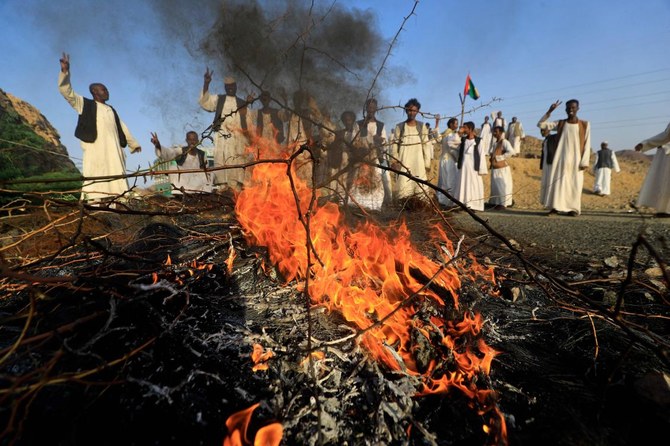
KHARTOUM: The US, UK and Norway on Friday urged Sudanese protesters who have shut down oil pipelines and the main port in the country’s east since mid-September to end their blockade.
The appeal came as the civilian-military government in Khartoum has warned that unrest has crippled Sudanese exports and imports of basic goods.
“The Troika (Norway, the United Kingdom and the United States) strongly supports the efforts of Sudan’s government to resolve protests in eastern Sudan,” a statement said.
But a prolonged blockage of roads, docks and the airport in east Sudan threaten to have “a serious impact on the country’s economy and the well-being of its citizens,” it said.
The Troika are guarantors of the 2005 peace agreement struck between Sudan and southern rebels ahead of South Sudan’s secession six years later.
On September 17, protesters objecting to parts of an October 2020 peace deal between the Khartoum government and a coalition of rebels blocked the country’s main container and oil export terminals in Port Sudan.
It crippled Sudan’s own exports and also blocked the 154,000 barrels of oil per day pumped from neighboring South Sudan — for which Khartoum earns lucrative transit fees that are an important source of revenue for the cash-strapped government.
The protesters in the east say the 2020 deal — orchestrated by a transitional government that came into being in 2019, following the ouster of veteran autocrat Omar Al-Bashir — overlooks them.
They agreed to allow South Sudanese oil exports to resume, but continued to block other key infrastructure in Port Sudan.
On Sunday, the Khartoum government said it was running out of life-saving medicine, fuel and wheat.
“The Troika joins with the civilian-led transitional government in calling for an end to the ongoing blockades of port and transportation infrastructure in eastern Sudan,” Friday’s statement read.
The Troika said it “fully recognizes the development challenges facing the people of eastern Sudan.”
But it called on protesters to engage in a political dialogue with the government and urged authorities in Khartoum to “intensify” efforts to resolve the issues that sparked the demonstrations.
Eastern Sudan is one of the country’s poorest regions, and residents have long complained of being marginalized politically and economically by the government.
Protesters have said they will keep on blocking infrastructure until their basic needs are met.
According to the demonstrators 60 percent of Sudan’s gold is mined in the east, which is also a crucial transit point for trade.
Beset by economic and security woes, the central government remains fragile.

UK, US, Norway urge end to east Sudan protests
https://arab.news/brssf
UK, US, Norway urge end to east Sudan protests
- Appeal came as government warns that unrest has crippled Sudanese exports and imports of basic goods
- The protesters in the east say the 2020 deal overlooks them
Israel’s ‘deliberate intention of preventing births among Palestinians’ meets ‘legal criteria of Genocide Convention’: Reports
- Births in Gaza fell by 41% during conflict as maternal deaths, miscarriages surged
- ‘The destruction of maternal care in Gaza reflects the deliberate infliction of conditions of life calculated to bring about the destruction of the Palestinian people, in whole or in part’
LONDON: Births in Gaza fell by 41 percent due to Israel’s war on the territory, with the conflict resulting in catastrophic numbers of maternal deaths, miscarriages and birth complications, two reports have found.
The data on pregnant women, babies and maternity care in the war-torn Palestinian enclave also revealed a surge in newborn mortality and premature births, The Guardian reported on Wednesday.
Dangerous wartime conditions and Israel’s systematic destruction of Gaza’s health systems were blamed for the alarming statistics.
The two reports were conducted by Physicians for Human Rights, in collaboration with the University of Chicago Law School’s Global Human Rights Clinic and Physicians for Human Rights — Israel.
Researchers highlighted Israel’s “deliberate intention of preventing births among Palestinians, meeting the legal criteria of the Genocide Convention.”
The reports build on earlier findings by PHR’s Israel branch. They place the testimonies of pregnant women and new mothers within the context of health data and field reports, which recorded “2,600 miscarriages, 220 pregnancy-related deaths, 1,460 premature births, over 1,700 underweight newborns, and over 2,500 infants requiring neonatal intensive care” between January and June 2025.
PHRI’s Lama Bakri, a psychologist and project manager, said: “These figures represent a shocking deterioration from pre-war ‘normalcy,’ and are the direct result of war trauma, starvation, displacement and the collapse of maternal healthcare.
“These conditions endanger both mothers and their unborn babies, newborns, and breastfed infants, and will have consequences for generations, permanently altering families.”
She added: “Beyond the numbers, what emerges in this report are the women themselves, their voices, choices and lived realities, confronting impossible dilemmas that statistics alone cannot fully capture.”
Maternal and newborn care in Gaza has been damaged by Israel’s destruction of health infrastructure, as well as fuel shortages, blocked medical supplies, mass displacement and relentless bombardment.
As a result, survival in Gaza’s overcrowded tent encampments has become the sole option for pregnant women and new mothers.
During the first six months of Israel’s war on the territory, more than 6,000 mothers were killed, at an average of two every hour, according to UN Women estimates.
It is also believed that about 150,000 pregnant women and new mothers have been forcibly displaced by the conflict.
In the first months of last year, just 17,000 births were recorded in Gaza, a 41 percent fall compared to the same period in 2022.
The researchers examined Israel’s apparent strategy to undermine Palestinian births, highlighting a targeted strike in December 2023 on the Al-Basma IVF clinic.
The attack on Gaza’s largest fertility center destroyed about 5,000 reproductive specimens and ended a pattern of 70-100 IVF procedures each month.
The strike was deliberately designed to target the reproductive potential of Palestinians, the Independent International Commission of Inquiry later found.
“Reproductive violence constitutes a violation under international law; when carried out systematically and with them intent to destroy, it falls within the definition of genocide of the Genocide Convention,” the reports said.
“The destruction of maternal care in Gaza reflects the deliberate infliction of conditions of life calculated to bring about the destruction of the Palestinian people, in whole or in part.”


