Sudan running out of essential medicine, fuel and wheat due to port blockade

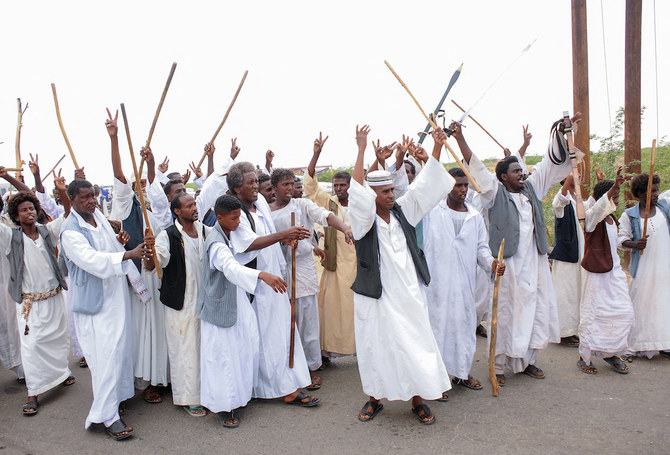
Supporters of Sudan’s head of the Supreme Council of Beja Prefectures and Independent Umudiyyahs rally in the city of Port Sudan, on Sept. 26, 2021. (AFP)
Short Url
Updated 03 October 2021
Follow

Sudan running out of essential medicine, fuel and wheat due to port blockade

  • Protesters from the Beja tribes in eastern Sudan have been blocking roads and forcing Red Sea ports to close in recent weeks.
  • They are demonstrating against what they say is lack of political power and poor economic conditions in the region

CAIRO: Sudan is about to run out of essential medicine, fuel and wheat after political protests forced the closure of Port Sudan, the main port in the east of the country, the cabinet said on Sunday.
Members of eastern Sudan’s Beja tribes have blocked roads and forced Red Sea ports to close in recent weeks in protest at what they say is the region’s lack of political power and poor economic conditions there.
The cabinet acknowledged eastern Sudan’s “just cause” and stressed the right to peaceful protest, but warned that the closure of Port Sudan and highways connecting the east with the rest of the country was “harming the interests of all Sudanese.”
In a statement, it pledged to work on a political solution to the problems of eastern Sudan and called on the protesters to start a dialogue with the government.
The demonstrators agreed last month to allow the resumption of exports of crude oil from landlocked South Sudan via a terminal on the Red Sea.
They had also forced the closure of a pipeline that carries imported crude to the capital Khartoum.


Lebanese government imposes immediate ban on Hezbollah’s military activities

Updated 5 sec ago
Follow

Lebanese government imposes immediate ban on Hezbollah’s military activities


BERUIT: Lebanon's government said Hezbollah’s overnight attack against Israel were “illegal” and imposed an immediate ban on the group’s military activities, while also demanding its hand over its weapons.

Lebanese Prime Minister Nawaf Salam said only the state could decide whether to go to war and called on the Lebanese military to prevent the firing of projectiles and detain anyone involved.

The move comes after Iran-backed Hezbollah launched rockets at Israel, provoking retaliatory Israeli strikes. The government convened for five hours and 15 minutes in an early morning meeting on Monday before reaching its decision.

The Lebanese cabinet meeting, chaired by President Joseph Aoun, started at 8am with ministers discussing the repercussions Hezbollah's launching of missiles from southern Lebanon into Israel and the Israeli attacks on Lebanon.

Sources initially told Arab News that ministers were “pushing for a decisive response to Hezbollah’s recklessness, regardless of the consequences.”

Lebanese MP Melhem Khalaf said the priority was to “shelter people that are evacuating their homes in relatively safe places. What happened at dawn on Monday has taken us from one stage to another, and we don't know where they've taken us.”

As US-Israeli attacks on Iran continued, Hezbollah said it fired missiles from Lebanon into Israel early Monday in response to the killing of Iranian Supreme Leader Ali Khamenei and “repeated Israeli aggressions.”

There were no reports of injuries or damage, and Israel said it had intercepted one projectile, while several fell in open areas.

Israel retaliated with strikes on Lebanon, killing at least 31 people and wounding 149 others, according to Lebanon's Health Ministry. Around two thirds of the dead were in the south of the country.

Lebanon’s government said it was holding an emergency meeting after Hezbollah’s attack triggered the Israeli airstrikes.

Iran has been firing missiles at Israel and Arab states in a counter-offensive since the joint America-Israeli attack Saturday that killed Khamenei and other top Iranian officials. The war has quickly expanded to proxy forces, including Hezbollah firing out of Lebanon.

MP Bilal Abdullah told Arab News: “All the appeals issued by officials in Lebanon not to embroil us in this destructive war seem to have been in vain. We were supposed to protect Lebanon.

“Whoever launched the missiles and drones from Lebanon has slaughtered Lebanon. Displacing people is a major tragedy. We are in the winter season, and the cold is severe.”