President Alvi in UAE today, will officially launch Pakistan Pavilion at Expo Dubai

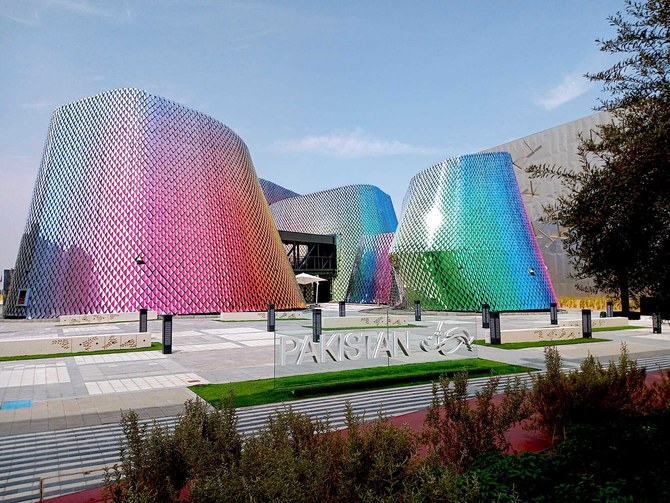
Exterior view of Pakistan pavilion inside the Expo 2020 arena in Dubai on October 2, 2021. (Courtesy Pakistan Pavilion)
Short Url
Updated 09 October 2021
Follow

President Alvi in UAE today, will officially launch Pakistan Pavilion at Expo Dubai

  • Exhibitors from almost 200 countries are participating in Expo with aim to boost trade and investment
  • President will also meet investors, entrepreneurs, companies and Pakistani community in UAE

ISLAMABAD: Pakistani President Dr. Arif Alvi will be undertaking a visit to the United Arab Emirates from October 9-10 during which he will meet UAE dignitaries and formally inaugurate the Pakistan Pavilion at Expo 2020 Dubai.
The Expo is the first world fair to be held in the Middle East, and Dubai, the region’s tourism, trade and business hub, is hoping to boost its economy by attracting 25 million business and tourist visits to the exhibition, which has been built from scratch on 4.3 sq km (1.7 sq mile) of desert at a cost of around $6.8 billion.
Exhibitors from almost 200 countries are participating, with many countries and companies including from Pakistan looking to the Expo — the first major global event open to visitors since the coronavirus pandemic — to boost trade and investment.
The Expo started on October 1 and will last till March 31, 2022.
“Pakistan Pavilion in the Expo 2020 is located at one of the prime areas of the Expo site, and is considered the largest Pavilion of Pakistan outside the country,” the ministry of foreign affairs said, while announcing the president’s upcoming visit to the UAE. “The Pavilion, with the theme “Hidden Treasure”, showcases the unexplored and undiscovered riches of Pakistan.”
The statement said other than officially launching the Pavilion, the president would meet leading businessmen, investors, entrepreneurs, senior representatives of IT companies and media, and also interact with members of the Pakistani community living and working in the UAE.
The visit coincides with the 50 years of the establishment of diplomatic relations between Pakistan and the UAE.


Pakistan reaffirms commitment to clamp down on informal sector to encourage investment

Updated 6 sec ago
Follow

Pakistan reaffirms commitment to clamp down on informal sector to encourage investment

  • Nestlé delegation briefs Finance Minister Muhammad Aurangzeb on localization, efficiency enhancements in Pakistan
  • Improved compliance, transparency, strengthened tax ecosystem central to economic recovery, stresses finance minister

KARACHI: Pakistan’s Finance Minister Muhammad Aurangzeb reaffirmed the government’s commitment to clamp down on the informal sector on Monday, the Finance Division said, citing transparency and a strengthened tax ecosystem as central to the country’s economic recovery. 

Pakistan’s government has cracked down on smuggled items and tightened enforcement in poorly taxed sectors, such as tobacco, in recent months as it pushes ahead with its efforts to maximize tax collection by discouraging the formal sector. Informal sector comprises businesses that operate outside the tax net, avoid registration and as a result, neglect regulatory oversight and violate quality, safety or labor standards. 

Aurangzeb met a delegation from Nestlé Pakistan at the Finance Division, where the two sides discussed the multinational’s efforts to strengthen its operations in the country through localization, portfolio adjustments and efficiency enhancements. 

“Emphasizing the government’s resolve to clamp down on the informal sector, an effort that has already begun yielding visible results in multiple industries, the finance minister noted that improved compliance, transparency and a strengthened tax ecosystem are central to Pakistan’s economic recovery,” the Finance Division said in a statement. 

Nestlé Pakistan Chief Executive Officer Jason Avancena provided an overview of the organization’s operations, claiming it had strengthened them through localization, portfolio adjustments, advanced automation, efficiency enhancements and continued innovation across product categories. 

Avancena said Nestlé is implementing solar and biomass energy systems, digital dashboards, environmentally improved packaging, and supply-chain automation in Pakistan. The delegation highlighted that Nestlé’s localization efforts have materially strengthened its resilience. 

“They noted that through sustained efforts to localize raw materials and reconfigure product portfolios, Nestlé Pakistan has reduced its import volumes by nearly half over the past three years from around $150 million to approximately $76–80 million, thereby minimizing exposure to foreign-exchange pressures and deepening integration with Pakistan’s agricultural and manufacturing base,” the Finance Division said. 

Aurangzeb commended the multinational for its efforts and underscored the government’s intention to facilitate greater formalization and enhanced tax equity across the food and beverages sector. He noted that informal players have “rapidly expanded” their market share by operating outside the tax net in sectors such as food and beverages. 

The delegation also discussed export performance, including the company’s presence in markets such as the United States, Canada, the Gulf, and the United Kingdom, sharing insights into challenges related to regional trade, particularly the Afghanistan corridor. 

Aurangzeb advised Nestlé to explore logistics partnerships to expand access to Central Asian markets, reiterating that Islamabad remains committed to enabling export-oriented industry growth.