Egypt, Tunisia agree on Libya recovery strategy

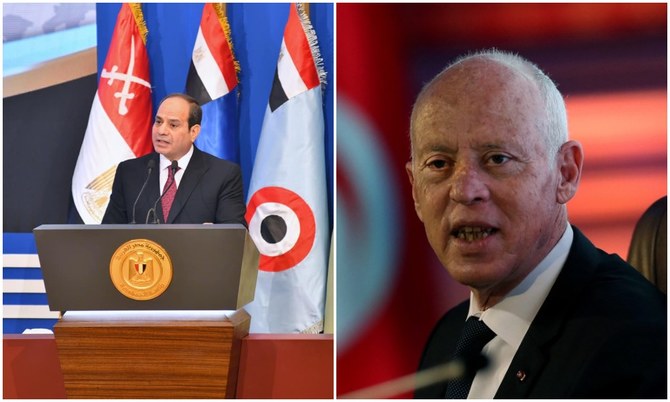
Egypt and Tunisia have agreed to a UN-supported plan on Libya that would see the withdrawal of foreign forces and the holding of elections in the country by the end of the year. (File/AFP/Spokesman of the Egyptian Presidency)
Short Url
Updated 07 October 2021
Follow

Egypt, Tunisia agree on Libya recovery strategy

  • A statement stressed the desire of both Egypt and Tunisia to end the crisis in Libya
  • El-Sisi also expressed Egypt’s support for the measures and efforts of the Tunisian president aimed at building a better future for the Tunisian people

CAIRO: Egypt and Tunisia have agreed to a UN-supported plan on Libya that would see the withdrawal of foreign forces and the holding of elections in the country by the end of the year.

A statement by the Egyptian presidency said that President Abdel Fattah El-Sisi had made a phone call to his Tunisian counterpart, Kais Saied, in which the two sides agreed on the need to intensify coordination in the Libyan crisis.

The statement stressed the desire of both sides to end the crisis in a way that paves the way for the return of security, stability and sovereignty to Libya.

As part of the agreement, presidential and parliamentary elections will be held on a scheduled date at the end of the year, in compliance with a road map agreed upon by Libyan parties.

El-Sisi also expressed Egypt’s support for the measures and efforts of the Tunisian president aimed at building a better future for the Tunisian people and achieving stability in the country.

Egyptian presidential spokesman Bassam Rady said that the call dealt with “visions regarding a number of regional files of common interest, especially the Libyan crisis.”

According to a statement by the Tunisian presidency, Saied and El-Sisi’s conversation “represented an opportunity to review the strong and distinguished brotherly relations that exist between the two countries and to emphasize the common determination to diversify and strengthen them.”

During the call, Saied also congratulated El-Sisi on the anniversary of the October War. The Tunisian president added that during the war, the Egyptian army achieved an “unprecedented victory and a military miracle by all standards, by being able, within hours, to cross the Suez Canal and cross the Bar Lev Line.”

Saied expressed his thanks to the Egyptian president for the “air bridge which he authorized to support Tunisia’s efforts in confronting the COVID-19 pandemic, which further consolidated the bonds of solidarity between the two brotherly peoples.”

Libya is awaiting parliamentary and presidential elections on Dec. 24, based on the road map approved by the Libyan Political Dialogue Forum with the support of the UN.


Hundreds mourn in Syria’s Homs after deadly mosque bombing

Updated 27 December 2025
Follow

Hundreds mourn in Syria’s Homs after deadly mosque bombing

  • Officials have said the preliminary investigations indicate explosive devices were planted inside the mosque but have not yet publicly identified a suspect

HOMS: Hundreds of mourners gathered Saturday despite rain and cold outside of a mosque in the Syrian city of Homs where a bombing the day before killed eight people and wounded 18.
The crowd gathered next to the Imam Ali ibn Abi Talib Mosque in the Wadi Al-Dhahab neighborhood, where the population is predominantly from the Alawite minority, before driving in convoys to bury the victims.
Officials have said the preliminary investigations indicate explosive devices were planted inside the mosque but have not yet publicly identified a suspect.
A little-known group calling itself Saraya Ansar Al-Sunna claimed responsibility for the attack in a statement posted on its Telegram channel, in which it indicated that the attack intended to target members of the Alawite sect, an offshoot of Shia Islam whom hard-line Islamists consider to be apostates.
The same group had previously claimed a suicide attack in June in which a gunman opened fire and then detonated an explosive vest inside a Greek Orthodox church in Dweil’a, on the outskirts of Damascus, killing 25 people as worshippers prayed on a Sunday.
A neighbor of the mosque, who asked to be identified only by the honorific Abu Ahmad (“father of Ahmad“) out of security concerns, said he was at home when he heard the sound of a “very very strong explosion.”
He and other neighbors went to the mosque and saw terrified people running out of it, he said. They entered and began trying to help the wounded, amid blood and scattered body parts on the floor.
While the neighborhood is primarily Alawite, he said the mosque had always been open to members of all sects to pray.
“It’s the house of God,” he said. “The mosque’s door is open to everyone. No one ever asked questions. Whoever wants to enter can enter.”
Mourners were unable to enter the mosque to pray Saturday because the crime scene remained cordoned off, so they prayed outside.
Some then marched through the streets chanting “Ya Ali,” in reference to the Prophet Muhammad’s cousin and son-in-law whom Shiite Muslims consider to be his rightful successor.