

TikTok announces new updates during first TikTok World event

TikTok hosted its first global virtual event, TikTok World, at the end of last month, which celebrated creators and brands. (Supplied)
Short Url
Updated 06 October 2021
Follow

TikTok announces new updates during first TikTok World event

  • Platform introduces new branding, creative and commerce solutions during inaugural event

DUBAI: TikTok hosted its first global virtual event, TikTok World, at the end of last month. The event celebrated creators and brands and announced new tools and solutions to help marketers better connect with their audiences.

President of Global Business Solutions at TikTok Blake Chandlee said during the event that TikTok became the most downloaded app in the world in the last year.

Creators on the platform have produced a “whole new form of communication that’s refreshing, impactful and entertaining, and they’re surrounded by a community that’s changing culture at large,” he said. The cultural shift was evident at the Tokyo Olympics earlier this year when TikTok was the “human social platform,” he added.

When brands join TikTok, they are encouraged to think like marketers and act like creators — especially with 44 percent of users saying they want branded content on the platform to be “fun.” During the event, TikTok made a case for why brands need to be on the platform by citing data showing that 92 percent of users take action after watching a video and 70 percent say TikTok ads are enjoyable.

FASTFACTS

* 46 percent watch TikTok without distractions

* 61 percent say videos on TikTok are more unique than on any other platform

* 70 percent say TikTok ads are enjoyable

* 92 percent take action after watching a video

* 44 percent want branded content to be fun

“TikTok has become one the most beloved platforms by defining a new form of entertainment for huge global audiences. This has massive implications for advertisers, which has shaped our journey so far and will keep guiding our vision for the future,” said Ray Cao, managing director, global head of product strategy and operations.

To further help brands, TikTok announced the following solutions:

TikTok Creator Marketplace, a self-serve portal that allows brands to find a variety of creators to partner with.

TikTok Creator Marketplace API, which enables access to TikTok first-party marketplace data for creator marketing experts — including Whalar, Influential, and Captiv8 — to provide brands with white-glove services to help manage the entire end-to-end process of creator marketing on TikTok.

Open Application Campaigns, which means brands can post campaign briefs to creators across TikTok Creator Marketplace so that they can self-apply and participate.

Branded Content Toggle, a tool that allows creators to mark videos and disclose commercial content.

Customized Instant Page, which is a landing page that loads 11 times faster than standard mobile pages and can be directly created by brands.

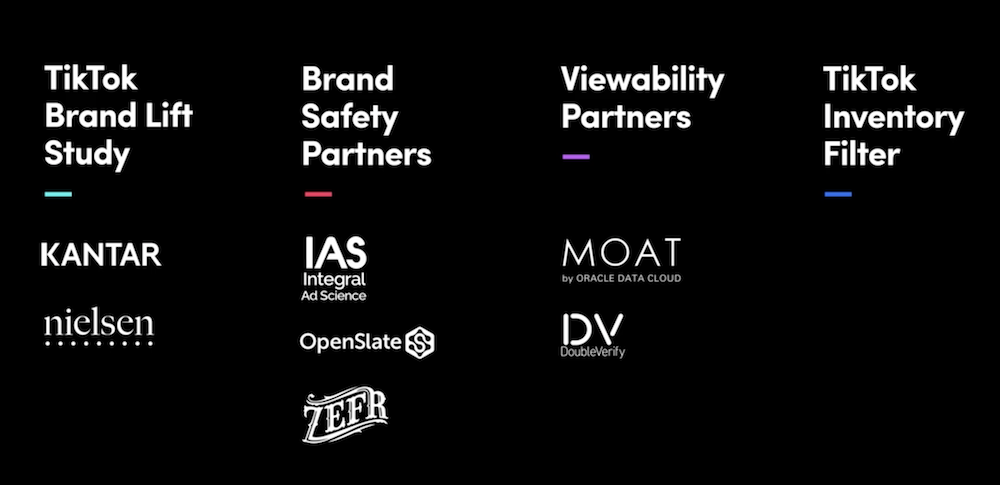
Additionally, TikTok also shared measurements and tracking tools such as the Brand Lift Study, in partnership with research consultancies Kantar and Nielsen; ad viewability in partnership with MOAT and DoubleVerify; and an inventory filter that allows advertisers to decide which inventory they want to place their ads next to.
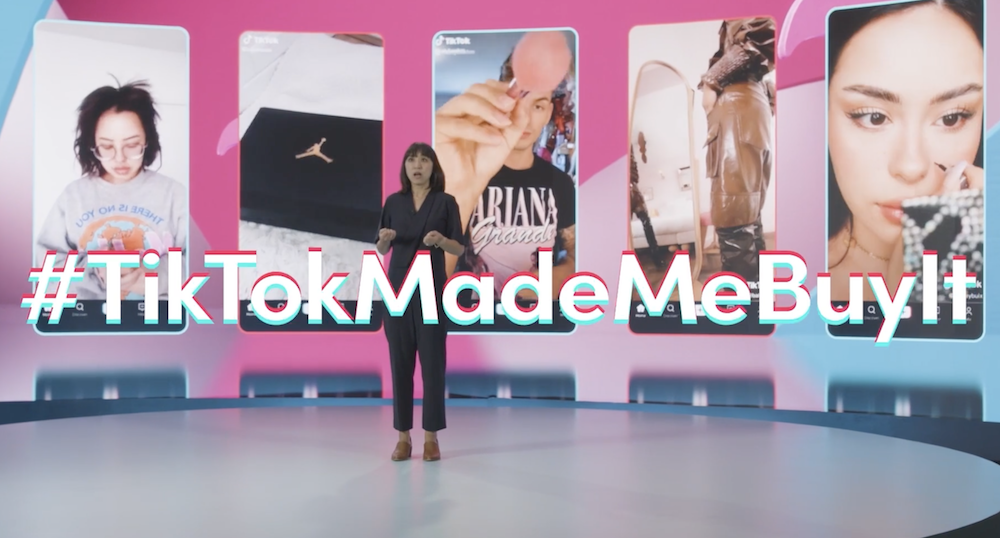
Lastly, the platform announced TikTok Shopping. “Over the years, we have seen the platform evolve into a place to shop and tell,” said Tao Baecklund, director of product management. Users on the platforms like to share specifics on what they’re buying and make recommendations to their audiences — a behavior that emerged organically, explained Baecklund. In fact, the trend led to the hashtag #TikTokMadeMeBuyIt, and videos with this hashtag have amassed 4.6 billion views in 2021.
TikTok Shopping will allow first-party integration, providing brands with an end-to-end commerce experience from uploading products to managing payment and shipping directly from the platform. It will also allow third-party integration from e-commerce partners such as Shopify and Square.

In addition to the new announcements, the event also celebrated creators, artists, small-to-medium businesses, and brands that succeeded on the platform.

“We have witnessed time and time again the important role that brands play in the TikTok experience. We’ve also seen how our community enjoys engaging with the brands they love. So when businesses of all sizes come to TikTok, we're excited to help them connect with their community, market their products, and build their brand in a way they can't do anywhere else,” said Chandlee.


Disinformation the new enemy in disaster zones, says Red Cross

Updated 05 March 2026
Follow

Disinformation the new enemy in disaster zones, says Red Cross

  • “Harmful information and dehumanizing narratives” undermines humanitarian aid and putting lives of aid workers at risk
  • Between 2020 and 2024, disasters affected nearly 700 million people, displaced over 105 million, and killed more than 270,000 — doubling the number in need of humanitarian aid

GENEVA: The rise of disinformation is undermining humanitarian aid and putting lives at risk, while disasters are affecting ever more people, the Red Cross warned Thursday.
“Between 2020 and 2024, disasters affected nearly 700 million people, caused more than 105 million displacements, and claimed over 270,000 lives,” the International Federation of Red Cross and Red Crescent Societies said.
The number of people needing humanitarian assistance more than doubled in the same timeframe, the IFRC said in its World Disasters Report 2026.
But the world’s largest humanitarian network said that “harmful information and dehumanizing narratives” were increasingly undermining trust, putting the lives of aid workers at risk.
“In polarized and politically-charged contexts, humanitarian principles such as neutrality and impartiality are increasingly misunderstood, misrepresented or deliberately attacked online,” it said.
The IFRC has more than 17 million volunteers across more than 191 countries.
“In every crisis I have witnessed, information is as essential as food, water and shelter,” said the Geneva-based federation’s secretary general Jagan Chapagain.
“But when information is false, misleading or deliberately manipulated, it can deepen fear, obstruct humanitarian access and cost lives.”
He said harmful information was not a new phenomenon, but it was now moving “with unprecedented speed and reach.”
Chapagain said digital platforms were proving “fertile ground for lies.”
The IFRC report said the challenge nowadays was no longer about the availability of information but its reliability, noting that the production and spread of disinformation was easily amplified by artificial intelligence.

- ‘Life and death’ -

The report cited numerous recent examples of harmful information hampering crisis response.
During the 2024 floods in Valencia, false narratives online accused the Spanish Red Cross of diverting aid to migrants, which in turn fueled “xenophobic attacks on volunteers,” the IFRC said.
In South Sudan, rumors that humanitarian agencies were distributing poisoned food “caused people to avoid life-saving aid” and led to threats against Red Cross staff.
In Lebanon, false claims that volunteers were spreading Covid-19, favoring certain groups with aid and providing unsafe cholera vaccines eroded trust and endangered vulnerable communities, the IFRC said.
And in Bangladesh, during political unrest, volunteers faced “widespread accusations of inaction and political alignment,” leading to harassment and reputational damage, it added.
Similar events were registered by the IFRC in Sudan, Myanmar, Peru, the United States, New Zealand, Canada, Kenya and Bulgaria.
The report underlined that around 94 percent of disasters were handled by national authorities and local communities, without international interventions.
“However, while volunteers, local leaders and community media are often the most trusted messengers, they operate in increasingly hostile and polarized information environments,” the IFRC said.
The federation called on governments, tech firms, humanitarian agencies and local actors to recognize that reliable information “is a matter of life and death.”
“Without trust, people are less likely to prepare, seek help or follow life-saving guidance; with it, communities act together, absorb shocks and recover more effectively,” said Chapagain.
The organization urged technology platforms to prioritize authoritative information from trusted sources in crisis contexts, and transparently moderate harmful content.
And it said humanitarian agencies needed to make preparing to deal with disinformation “a core function” of their operations, with trained teams and analytics.