

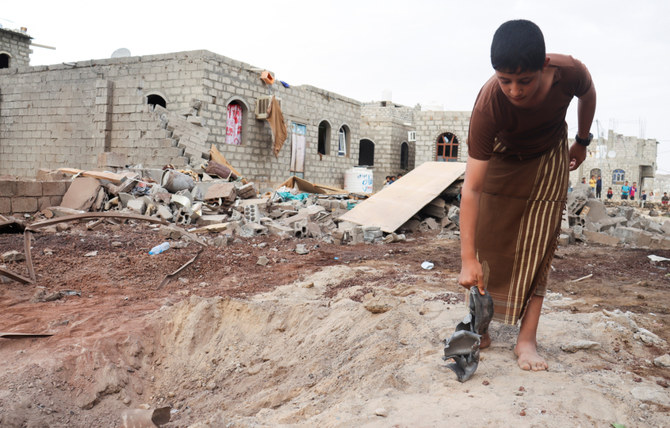

AL-MUKALLA: Yemeni government officials, local and international activists and rights groups and western diplomats on Monday strongly condemned the Houthi shelling of a residential area in the central city of Marib that killed and wounded more than three dozen civilians.
On Sunday, three ballistic missiles fired by the Iran-backed Houthis hit the city of Marib, killing two children and wounding more than 30 people.
One of the three missiles landed in a house in Al-Rawada neighborhood hosting thousands of internally displaced people, flattening the building and killing Ghazlan Faisal Al-Bareq and her brother Rada and critically wounding their parents.
The family comes from the northern province of Amran, sheltering in Marib like thousands of Yemenis who fled the fighting and Houthi repression.
Graphic images taken by local journalists show the headless and burnt Ghazlan lying in a bed in a local hospital in Marib, with several other badly wounded children crying as they receive medication.
The US embassy in Yemen strongly condemned the “terrible” attack by the Houthis and demanded the militias work on achieving peace in Yemen.
“The Houthis only confirm their savagery with such attacks. They must abandon this aggression against their fellow Yemenis and seek a peaceful resolution to the conflict,” Cathy Westley, charge d’affaires for the US embassy to Yemen, said in a brief statement.
Yemeni officials said that the latest deadly strike by the Houthis showed the rebels seeking to obstruct peace efforts to end the war, and vowed to punish them for murdering civilians.
Yemen’s Vice President Ali Mohsen Ahmer on Monday accused the Houthis of “indifferently” snubbing calls and diplomatic activities to put an end to the conflict in Yemen and intensifying their deadly strikes on heavily populated civilian areas.
“Day after day, the terrorist militias prove to the Yemeni people, the region and the world their disregard for the blood of Yemenis and their rejection of everything that would lead to ending the bloodshed,” the official news agency SABA quoted the vice president as saying.
Similarly, Yemeni human rights activists and local rights groups have turned to social media and local press to voice their anger over the shelling, calling for greater pressure on the Houthis and blasting the rebels for violating international laws.
“The international community, the UN, and the (UN Yemen) envoy’s office are more concerned than ever to intensify pressure on the Houthi militia to immediately stop launching any attacks on civilian objects,” said Mutahar Al-Badhiji, executive director of the Yemeni Coalition to Monitor Human Rights Violations.
Al-Badhiji told Arab News said that his organization has recorded the deaths of hundreds of civilians in Marib during the past seven years due to Houthi drone and missile strikes or land mines planted by the militia.
His organization said in a report released last week that land mines, missiles, explosive-laden and artillery rounds fired by the Houthis at central Marib had killed 440 civilians, including 61 children and 37 women, and wounded 914 civilians, including 124 children and 73 women, from December 2014 to June this year. During this period, the Houthis had fired 871 missiles, 119 projectiles and 44 exploding drones at 11 districts in Marib province.
“These are gross violations of human rights and international laws, and war crimes,” Al-Badhiji said.
International rights and aid organizations also expressed concerns about the growing number of civilian casualties during the conflict, urging warring factions to protect civilians.
“Alarming reports from Marib, Yemen, where an attack on a neighborhood killed 2 children, injuring dozens others. Warring parties are duty bound to protect civilians. We need an end to fighting in Marib and across all Yemen,” Jan Egeland, secretary-general of the Norwegian Refugee Council, said on Twitter.


