

Yemen government troops make new advances in Jouf province

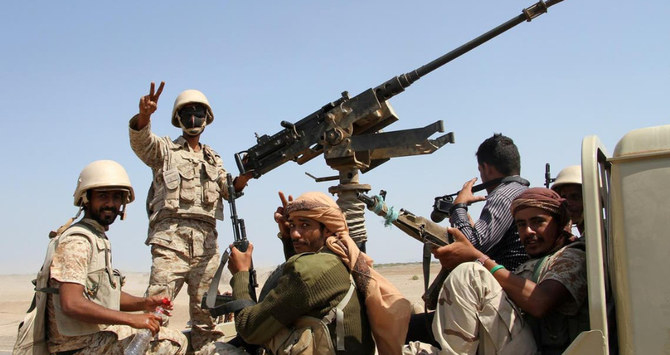
Yemeni army troops and allied tribesmen on Sunday seized control of new areas in the northern province of Jouf. (AFP/File)
Short Url
Updated 04 October 2021
Follow

Yemen government troops make new advances in Jouf province

  • Houthis abandon weapons after mountain, desert areas liberated in offensive

AL-MUKALLA: Yemeni army troops and allied tribesmen on Sunday seized control of new areas in the northern province of Jouf after heavy clashes with the Iran-backed Houthis, Yemen’s army spokesman told Arab News.

Brig. Gen. Abdu Abdullah Majili said that government troops, backed by air cover from the Arab coalition warplanes, liberated a number of locations, mountains and desert areas after a new offensive by the Houthis east of Jouf that began on Saturday.

“The national army has taken control of a large swath of land in Al-Jadafer, east of Al-Hazem, and inflicted heavy blows to the Houthis,” Majili said, adding that the Arab coalition warplanes carried out several air raids in support of government troops on the ground.

State media broadcast a video showing the government’s armed vehicles attacking Houthi locations in a desert area in Jouf and later retrieving weapons abandoned by the Houthis.

The Yemeni army has been advancing in the province for months with the aim of seizing control of strategic locations, including the Labenat military base, which fell to the Houthis last year.

Yemeni army officers said that Sunday’s gains would help the army cut off supply lines to the Houthis east of Hazem.

In the neighboring Marib province, local officials and residents told Arab News that a woman and two children were killed and 28 others wounded in Marib when a missile fired by the Houthis hit a residential area housing displaced people.

On Sunday, one of three missiles that hit Marib exploded in Al-Rawada district, destroying a house. 

Meanwhile, dozens of Houthis and government troops were killed in heavy clashes south and west of Marib province as the army pushed back Houthi attacks, Majili said.

The intense fighting on the ground is happening as coalition warplanes carry out dozens of airstrikes targeting Houthi military vehicles and key locations in Marib province.

Fighting in Aden’s Crater district subsided on Sunday after military forces loyal to the separatist Southern Transitional Council seized full control of the district following two nights of bloody clashes with a rival group.

Residents told Arab News on Sunday that security forces opened roads and set up checkpoints at the district’s entrances as businesses opened and people returned to the streets.

“The situation is calm now,” a resident who requested anonymity said.

Fighting broke out on Friday night between STC forces and a rival group commanded by Brig. Imam Al-Noubi, claiming the lives of at least five people, including a journalist, a local security official told Arab News on Sunday.

Images and videos circulating on social media show masked armed men, hiding in Crater’s narrow streets, exchanging gun and rocket fire with STC security forces.

Aden’s Security Committee earlier urged local residents to stay indoors as armed vehicles entered the district to restore peace and order.

Under the Riyadh Agreement designed to defuse tension in Aden between the STC and internationally recognized government, armed groups in Aden must be disarmed, united and merged into state security and military establishments.


Iraq’s parliament delays presidential vote

Updated 8 sec ago
Follow

Iraq’s parliament delays presidential vote

  • Iraq’s two main Kurdish parties, who ususally put forward a candidate for president, asked to postpone the vote
  • Once elected, the president will then have 15 days to appoint a prime minister
BAGHDAD: Iraq’s parliament postponed the election of the country’s president on Tuesday to allow Kurdish rivals time to agree on a candidate.
The parliament delayed the session, the official INA press agency reported, without saying whether a new date had been agreed.
The agency reported earlier that speaker Haibat Al-Halbussi received requests from Iraq’s two main Kurdish parties, the Kurdistan Democratic Party (KDP) and the Patriotic Union of Kurdistan (PUK), to postpone the vote to “allow both parties more time” to reach a deal.
By convention, a Shiite Muslim holds the powerful post of prime minister, the parliament speaker is a Sunni and the largely ceremonial presidency goes to a Kurd.
Under a tacit agreement between the two main Kurdish parties, a PUK member holds the Iraqi presidency, while the president and regional premier of the semi-autonomous Kurdish region is selected from the KDP.
But this time the KDP named its own candidate for Iraq’s presidency: Iraqi Foreign Minister Fuad Hussein.
Once elected, the president will then have 15 days to appoint a prime minister, expected to be former premier Nouri Al-Maliki.
On Saturday, the Coordination Framework, an alliance of Shiite parties with varying ties to Iran that holds a parliamentary majority, endorsed Maliki.
But his nomination appeared to stoke concern in Washington.
The 75-year-old shrewd politician is Iraq’s only two-term premier (2006-2014) since the 2003 US invasion.
Seen as close to Iran, Al-Maliki left power in 2014 following heated pressure from Washington.
US Secretary of State Marco Rubio warned on Sunday against a pro-Iranian government in Iraq.
An Iraqi source close to the Coordination Framework told AFP that Washington had conveyed that it “holds a negative view of previous governments led by former prime minister Maliki.”
In a letter, US representatives said that while the selection of the prime minister is an Iraqi decision, “the United States will make its own sovereign decisions regarding the next government in line with American interests.”
Another Iraqi source confirmed the letter, adding that the Shiite alliance had still moved forward with its choice, confident that Al-Maliki could allay Washington’s concerns.
Iraq has long been a proxy battleground between the US and Iran, with successive governments negotiating a delicate balance between the two foes.
Iraq’s new premier will be expected to address Washington’s longstanding demand that Baghdad disarm Tehran-backed factions, many of which are designated terrorist groups by the US.