

Efforts ongoing to resume the Renaissance Dam negotiations, says Egyptian minister

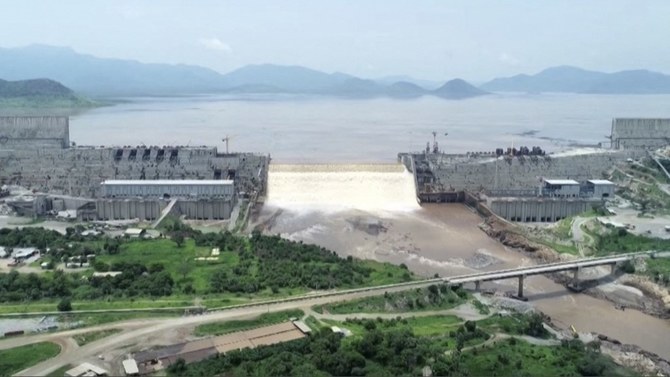
An aerial view of water levels at the Grand Ethiopian Renaissance Dam in Guba, Ethiopia. (File/AFP)
Short Url
Updated 02 October 2021
Follow

Efforts ongoing to resume the Renaissance Dam negotiations, says Egyptian minister

  • Ethiopia says the dam on its Blue Nile is crucial to its economic development and providing power to its population
  • Egypt views the dam as a grave threat to its Nile water supplies, on which it is almost entirely dependent

CAIRO: Egyptian Foreign Minister Sameh Shoukry said there was currently communication between the Democratic Republic of Congo and the three countries involved in negotiations about the Grand Ethiopian Renaissance Dam.

Ethiopia says the dam on its Blue Nile is crucial to its economic development and providing power to its population.

Egypt views the dam as a grave threat to its Nile water supplies, on which it is almost entirely dependent. Sudan, another downstream country, has expressed concern about the safety of the dam and the impact on its own dams and water stations.

Shoukry said his country was “always ready to engage in negotiations,” but stressed the importance of having a legal and binding agreement on filling and operating the dam’s reservoir based on the outcome of a UN Security Council session.

He described the council’s statement on the dam as a “great achievement” that came after a lot of hard work to reach a consensus between the body’s 14 member states, including its permanent members.

He said a DRC delegation had visited Egypt and expressed a number of ideas, and that there were currently high-level communications under the auspices of Congolese President Felix Tshisekedi.

“The goal is to reach a binding legal agreement on filling and operating the dam within a short, pre-announced period, and that there be an enhanced framework of observers assisting the African Union to provide solutions and proposals,” Shoukry said.

He also responded to statements from Ethiopian officials saying they would refuse to sign any binding agreement: “It is propaganda for Ethiopian consumption and a challenge to the international community. It proves that Egypt has flexibility as a responsible country and it casts shadows on the actions of the Ethiopian government. Egypt does not set pre-conditions for engaging in negotiations.”  

The minister explained that his country involved Ethiopia in “good faith,” but, after a long period of negotiations, both Egypt and Sudan felt these negotiations were “endless.”

“We place our trust in Tshisekedi that negotiations will resume in accordance with what was approved by the African Union office, as well as the outcomes of the presidential statement issued by the Security Council. If the Ethiopian side has the desire to reach an agreement, we are fully prepared. 

“If this intransigence continues, this does not indicate a comfortable situation and I predict more tension at the regional level. I have emphasised many times that the matter is related to preserving Egypt's water needs, and we have seen even after the first and the second filling that Egypt is taking measures that secure its needs and can continue to provide the required protection in different ways.”

The dam negotiations between Sudan, Ethiopia and Egypt have been suspended since the failure of the last round held in Kinshasa.

Over the course of previous rounds, Cairo and Khartoum insisted on reaching a binding agreement before the second filling, which Addis Ababa has already implemented.


Battle for the Nile
How will Egypt be impacted by Ethiopia filling its GERD reservoir ?

Enter


keywords


Sudan’s prime minister takes his peace plan to the UN, but US urges humanitarian truce now

Updated 23 December 2025
Follow

Sudan’s prime minister takes his peace plan to the UN, but US urges humanitarian truce now

  • Sudan’s prime minister is proposing a wide-ranging peace initiative to end a nearly 1,000-day war with a rival paramilitary force
  • It seems unlikely the RSF would support the proposal, which would essentially give government forces a victory and take away their military power

UNITED NATIONS: Sudan’s prime minister on Monday proposed a wide-ranging peace initiative to end a nearly 1,000-day war with a rival paramilitary force, but the United States urged both sides to accept the Trump administration’s call for an immediate humanitarian truce.
Kamil Idris, who heads Sudan’s transitional civilian government, told the Security Council his plan calls for a ceasefire monitored by the United Nations, African Union and Arab League, and the withdrawal of paramilitary forces from all areas they occupy, their placement in supervised camps and their disarmament.
Sudan plunged into chaos in April 2023 when a power struggle between the military and the powerful paramilitary Rapid Support Forces exploded into open fighting, with widespread mass killings and rapes, and ethnically motivated violence. This has amounted to war crimes and crimes against humanity, according to the UN and international rights groups.
It seemed highly unlikely the RSF would support the prime minister’s proposal, which would essentially give government forces a victory and take away their military power.
In an indirect reference to the truce supported by the US and key mediators Saudi Arabia, Egypt and the United Arab Emirates, known as the Quad, Idris stressed to the UN Security Council that the government’s proposal is “homemade — not imposed on us.”
In early November, the Rapid Support Forces agreed to a humanitarian truce. At that time, a Sudanese military official told The Associated Press the army welcomed the Quad’s proposal but would only agree to a truce when the RSF completely withdraws from civilian areas and gives up their weapons — key provisions in the plan Idris put forward on Monday.
Idris said unless the paramilitary forces were confined to camps, a truce had “no chance for success.” He challenged the 15 members of the Security Council to back his proposal.
“This initiative can mark the moment when Sudan steps back from the edge and the international community — You! You! — stood on the right side of history,” the Sudanese prime minister said. He said the council should “be remembered not as a witness to collapse, but as a partner in recovery.”
US deputy ambassador Jeffrey Bartos, who spoke to the council before Idris, said the Trump administration has offered a humanitarian truce as a way forward and “We urge both belligerents to accept this plan without preconditions immediately.”
Bartos said the Trump administration strongly condemns the horrific violence across Darfur and the Kordofan region — and the atrocities committed by both the Sudanese Armed Forces and the Rapid Support Forces, who must be held accountable.
UAE Ambassador Mohamed Abushahab, a member of the Quad, said there is an immediate opportunity to implement the humanitarian truce and get aid to Sudanese civilians in desperate need.
“Lessons of history and present realities make it clear that unilateral efforts by either of the warring parties are not sustainable and will only prolong the war,” he warned.
Abushahab said a humanitarian truce must be followed by a permanent ceasefire “and a pathway toward civilian rule independent of the warring parties.”
UN Assistant Secretary-General for political affairs Khaled Khiari reflected escalating council concerns about the Sudan war, which has been fueled by the continuing supply of increasingly sophisticated weapons.
He criticized unnamed countries that refuse to stop supplying weapons, and both government and paramilitary forces for remaining unwilling to compromise or de-escalate.
“While they were able to stop fighting to preserve oil revenues, they have so far failed to do the same to protect their population,” Khiari said. “The backers of both sides must use their influence to help stop the slaughter, not to cause further devastation.”
The devastating war in Sudan has killed more than 40,000 people according to UN figures, but aid groups say the true number could be many times higher. The conflict has created the world’s largest humanitarian crisis, with over 14 million people displaced, disease outbreaks and famine spreading in parts of the country.