

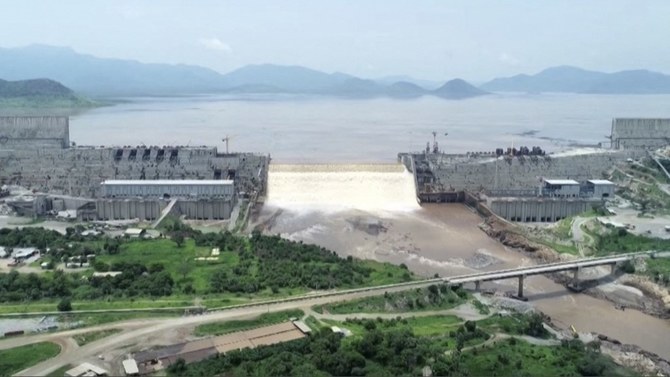

CAIRO: Egyptian Foreign Minister Sameh Shoukry said there was currently communication between the Democratic Republic of Congo and the three countries involved in negotiations about the Grand Ethiopian Renaissance Dam.
Ethiopia says the dam on its Blue Nile is crucial to its economic development and providing power to its population.
Egypt views the dam as a grave threat to its Nile water supplies, on which it is almost entirely dependent. Sudan, another downstream country, has expressed concern about the safety of the dam and the impact on its own dams and water stations.
Shoukry said his country was “always ready to engage in negotiations,” but stressed the importance of having a legal and binding agreement on filling and operating the dam’s reservoir based on the outcome of a UN Security Council session.
He described the council’s statement on the dam as a “great achievement” that came after a lot of hard work to reach a consensus between the body’s 14 member states, including its permanent members.
He said a DRC delegation had visited Egypt and expressed a number of ideas, and that there were currently high-level communications under the auspices of Congolese President Felix Tshisekedi.
“The goal is to reach a binding legal agreement on filling and operating the dam within a short, pre-announced period, and that there be an enhanced framework of observers assisting the African Union to provide solutions and proposals,” Shoukry said.
He also responded to statements from Ethiopian officials saying they would refuse to sign any binding agreement: “It is propaganda for Ethiopian consumption and a challenge to the international community. It proves that Egypt has flexibility as a responsible country and it casts shadows on the actions of the Ethiopian government. Egypt does not set pre-conditions for engaging in negotiations.”
The minister explained that his country involved Ethiopia in “good faith,” but, after a long period of negotiations, both Egypt and Sudan felt these negotiations were “endless.”
“We place our trust in Tshisekedi that negotiations will resume in accordance with what was approved by the African Union office, as well as the outcomes of the presidential statement issued by the Security Council. If the Ethiopian side has the desire to reach an agreement, we are fully prepared.
“If this intransigence continues, this does not indicate a comfortable situation and I predict more tension at the regional level. I have emphasised many times that the matter is related to preserving Egypt's water needs, and we have seen even after the first and the second filling that Egypt is taking measures that secure its needs and can continue to provide the required protection in different ways.”
The dam negotiations between Sudan, Ethiopia and Egypt have been suspended since the failure of the last round held in Kinshasa.
Over the course of previous rounds, Cairo and Khartoum insisted on reaching a binding agreement before the second filling, which Addis Ababa has already implemented.

keywords


