

Saudi Arabia predicts budget surpluses from 2023: Ministry of Finance

The Saudi government aims to continue economic and fiscal reforms it has implemented under Vision 2030. (Shutterstock)
Short Url
Updated 12 December 2021
Follow

Saudi Arabia predicts budget surpluses from 2023: Ministry of Finance

RIYADH: Saudi Arabia is forecasting budget surpluses from 2023 as the economy experiences a “noticeable and anticipated uptick,” the Ministry of Finance said on Thursday.

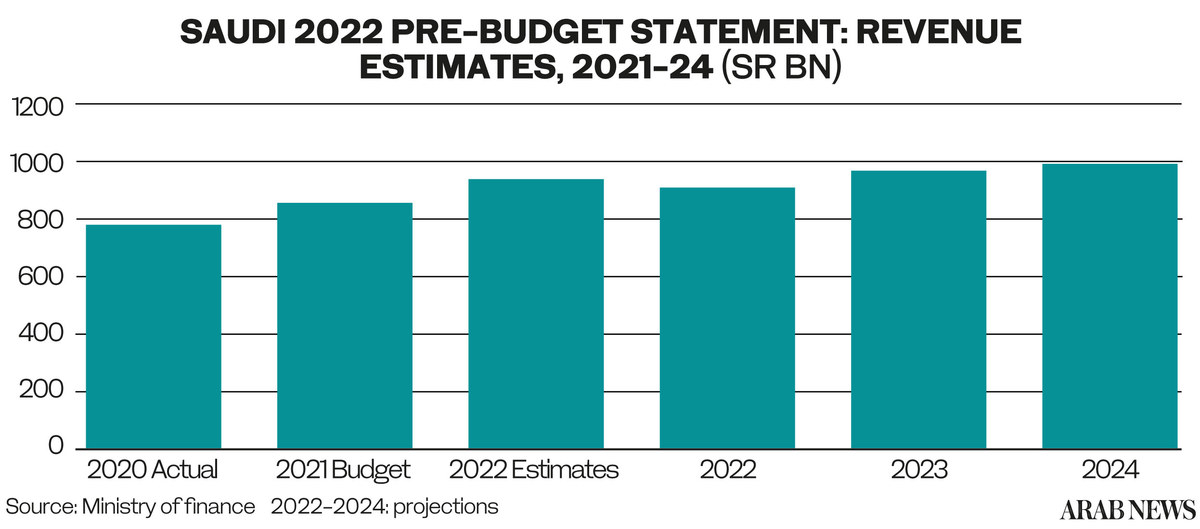
The Kingdom will post a surplus of about SR27 billion in 2023, rising to SR42 billion in 2024, the ministry said in a report. That compares with a projected deficit of SR85 billion in 2021 and SR52 billion in 2022.

Government revenue will slip to SR903 billion in 2022 from SR930 billion in 2021, but will have reached SR992 billion by 2024, the Ministry of Finance said.

The extra revenue will come from government initiatives and reforms aimed at enhancing and developing non-oil revenues as the pandemic diminishes.
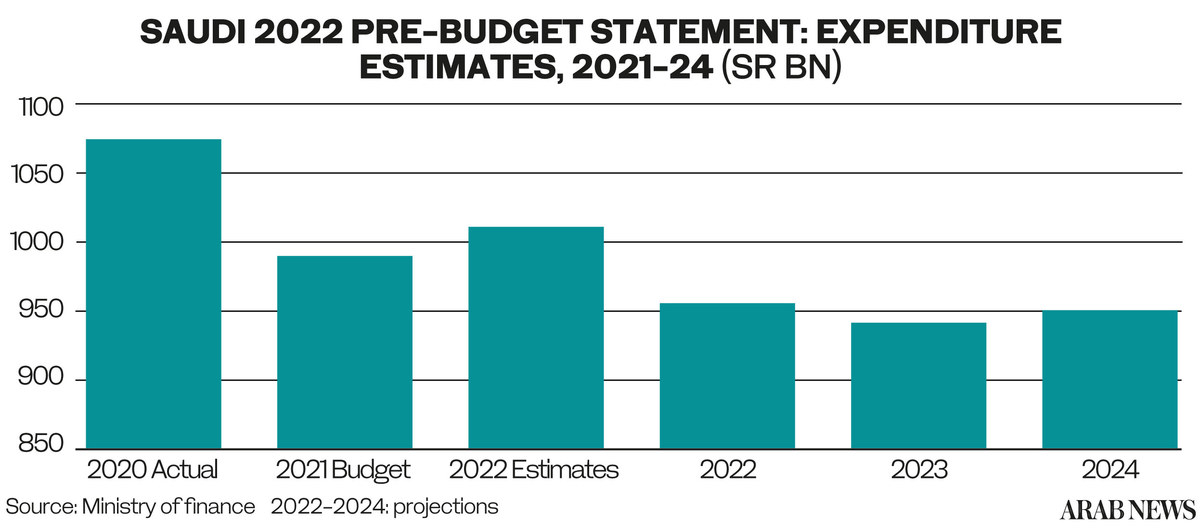
The government aims to sustain the spending ceilings approved last year for the medium-term, the ministry said. Expenditure is projected to reach approximately SR955 billion for fiscal year 2022 before falling to SR951 billion in fiscal year 2024.

The Saudi government aims to continue economic and fiscal reforms it has implemented under Vision 2030.

The annual borrowing plan is being prepared to meet funding needs within the framework of a medium-term debt strategy, through the coordination between the ministry and the National Debt Management Center.

Public debt is expected to reach SR989 billion by 2022, or 31.3 percent of GDP. The size of the public debt is anticipated to remain fixed in the medium-term whereas debt-to-GDP ratio is projected to decline 27.6 percent in fiscal year 2024.
While budget surpluses, projected to be realized starting in fiscal year 2023, are to be used to enhance government reserves, new debt issuances will be directed toward principal repayment, the MoF report said.

Government deposits at SAMA are expected to exceed initial projections in the fiscal year 2022, and to continue to grow due to expected surpluses in fiscal year 2023 and fiscal year 2024.

Saudi oil revenues are expected to reach SR545 billion by the end of 2021, while total state revenues could reach SR925 billion, according to Al-Rajhi Capital.

The investment bank based its estimates on Brent prices of $75 per barrel, with a Saudi average oil production of 9.1 million barrels per day, of which 6.2 million to be exported by the end of the year.

The bank's estimate for non-oil revenue is at SR380 billion, unchanged from an earlier forecast, and it is driven by the increase in VAT last year to 15 percent from 10 percent.


Real Estate Registry signs 10 agreements at forum in Riyadh

Updated 29 January 2026
Follow

Real Estate Registry signs 10 agreements at forum in Riyadh

RIYADH: The Real Estate Registry concluded its participation in the Real Estate Future 2026, as a partner of the forum, with a distinguished presence that included the launch of its business portal, the signing of 10 agreements and memoranda of understanding with entities from the public and private sectors, the organization of specialized workshops, and the awarding of the Gold Award at the Real Estate Excellence Awards.

During his participation in the forum, the CEO of the firm, Mohammed Al-Sulaiman, reviewed the latest developments in real estate registration in the Kingdom in a keynote speech, highlighting the pivotal role of the Real Estate Registry in building a unified and reliable system for data. He also announced the launch of the national blockchain infrastructure, which aims to enable the microcoding of real estate assets, enhance transparency, expand investment opportunities, and support innovative ownership models within a reliable regulatory framework.

On the sidelines of the forum, Al-Sulaiman met with Nigeria’s Minister of Housing and Urban Development, Ahmed Dangiwa. During the meeting, they discussed areas of joint cooperation, exchanged experiences and advice on shaping the future of the real estate sector, and reviewed best practices in implementing real estate registration systems that enhance reliability and improve the efficiency of property registration.
efficiency of property registration systems.

The Real Estate Registry’s participation included organizing three specialized workshops that focused on the role of geospatial technologies in identifying ownership, enhancing transparency, and improving the quality of real estate data. 

The workshop “Empowering the Real Estate Registry for the Business Sector” reviewed digital solutions that enable the business sector to manage its real estate assets more efficiently and enhance governance and technical integration. The workshop “From Off-Plan Sales to Title Deed” focused on the journey of documenting real estate ownership and the role of the registry in linking the stages of development and documentation within an integrated digital system.

On the sidelines of the forum, the Real Estate Registry signed 10 agreements and memorandums of understanding, including a deal with Yasmina Information Technology Co. to utilize real estate data in developing smarter insurance solutions that support the real estate sector and enhance service reliability. 

Partnerships were also signed with Haseel, NewTech, and Sahl, as well as HissaTech and Droub, to develop innovative digital solutions in property ownership, fractional ownership, and asset tokenization, as well as real estate finance and investment within a trusted regulatory framework.

Further collaborations included an MoU with ROSHN Group, an agreement with the Saudi Water Authority to enable data integration and quality enhancement, an agreement with the Saudi National Bank, and a partnership with Saudi Post to link the national address with the property registry as a unified geospatial identifier supporting data accuracy and integration.

The registry’s participation was crowned with the Golden Award at the Real Estate Excellence Awards in the category of Excellence in Property Documentation, in recognition of its role in building a model based on transparency, accuracy, and speed, as well as advanced digital technologies and specialized legal expertise, contributing to rights protection and increasing the sector’s attractiveness.

The Real Estate Registry emphasized that its participation reflects its continued role as a key enabler of the real estate sector, a trusted data source, and an active partner in driving digital transformation, enhancing market efficiency, and building investor and financier confidence, in line with Saudi Arabia’s Vision 2030 objectives for a fully integrated and sustainable digital real estate ecosystem.