PetroChina's Gulong shale project may bolster China's oil output

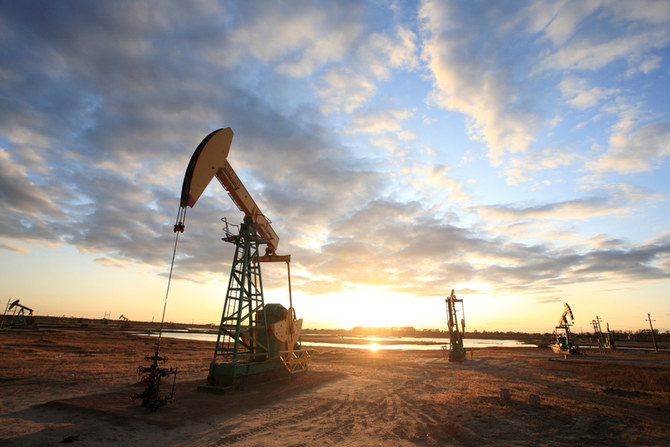
Daqing oil field pumpjacks, at sunset (Shutterstock)
Short Url
Updated 30 September 2021
Follow

PetroChina's Gulong shale project may bolster China's oil output

  • The state-run oil and gas producer aims to kick off production at its unconventional oil project in 2025
  • The oil major's plans would sustain Daqing's role as the top producing field as well as help arrest China's declining oil production

PetroChina will be spending billions of dollars to accelerate drilling of rare shale formations in northeast China that could be pivotal to sustaining oil output in the world's largest consumer.


The state-run oil and gas producer aims to kick off production at its unconventional oil project in 2025 and double its capacity by the end of this decade, company officials and analysts say.

If the pilot is successful, the technologies could be replicated elsewhere to unlock China's vast untapped shale reserves.


Gulong lies within the area of PetroChina's flagship Daqing field, China's biggest oilfield which has been pumping for over six decades but where output is diminishing.


The oil major's plans would sustain Daqing's role as the top producing field as well as help arrest China's declining oil production.


"With the breakthrough in Gulong China could hopefully develop its vast proven yet undeveloped resource," said Palzor Shenga, vice president of upstream research at Rystad Energy.


China produces only 35,000 barrels per day (bpd) of shale oil, less than 1 percent of total output. But Gulong is touted as a more prospective project.

Shenga added the firm was aiming for break-even cost below $55 a barrel.


Having outlined lower-carbon goals to fight climate change, Chinese state majors also need to balance long-term targets against Beijing's pre-occupation with energy security.


After over a decade of work, PetroChina said last month it aims to produce 20,000 bpd of shale oil in 2025 from Gulong, where it has proven geological reserves of more than 9 billion barrels.


He Wenyuan, Daqing's chief geologist, said PetroChina still faces tremendous challenges such as how to locate high-yielding oil flows faster and to extend its life span once a well reaches peak output.


"We're venturing into a 'no man's' zone in Gulong," he said.


Shell and BP were invited to study Gulong shale in 2019 and 2020, but the companies concluded there was no similar geology elsewhere that has been commercially viable, the geologist said.


Neither BP nor Shell responded to a request for comment.

Zhang Xianhui, researcher at consultancy Wood Mackenzie, said the Gulong find shows China still holds significant untapped oil resources, but in more challenging reservoirs.


"Despite the proven reserve figure, the level of commercial recovery is highly uncertain," Zhang said.


Closing Bell: Saudi main index rises to close at 11,251 

Updated 12 February 2026
Follow

Closing Bell: Saudi main index rises to close at 11,251 

RIYADH: Saudi Arabia’s Tadawul All Share Index rose on Thursday, gaining 84.27 points, or 0.75 percent, to close at 11,251.81. 

The total trading turnover of the benchmark index was SR5.38 billion ($1.43 billion), as 188 of the stocks advanced and 67 retreated.    

Similarly, the Kingdom’s parallel market Nomu gained 157.22 points, or 0.67 percent, to close at 23,643.74. This comes as 44 of the stocks advanced while 32 retreated.    

The MSCI Tadawul Index gained 10.88 points, or 0.72 percent, to close at 1,517.43.     

The best-performing stock of the day was Saudi Kayan Petrochemical Co., whose share price surged 9.96 percent to SR5.30.   

Other top performers included Ataa Educational Co., whose share price rose 9.94 percent to SR57.50, as well as Rabigh Refining and Petrochemical Co., whose share price surged 5.74 percent to SR7.55. 

Saudia Dairy and Foodstuff Co. recorded the most significant drop, falling 5.93 percent to SR220.50. 

Abdullah Saad Mohammed Abo Moati for Bookstores Co. also saw its stock prices fall 2.77 percent to SR43.56. 

Zahrat Al Waha for Trading Co. also saw its stock prices decline 2.30 percent to SR2.55. 

On the announcement front, Multi Business Group Co. reported its annual financial results for the year ended Dec. 31. According to a Tadawul statement, the firm recorded a net profit of SR352,172 during the year, down 98 percent from the previous year. 

The company attributed the decline primarily to a 2 percent drop in building contracting revenues and a 73 percent decrease in gross profit.  

Multi Business Group Co. ended the session at SR9.90, down 1 percent. 

Hamad Mohammed Bin Saedan Real Estate Co. announced the signing of a memorandum of understanding with Saudi Awwal Bank to enhance collaboration in financing solutions, advance real estate development projects, and expand access to customer financing programs. 

Hamad Mohammed Bin Saedan Real Estate Co. ended the session at SR6.67, up 1.21 percent.