COP26 climate talks ‘difficult’ without promised finance, says UN fund head

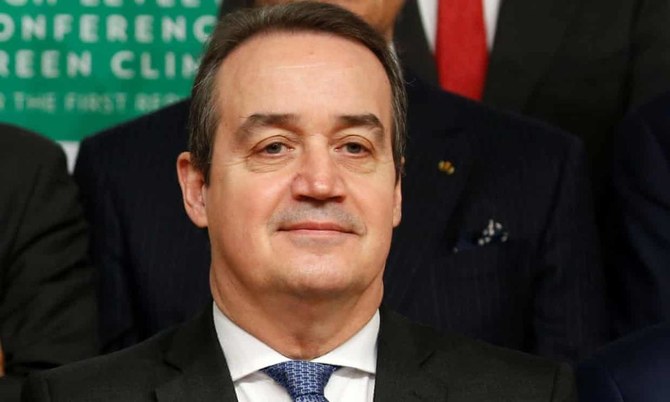
The call by Yannick Glemarec comes as about 50 climate ministers meet in Milan, Italy, on Thursday to hammer out details and tackle differences on the pace of green transition and who pays for it, ahead of the COP26 climate summit. (File/Reuters)
Short Url
Updated 30 September 2021
Follow

COP26 climate talks ‘difficult’ without promised finance, says UN fund head

  • COP26 talks, from Oct. 31-Nov. 12 in Scotland, have been billed as the last chance to galvanize the collective effort needed to limit global warming

KUALA LUMPUR: Rich countries must deliver on a promise to channel $100 billion a year in climate finance to developing nations, otherwise they may jeopardize November’s critical negotiations to limit global warming, said the head of the UN-backed Green Climate Fund.
The call by Yannick Glemarec comes as about 50 climate ministers meet in Milan, Italy, on Thursday to hammer out details and tackle differences on the pace of green transition and who pays for it, ahead of the COP26 climate summit.
Those talks, from Oct. 31-Nov. 12 in Scotland, have been billed as the last chance to galvanize the collective effort needed to limit global warming to 1.5 degrees Celsius above pre-industrial times, the lowest goal in the 2015 Paris Agreement.
But with a month to go, UN officials say they have yet to see ambitious enough action, including fulfilment of an overdue pledge to channel $100 billion a year from 2020 to help poorer nations adapt to global warming and adopt cleaner energy.
“The $100 billion is critical to catalyze much larger financial flows,” said Glemarec, the executive director of the multi-billion-dollar Green Climate Fund (GCF), speaking in an interview from its headquarters in South Korea.
“It’s also critical for establishing a climate of trust — you have no successful negotiation without trust,” he told the Thomson Reuters Foundation.
The GCF was set up under UN climate talks in 2010 as one of the main global funds to support developing-country efforts to tackle climate change, and started allocating money in 2015.
Glemarec said the latest figures — showing climate finance for vulnerable nations at just under $80 billion in 2019 — were a “disappointment” and could undermine the COP26 talks.
“It’s very difficult to trust parties when we have been telling you since Copenhagen COP15 (in 2009) that we will be mobilizing the $100 billion,” he said.
“So it’s really important to deliver on this commitment.”
US shortfall
The pre-COP26 summit in Milan this week is the last major UN meeting before negotiators head to Glasgow.
Thousands of young activists have converged on the Italian city to demand leaders match rhetoric with action and stump up the billions of dollars needed to wean the world off fossil fuels and onto cleaner energy, while adapting to a warmer world.
Glemarec said delivery of the $100 billion — some of which flows through the GCF — was important to ensure the fund has enough money in its coffers to disburse to developing countries.
The GCF board meets next week and will consider approving $1.2 billion for 13 new climate projects — from improving water security for communities in Kenya to enhancing early warning systems against floods and cyclones in East Timor.
If they all get the green light, the fund will have used up its available resources before COP26.
Glemarec joked that the GCF would have “just enough money in our bank account to pay for electricity bills” by the time he heads to the talks in Glasgow.
“If we want to be able to meet the needs of some developing countries, we need to be capitalized — and our capitalization comes from this $100 billion,” he stressed.
Securing a backlog of US contributions to the GCF, which were halted by former President Donald Trump, a climate-change skeptic, would be “significant,” Glemarec said.
The new Democratic US government has thrown its support behind the GCF again, with President Joe Biden requesting about $1.2 billion for the fund in the coming fiscal year’s budget, according to his climate envoy John Kerry in April.
But the Biden administration’s spending plans have hit a standstill in Congress.
“I will not venture a guess on what will be the final result but a stronger replenishment from the US will enable us to maintain a very ambitious level of programming in 2022 and (going) forward,” said Glemarec.


Future Minerals Forum launches global index to track critical mineral supply chains 

Updated 29 sec ago
Follow

Future Minerals Forum launches global index to track critical mineral supply chains 

RIYADH: The Future Minerals Forum on Jan. 12 launched the “Future Minerals Index Report,” a first-of-its-kind global tool designed to measure and track progress in developing critical mineral value chains across producing, exporting, and consuming countries.  

The initiative aims to support the creation of more resilient and responsible supply chains and promote sustainable development worldwide.  

Khalid Al-Mudaifer, vice minister of industry and mineral resources for mining affairs, stated: “The Future Minerals Index Report is an unprecedented and essential document; it is an intellectual tool that highlights key trends in the mining and minerals sector, particularly in terms of insights and directions from sector stakeholders, including government leaders, global mining executives, experts, and interested parties.”   

He pointed out that the report is distinguished by its tracking of developments in mineral supplies and its provision of actionable recommendations to ensure the sustainable development of critical mineral value chains. 

Al-Mudaifer described the report as a new international benchmark that establishes a comprehensive baseline to measure the progress of governments, companies, and investors in enhancing more resilient and responsible mineral supply chains.   

He said it provides a clear picture of how global critical mineral markets are shaped by capital, risk, and trust dynamics. “It shows where investment is growing or shrinking and identifies the widening gap between resource availability and capital allocation. Based on this baseline, the report will monitor changes in risk perceptions, investment flows, and progress toward more resilient mineral value chains.”  

Ali Al-Mutairi, general supervisor of the Future Minerals Forum, emphasized the report’s importance and the attention it received at the forum due to its role in highlighting global trends in the mining sector.   

He explained that the report was prepared in partnership with McKinsey & Co. and in collaboration with other sector experts, including S&P Global Market Intelligence, Global AI, and GlobeScan.  

“It integrates stakeholder trends, data, market insights, and intelligence into a single reference that supports global mining and mineral sector decision-making,” he said.  

Jeffrey Lorsch, partner at McKinsey & Co., commented: “The Future Minerals Index Report, by integrating market data, stakeholder perspectives, and value chain standards, provides a strategic roadmap to help companies navigate volatility and unlock long-term growth opportunities.”  

The report is based on the “Future Minerals Framework,” developed with contributions from 47 experts across multilateral organizations, non-profits, and private companies. It was first introduced at the 2025 International Ministerial Meeting.   

The framework outlines key enablers for end-to-end value chains, including supportive policies and regulations, innovative financing solutions to secure and manage investments, multimodal infrastructure such as roads, railways, and ports to reduce costs and increase viability, and sustainability through strong environmental and social governance frameworks.   

It also includes talent development through education, training, R&D, technological modernization via updated geological data systems and global expertise partnerships, and geology through reliable, accessible geological data in producing, exporting, and consuming countries as a critical factor in attracting investment.  

The report highlighted the world’s urgent need to sustain mineral supplies, featuring contributions from leading industry figures.  

Robert Friedland, founder of Ivanhoe Mines, Ivanhoe Electric, and I-Pulse, stated that the electrification of energy systems, digitalization of the economy, and the rapid growth of artificial intelligence are converging toward a future that increasingly depends on minerals.   

He stressed: “You can’t reduce emissions, build computing systems, or transport energy without mining.”  

Bob Wilt, CEO of Ma’aden, said in the report: “We are not fully prepared to deliver the minerals the world needs. Our biggest challenges are not equipment, capital, or technology — but people.”  

Duncan Wanblad, CEO of Anglo American, noted that global copper demand is expected to grow by 75 percent to reach 56 million tonnes annually by 2050. To meet this demand and offset declines from aging mines, the sector will need to open approximately 60 new mines the size of Quellaveco within the next decade alone.  

Gustavo Pimenta, CEO of Vale, said in his contribution: “I can’t imagine a future without mining — at least not a sustainable one that balances economic development with environmental protection and social responsibility. Mining has become essential to everything.”  

The release of the Future Minerals Index Report coincides with the upcoming fifth edition of the Future Minerals Forum, being held from Jan. 13 to 15, 2026, in Riyadh under the patronage of the Custodian of the Two Holy Mosques, King Salman bin Abdulaziz Al Saud. The event is held under the theme “Minerals: Facing the Challenges of a New Era of Development.”  

The forum will host a wide range of ministers and CEOs from leading global mining companies, reflecting its stature as a global platform in the mining sector and a key event showcasing Saudi Arabia’s leadership in shaping the future of minerals regionally and internationally.