

Saudi industry minister meets foreign officials ahead of Future Minerals Forum 2026

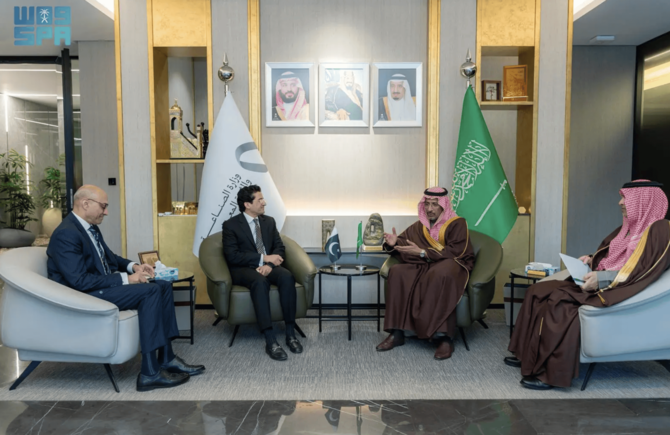
Saudi Arabia’s Minister of Industry and Mineral Resources Bandar Alkhorayef with Pakistan’s Minister of Petroleum Ali Pervaiz Malik. SPA
Short Url
Updated 13 January 2026
Follow

Saudi industry minister meets foreign officials ahead of Future Minerals Forum 2026

RIYADH: Saudi Arabia’s Minister of Industry and Mineral Resources Bandar Alkhorayef held a series of bilateral meetings at the department’s headquarters with ministers from several countries participating in the Future Minerals Forum 2026.

The meetings were also attended by the Deputy Minister for Mining Affairs Khalid Al-Mudaifer.

During his meeting with the Brazilian Minister of Mining and Energy Alexandre Silveira, Alkhorayef discussed ways to enhance cooperation between the two countries in the mining and minerals sector as well as highlighted the most prominent opportunities available for developing joint mining investments.

In a meeting with Pakistan’s Minister of Petroleum Ali Pervaiz Malik, he discussed expanding the horizons of strategic partnership in the mining sector between the Kingdom and Pakistan, particularly in the field of mineral industries related to enhancing food security.

The minister also met with Nigeria’s Minister of Solid Minerals Development Dele Alake as they discussed joint opportunities to develop cooperation and exchange technical expertise in the mining and manufacturing sectors, emphasizing the African country’s pivotal economic role in West Africa.

Alkhorayef also held talks with the Minister of Mines of the Democratic Republic of the Congo Louis Watum Kabamba to explore joint investment opportunities in the mining sector and ways to enable the private sector to capitalize on these opportunities, thereby strengthening supply chains for strategic minerals.

In a related development, the Saudi minister held a bilateral meeting with the World Health Organization Regional Director for the Eastern Mediterranean Hanan Balkhi during which they tackled cooperation between the Kingdom and the WHO in the manufacturing and supply chains of medicines and vaccines.

They also discussed ways to enhance global health security and solidifying the Kingdom’s position as a strategic partner of the WHO as well as a promising regional hub for the pharmaceutical industry.

Alkhorayef’s meetings with ministers preceded the fifth edition of the Future Minerals Forum, held from Jan. 13 to 15, in Riyadh.

The conference serves as a leading international platform for dialogue on the future of the global mining sector and for building effective partnerships between governments and the private sector, contributing to the growth and sustainability of the mining sector. It also reinforces Saudi Arabia’s position as a global hub for mining and minerals.


G7 countries to release oil reserves in global push to tackle Iran war energy price surge 

Updated 8 sec ago
Follow

G7 countries to release oil reserves in global push to tackle Iran war energy price surge 

  • IEA expected to recommend the largest oil reserve release in the agency’s history

RIYADH: Germany, the US, Japan and Austria will release part of their oil reserves after the International Energy Agency recommended the release of 400 million barrels of oil ‌from stockpiles, the largest ‌such move in IEA ​history.

Germany’s Economy ⁠Minister ​Katherina Reiche ⁠confirmed on Wednesday the government plans to limit petrol price increases at filling stations to once a day and to introduce more stringent antitrust regulation of the sector.

She did not ⁠give an exact timing for ‌those measures, but added that ‌the US and ​Japan would be the ‌largest contributors to the release of the ‌oil reserves.

The announcements did not stop oil prices rising, with Brent crude up 3.26 percent to $90.66 a barrel at 4:29 p.m Saudi time, and West Texas Intermediate up 3.12 percent to $86.05. Both were some way below the $119 a barrel seen earlier in the week.

“The situation regarding oil supplies is tense, as the Strait of Hormuz is currently virtually impassable,” Reiche said.

“We will comply with this request and ‌contribute our share, because Germany stands behind the IEA’s most important principle: mutual ⁠solidarity,” Reiche ⁠said about the IEA’s request.

According to a statement by Reiche’s ministry, Germany will contribute 2.64 million tonnes of oil. This corresponds to 19.51 million barrels.

Reiche stressed there was no supply shortage in the country, which has a legally mandated reserve of oil and oil products intended to cover 90 days’ demand.

The IEA’s move comes as countries are grappling with ​soaring crude prices amid ​the US-Israeli war with Iran. 

Austrian Economy Minister Wolfgang Hattmannsdorfer said his country was releasing part of the emergency oil reserve and extending the national strategic gas reserve, adding: “One thing is clear: in a crisis, there must be no crisis winners at the expense of commuters and businesses.”

Acting ahead of the IEA move, G7 ​member Japan announced plans to release 15 days' worth of ‌private-sector oil reserves and one month's worth of state oil reserves.

“Rather than wait for formal IEA approval ‌of a coordinated international reserve release, Japan will act first to ease global energy market supply and demand, releasing reserves as early as the 16th of this month,” Prime Minister Sanae Takaichi said in a broadcast statement.