

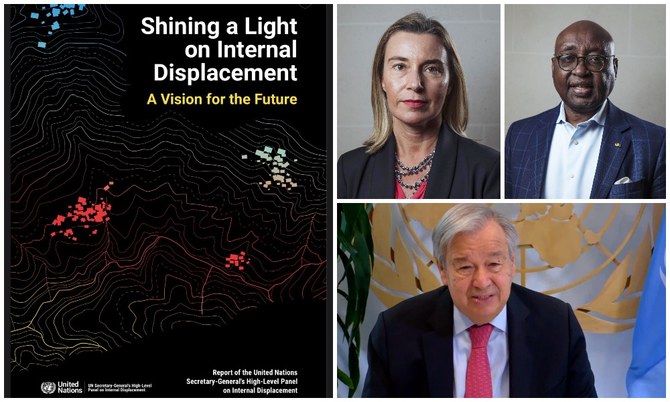

LONDON: Failure to act is no longer an option for the international community in response to the needs of millions of internally displaced people worldwide, according to a report by a high-level panel formally submitted to UN Secretary-General Antonio Guterres on Wednesday.
The study, which was handed over by panel co-chairs Donald Kaberuka and Federica Mogherini, calls for regionally and internationally driven solutions to the issues affecting more than 55 million people displaced within their own countries.
As he received the report, titled Shining a Light on Internal Displacement: A Vision for the Future, Guterres said that the problems faced by internally displaced people differ from those of the world’s 26 million refugees, and so different solutions are required. He highlighted the report’s mandate to make recommendations of achievable ways to better prevent, respond and develop solutions to the internal displacement crisis, and the need for new strategies and policies to do so.
“For several decades, the number of IDPs around the world has been growing, reaching record highs year after year,” he said. “Humanitarian assistance is vital to help them survive but more is needed to restore a sense of normalcy and provide solutions.”
The report urges governments and states to take a “development-oriented approach” to solutions for citizens and residents displaced by violence, conflicts, disasters and the effects of climate change.
Unlike refugees, Guterres said, IDPS remain citizens of their country with the same rights as non-displaced citizens, and that states therefore have a “responsibility” to address their plight.
Panel co-chair Kaberuka said: “It is in the best interest of governments to own this issue because they cannot achieve sustainable development goals without improving the lives of all IDPs, from displaced women and children to older persons.”
Mogherini added: “Given the current state of conflicts and trajectory of urbanization and climate change, the time to act is now. Maintaining the status quo is not an option.”
The panel was formed after 57 UN member states in May 2019 called on Guterres to establish an independent, high-level group to examine the global internal displacement crisis. The countries expressed concern that “international attention to internal displacement has been insufficient in comparison with the rising needs.”
The resultant report confirms and laments this “collective failure” to tackle internal displacement and includes a number of recommendations for action to bring about the shifts in approaches and practices that are required to end unnecessary suffering, one of which is for enhanced leadership from the UN.
The report also recommended the establishment of a Global Fund on Internal Displacement Solutions to help nations overcome key barriers to developing and implementing solutions.
Other key recommendations include:
- Make solutions a nationally owned, whole-of-government priority
- Political will is key and should be catalyzed
- Ensure the whole of society is invested in the issue
- Make better use of the capacities of the private sector when developing solutions
- Make the UN fit for purpose and accountable for solutions
- Harness international financing for solutions
- Enhance the effective use of internal displacement data
- Address the drivers of displacement and reduce displacement risks
- Strengthen the quality of protection and assistance provided to IDPs and their host communities
- Sustain momentum and ensure robust follow-up procedures


