

Yemen PM returns to Aden amid protests, plunging currency

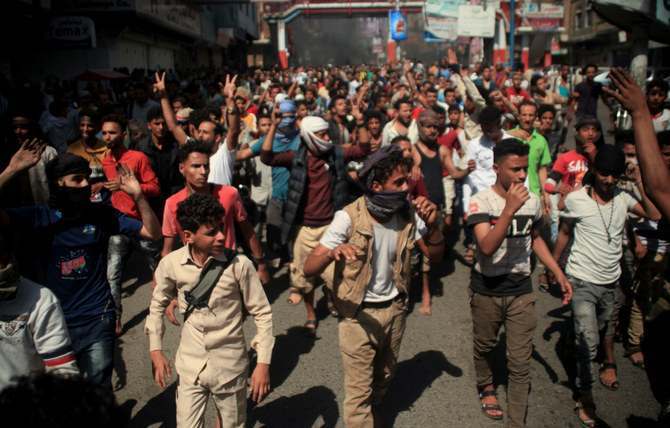
People demonstrate against the deteriorating economic situation and the devaluation of the local currency, in Taiz, Yemen September 27, 2021. (Reuters)
Short Url
Updated 28 September 2021
Follow

Yemen PM returns to Aden amid protests, plunging currency

  • Maeen Abdul Malik Saeed is back in the interim capital of Yemen to revive hopes of full implementation of the Riyadh Agreement
  • Dozens of Yemeni government troops and Houthis were killed over the past 24 hours as fighting rages in the provinces of Jouf and Marib

AL-MUKALLA: As Yemen’s prime minister touched down on Tuesday in the port city of Aden for the first time in months, thousands of Yemenis took to the streets of the southern city of Taiz and many other cities to protest against the country’s plunging currency and skyrocketing prices. 

Maeen Abdul Malik Saeed returned to Aden, the interim capital of Yemen, to revive hopes of quick and full implementation of the Riyadh Agreement and address the financial meltdown that has paralyzed the country. 

The prime minister and his cabinet left Aden in March after separatist protesters stormed the presidential palace.

For the second consecutive day, demonstrators marched around the densely populated Taiz carrying loaves of bread and posters. They demanded the government pay salaries and address the devaluation of the Yemeni riyal along with increasing prices of fuel and food. 

“I am hungry,” one protester shouted as security forces and armed vehicles were deployed outside key government facilities. Some protesters blocked roads and torched car tires. 

On Monday, at least five protesters were wounded when security forces fired live bullets to prevent protesters from blocking roads and disrupting traffic. 

The security committee in the city said it was safeguarding peaceful protests and warned against attacking private and public property. 

On Sept. 15, two protesters were killed during violent demonstrations over the economic meltdown and intensifying power cuts in Aden and Al-Mukalla. The protesters clashed with security forces, burnt garbage and tires, and stormed public facilities. 

The Yemeni riyal this week hit a record low against the dollar, trading at 1,200. The US dollar traded at 215 riyals in January 2015. 

In August, tough punitive measures by the Aden-based central bank against several currency-exchange firms that violated monetary rules helped the riyal recover by 10 percent, surging from 1,050 to 950. 

But the Yemeni riyal tumbled in the following weeks — breaking the historic 1,200 against the US dollar for the first time — as many firms have closed and banks in Houthi-controlled areas are being asked to relocate their operations to Aden.

On Tuesday, the central bank monitors inspected local exchange firms and shops, looking for violators of the bank’s rules. The banks also announced that the Bank of England had agreed to unfreeze its account, giving it access to millions of dollars.

At the same time, economists have warned that the deepening financial meltdown would exacerbate the already dire humanitarian crisis in Yemen and would fuel violence.  

Waled Al-Attas, an assistant professor of finance and banking sciences at Hadramout University, criticized the Yemeni government’s silence and late solutions to the continuing depreciation of the Yemeni riyal. 

“The state has given up doing the simplest things for the citizens and left them in the lurch,” he told Arab News. “This situation spells a real catastrophe as the plunging of the riyal continues and prices are going up. Salaries lost their values.”

During a brief visit to the southern city of Shabwa on Monday, the Yemeni premier attributed the fall of the riyal and the financial crisis in the country to the parallel Houthi economy and the movement’s military operations along with speculative activities by currency traders. 

“The economic situation is very difficult,” he said. 

Meanwhile, fighting has raged between Yemeni government troops and the Houthis over the past 24 hours in the province of Jouf and the central province of Marib. Dozens of combatants on both sides were killed.

The fiercest clashes on Tuesday were reported in Hareb district, south Marib province, where government troops, backed by air support from the Arab coalition warplanes, thwarted consecutive Houthi attacks. 

The rebels have recently opened new fronts south of Marib city after their forces failed to make major headway in their push west of Marib. In the Jouf province, government troops announced liberating a number of locations, east of Hazem city, the province’s capital.


Saad Hariri pledges to contest May election

Updated 14 February 2026
Follow

Saad Hariri pledges to contest May election

  • Beirut rally draws large crowds on anniversary of his father’s assassination

BEIRUT: Lebanon’s former Prime Minister Saad Hariri announced on Saturday that his movement, which represents the majority of Lebanon’s Sunni community, would take part in upcoming parliamentary elections scheduled for May.

The Future Movement had suspended its political activities in 2022.

Hariri was addressing a large gathering of Future Movement supporters as Lebanon marked the 21st anniversary of the assassination of his father and former Prime Minister Rafik Hariri, at Martyrs’ Square in front of his tomb.

He said his movement remained committed to the approach of “moderation.”

A minute’s silence was observed by the crowd in Martyrs’ Square at the exact time when, in 2005, a suicide truck carrying about 1,000 kg of explosives detonated along Beirut’s seaside road as Rafik Hariri’s motorcade passed, killing him along with 21 others, including members of his security guards and civilians, and injuring 200 people.

Four members of Hezbollah were accused of carrying out the assassination and were tried in absentia by the Special Tribunal for Lebanon.

The crowd waved Lebanese flags and banners of the Future Movement as they awaited Saad Hariri, who had returned to Beirut from the UAE, where he resides, specifically to commemorate the anniversary, as has been an annual tradition.

Hariri said that “after 21 years, the supporters of Hariri’s approach are still many,” denouncing the “rumors and intimidation” directed at him.

He added: “Moderation is not hesitation … and patience is not weakness. Rafik Hariri’s project is not a dream that will fade. He was the model of a statesman who believed, until martyrdom, that ‘no one is greater than their country.’ The proof is his enduring place in the minds, hearts and consciences of the Lebanese people.”

Hariri said he chose to withdraw from political life after “it became required that we cover up failure and compromise the state, so we said no and chose to step aside — because politics at the expense of the country’s dignity and the project of the state has no meaning.”

He said: “The Lebanese are weary, and after years of wars, divisions, alignments and armed bastions, they deserve a normal country with one constitution, one army, and one legitimate authority over weapons — because Lebanon is one and will remain one. Notions of division have collapsed in the face of reality, history and geography, and the illusions of annexation and hegemony have fallen with those who pursued them, who ultimately fled.”

Hariri said the Future Movement’s project is “One Lebanon, Lebanon first — a Lebanon that will neither slide back into sectarian strife or internal fighting, nor be allowed to do so.”

He added that the Taif Agreement is “the solution and must be implemented in full,” arguing that “political factions have treated it selectively by demanding only what suits them — leaving the agreement unfulfilled and the country’s crises unresolved.”

He said: “When we call for the full implementation of the Taif Agreement, we mean: weapons exclusively in the hands of the state, administrative decentralization, the abolition of political sectarianism, the establishment of a senate and full implementation of the truce agreement. All of this must be implemented — fully and immediately — so we can overcome our chronic problems and crises together.

“Harirism will continue to support any Arab rapprochement, and reject any Arab discord. Those who seek to sow discord between the Gulf and Arab countries will harm only themselves and their reputation.

“We want to maintain the best possible relations with all Arab countries, starting with our closest neighbor, Syria — the new Syria, the free Syria that has rid itself of the criminal and tyrannical regime that devastated it and Lebanon, and spread its poison in the Arab world.”

Hariri said he saluted “the efforts of unification, stabilization and reconstruction led by Syrian President Ahmad Al-Sharaa.”

When asked about the Future Movement’s participation in parliamentary elections following his withdrawal from politics, he said: “Tell me when parliamentary elections will be held, and I will tell you what the Future Movement will do. I promise you that, when the elections take place, they will hear our voices, and they will count our votes.”

The US Embassy in Lebanon shared a post announcing that Ambassador Michel Issa laid a wreath at the grave of Rafik Hariri.

Hariri’s legacy “to forge peace and prosperity continues to resonate years later with renewed significance,” the embassy said.