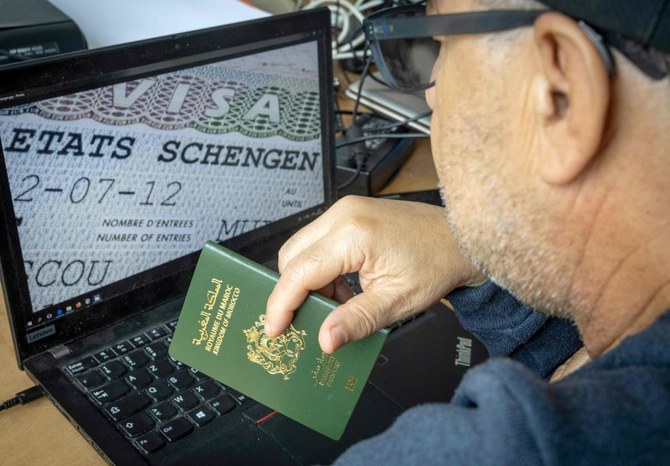
PARIS: France on Tuesday said it would sharply reduce the number of visas granted to people from Algeria, Morocco and Tunisia, accusing the former French colonies of not doing enough to allow illegal immigrants to return.
“It’s a drastic decision, and unprecedented, but one made necessary by the fact that these countries are refusing to take back nationals who we do not want or cannot keep in France,” government spokesman Gabriel Attal told Europe 1 radio.
The station first reported the visa clampdown earlier Tuesday, saying President Emmanuel Macron took the decision a month ago after failed diplomatic efforts with the three North African countries.
Immigration is shaping up to be a key issue in next year’s French presidential election, when Macron is widely expected to face off again against the far-right leader Marine Le Pen.
When a French court denies a person’s visa request, authorities must still secure a special travel pass from his or her home country in order to forcibly expel them, a document that Paris says Algiers, Rabat and Tunis are refusing to provide.
“There was dialogue, then there were threats, and today we’re carrying out those threats,” Attal said.
“We’re hoping that the response will be more cooperation with France so that we can apply our immigration rules,” he said.
Morocco’s Foreign Minister Nasser Bourita however condemned the move as “unjustified,” saying his country had carefully dealt with migrant issues to find a balance between allowing freedom of movement while clamping down on illegal migration.
“The decision (by France) is sovereign. Morocco will study it, but the reasons given to justify it require explanation and a dialogue, because they do not reflect reality,” he told reporters in Rabat.
According to Europe 1, which cited administration figures, Macron has ordered the number of visa deliveries to Algeria and Morocco to be halved from 2020 levels, and by a third for Tunisia.
It said that in the case of Algeria, French courts had rejected 7,731 visa requests in the first six months of this year, yet because the travel passes had not been granted, only 22 individuals had been expelled from French territory.
For the next six months, Macron has capped visas for Algerians at 31,500, the report said.
France granted a record number of visas — 275,000 — to Algerians in 2019.


France slashes visas for Algeria, Morocco, Tunisia in migrant row
https://arab.news/gp9bx
France slashes visas for Algeria, Morocco, Tunisia in migrant row

- Reports say President Emmanuel Macron took the decision after failed diplomatic efforts with the three North African countries


Algeria parliament to vote on law declaring French colonization ‘state crime’
- The vote comes as the two countries are embroiled in a major diplomatic crisis
ALGERIA: Algeria’s parliament is set to vote on Wednesday on a law declaring France’s colonization of the country a “state crime,” and demanding an apology and reparations.
The vote comes as the two countries are embroiled in a major diplomatic crisis, and analysts say that while Algeria’s move is largely symbolic, it could still be politically significant.
The bill states that France holds “legal responsibility for its colonial past in Algeria and the tragedies it caused,” according to a draft seen by AFP.
The proposed law “is a sovereign act,” parliament speaker Brahim Boughali was quoted by the APS state news agency as saying.
It represents “a clear message, both internally and externally, that Algeria’s national memory is neither erasable nor negotiable,” he added.
France’s colonization of Algeria from 1830 until 1962 remains a sore spot in relations between the two countries.
French rule over Algeria was marked by mass killings and large-scale deportations, all the way to the bloody war of independence from 1954-1962.
Algeria says the war killed 1.5 million people, while French historians put the death toll lower at 500,000 in total, 400,000 of them Algerian.
French President Emmanuel Macron has previously acknowledged the colonization of Algeria as a “crime against humanity,” but has stopped short of offering an apology.
Asked last week about the vote, French foreign ministry spokesman Pascal Confavreux said he would not comment on “political debates taking place in foreign countries.”
Hosni Kitouni, a researcher in colonial history at the University of Exeter in the UK, said that “legally, this law has no international scope and therefore is not binding for France.”
But “its political and symbolic significance is important: it marks a rupture in the relationship with France in terms of memory,” he said.


