


Pakistani PM breaks ground to revive Karachi Circular Railway

Pakistan's Prime Minister Imran Khan (second left) performs the groundbreaking of KCR infrastructure project in Karachi, Pakistan, on September 27, 2021. (Photo courtesy: PID)
Short Url
Updated 27 September 2021
Follow

Pakistani PM breaks ground to revive Karachi Circular Railway

  • KCR, worth Rs20.7 billion, will have 16 stations and 24 level crossings
  • KCR was main mode of transportation in 70s and 80s but had to be shut down in 1999

KARACHI: Pakistani Prime Minister Imran Khan on Monday performed the groundbreaking to revive the Karachi Circular Railway (KCR), which is aimed at easing commutes in Karachi, a metropolis of 15 million people that is known for its lack of transport facilities. 
The KCR, worth Rs20.7 billion, will have 16 stations and 24 level crossings, connecting major neighborhoods of the city through trains along a 29-kilometer track. The project was partially launched last year. 
Karachi ranks as having the worst public transport system globally, according to a 2019 study by car-parts company Mister Auto that looked at 100 major cities. It serves about 42 percent of Karachi’s commuters, relying on decades-old, overcrowded buses that use the roof as a second deck for passengers at times. This despite the city being home to Pakistan’s main ports and the regional headquarters for companies such as Standard Chartered Plc and Unilever Plc, helping it generate half of the nation’s tax revenue.
Khan said Karachi as the nation’s financial heart could attract investment from across the world, but the provision of basic infrastructure like public transport was a prerequisite, saying the KCR project would “shift the burden from Karachi’s roads.” 
“Despite political differences, we will have to move along for the sake of country and Sindh. All this is inter-linked,” he said, referring to ongoing political squabbles between his ruling PTI party and the Pakistan People’s Party which rules Sindh province of which Karachi is the capital.
“Some things the federal government cannot do alone, while others Sindh government cannot do solely without support from the federal government,” Khan added. 
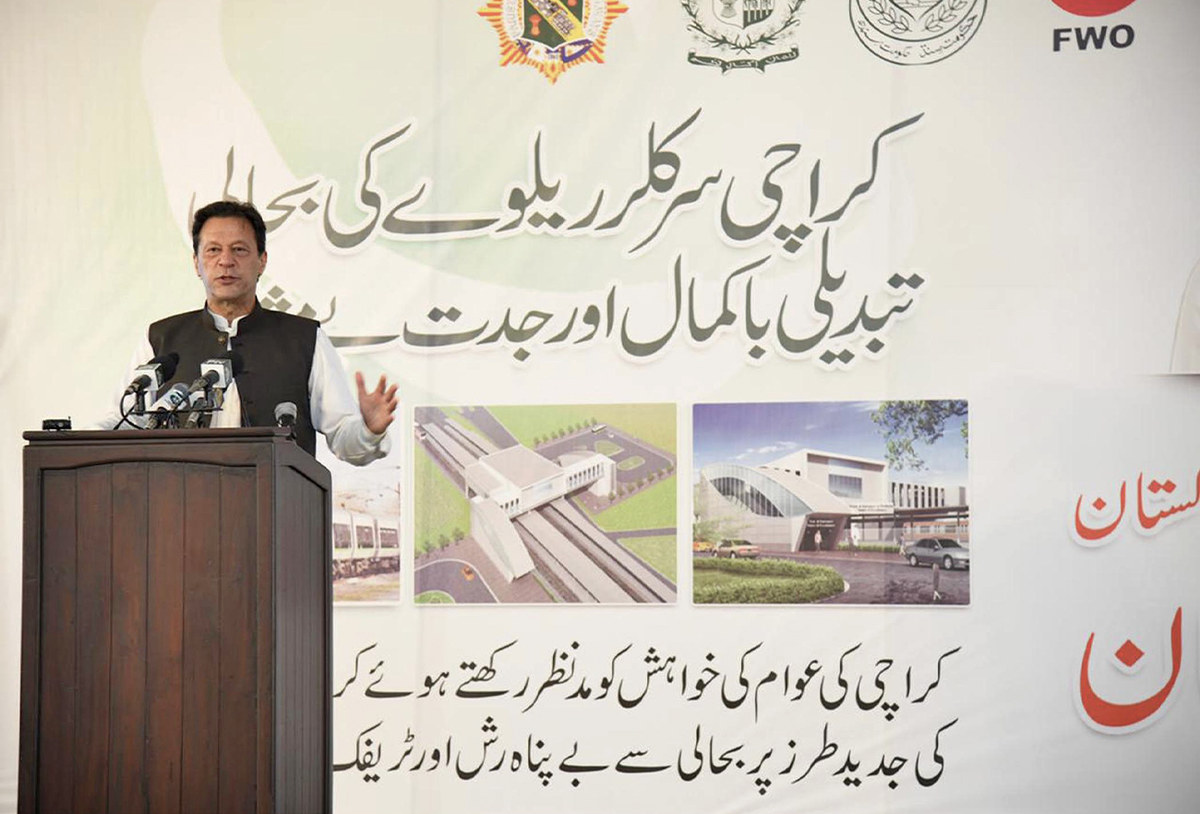


Pakistan's Prime Minister Imran Khan addresses the groundbreaking ceremony of Karachi Circular Railway (KCR) infrastructure project in Karachi, Pakistan, on September 27, 2021. (Photo courtesy: PID)

Commissioned in 1964, the KCR was originally designed to help the employees of Pakistan Railways travel between their workplaces and residences in Karachi’s eastern neighborhoods.
The service later turned into a full circle of 44 kilometers in 1970 and connected Karachi’s four main work areas — the port, the Sindh Industrial Trading Estate, the city’s central commercial areas such as Saddar, and the Landhi Industrial Area.
It remained the means of transportation till 1984 when the number of trains was reduced, but a lack of maintenance and repair and a growing gap between expenditure and revenue led to the service being shut down in 1999.
In March 2020, the Supreme Court ordered authorities to revive the rail transit project.
Earlier on Monday, Railways Minister Azam Khan Swati said in a statement that the KCR project would be completed in three years at a cost of Rs20.7 billion. 


Pakistan warns of strict action against hoarding petroleum products amid Iran crisis

Updated 4 sec ago
Follow

Pakistan warns of strict action against hoarding petroleum products amid Iran crisis

  • OGRA says reports indicate “certain elements” may attempt to hoard petroleum products for profiteering
  • Oil and Gas Regulatory Authority says Pakistan’s petroleum reserves stocks adequate, no need for panic buying

ISLAMABAD: Pakistan’s Oil and Gas Regulatory Authority (OGRA) warned on Thursday that the government will take strict action against anyone found illegally hoarding petroleum products for profiteering, amid fears of a shortage of energy supplies due to the ongoing conflict in the Middle East. 

Pakistan has formed a government committee to monitor the country’s stock of petroleum products amid ongoing hostilities between the US and Israel against Iran. The committee is also reviewing supply chains, price movements and assessing broader implications for inflation, external accounts, and financial stability due to the crisis. 

OGRA has repeatedly urged that Pakistan’s stock of petroleum products is adequate and urged the masses not to take part in panic buying. On Wednesday, it allowed oil marketing companies to regulate supplies to their retail outlets so as to discourage hoarding.

“It has been emphasized that strict action will be taken against any individual or entity found involved in illegal hoarding or storage of petroleum products at unauthorized locations,” OGRA spokesperson Imran Ghaznavi said in a statement.

“Particularly at places other than duly licensed oil depots and retail outlets of Oil Marketing Companies (OMCs).”

The OGRA spokesperson said reports indicate certain elements may attempt to hoard petroleum products for profiteering. It said that provincial chief secretaries have been requested to direct deputy commissioners to conduct inspections in their jurisdictions. 

“Any premises found involved in illegal storage of petroleum products will be sealed and action will be taken in accordance with the law,” OGRA warned. 

The spokesperson said OGRA was monitoring energy supplies in Pakistan, adding that inspections are being conducted at oil depots and retail outlets to ensure smooth supply of petroleum products.

“The public is advised not to pay attention to rumors and to continue normal consumption patterns, as the petroleum supply situation in the country remains stable,” it added. 

Pakistan this week asked Saudi Arabia to help Islamabad secure crude oil supplies through the Red Sea port of Yanbu, as the Strait of Hormuz’s closure threatens the country’s energy supply routes.

Pakistan fears higher global energy prices could lead to consumers paying more for petrol and shelling out more for groceries and other goods, at a time when many are already feeling the impacts of inflation.

Pakistan warns of strict action against hoarding petroleum products amid Iran crisis

OGRA says reports indicate “certain elements” may attempt to hoard petroleum products for profiteering

Oil and Gas Regulatory Authority says Pakistan’s petroleum reserves stocks adequate, no need for panic buying

Arab News Pakistan 

Islamabad: Pakistan’s Oil and Gas Regulatory Authority (OGRA) warned on Thursday that the government will take strict action against anyone found illegally hoarding petroleum products for profiteering, amid fears of a shortage of energy supplies due to the ongoing conflict in the Middle East. 

Pakistan has formed a government committee to monitor the country’s stock of petroleum products amid ongoing hostilities between the US and Israel against Iran. The committee is also reviewing supply chains, price movements and assessing broader implications for inflation, external accounts, and financial stability due to the crisis. 

OGRA has repeatedly urged that Pakistan’s stock of petroleum products is adequate and urged the masses not to take part in panic buying. On Wednesday, it allowed oil marketing companies to regulate supplies to their retail outlets so as to discourage hoarding.

“It has been emphasized that strict action will be taken against any individual or entity found involved in illegal hoarding or storage of petroleum products at unauthorized locations,” OGRA spokesperson Imran Ghaznavi said in a statement.

“Particularly at places other than duly licensed oil depots and retail outlets of Oil Marketing Companies (OMCs).”

The OGRA spokesperson said reports indicate certain elements may attempt to hoard petroleum products for profiteering. It said that provincial chief secretaries have been requested to direct deputy commissioners to conduct inspections in their jurisdictions. 

“Any premises found involved in illegal storage of petroleum products will be sealed and action will be taken in accordance with the law,” OGRA warned. 

The spokesperson said OGRA was monitoring energy supplies in Pakistan, adding that inspections are being conducted at oil depots and retail outlets to ensure smooth supply of petroleum products.

“The public is advised not to pay attention to rumors and to continue normal consumption patterns, as the petroleum supply situation in the country remains stable,” it added. 

Pakistan this week asked Saudi Arabia to help Islamabad secure crude oil supplies through the Red Sea port of Yanbu, as the Strait of Hormuz’s closure threatens the country’s energy supply routes.

Pakistan fears higher global energy prices could lead to consumers paying more for petrol and shelling out more for groceries and other goods, at a time when many are already feeling the impacts of inflation.