


Pakistani PM breaks ground to revive Karachi Circular Railway

Pakistan's Prime Minister Imran Khan (second left) performs the groundbreaking of KCR infrastructure project in Karachi, Pakistan, on September 27, 2021. (Photo courtesy: PID)
Short Url
Updated 27 September 2021
Follow

Pakistani PM breaks ground to revive Karachi Circular Railway

  • KCR, worth Rs20.7 billion, will have 16 stations and 24 level crossings
  • KCR was main mode of transportation in 70s and 80s but had to be shut down in 1999

KARACHI: Pakistani Prime Minister Imran Khan on Monday performed the groundbreaking to revive the Karachi Circular Railway (KCR), which is aimed at easing commutes in Karachi, a metropolis of 15 million people that is known for its lack of transport facilities. 
The KCR, worth Rs20.7 billion, will have 16 stations and 24 level crossings, connecting major neighborhoods of the city through trains along a 29-kilometer track. The project was partially launched last year. 
Karachi ranks as having the worst public transport system globally, according to a 2019 study by car-parts company Mister Auto that looked at 100 major cities. It serves about 42 percent of Karachi’s commuters, relying on decades-old, overcrowded buses that use the roof as a second deck for passengers at times. This despite the city being home to Pakistan’s main ports and the regional headquarters for companies such as Standard Chartered Plc and Unilever Plc, helping it generate half of the nation’s tax revenue.
Khan said Karachi as the nation’s financial heart could attract investment from across the world, but the provision of basic infrastructure like public transport was a prerequisite, saying the KCR project would “shift the burden from Karachi’s roads.” 
“Despite political differences, we will have to move along for the sake of country and Sindh. All this is inter-linked,” he said, referring to ongoing political squabbles between his ruling PTI party and the Pakistan People’s Party which rules Sindh province of which Karachi is the capital.
“Some things the federal government cannot do alone, while others Sindh government cannot do solely without support from the federal government,” Khan added. 
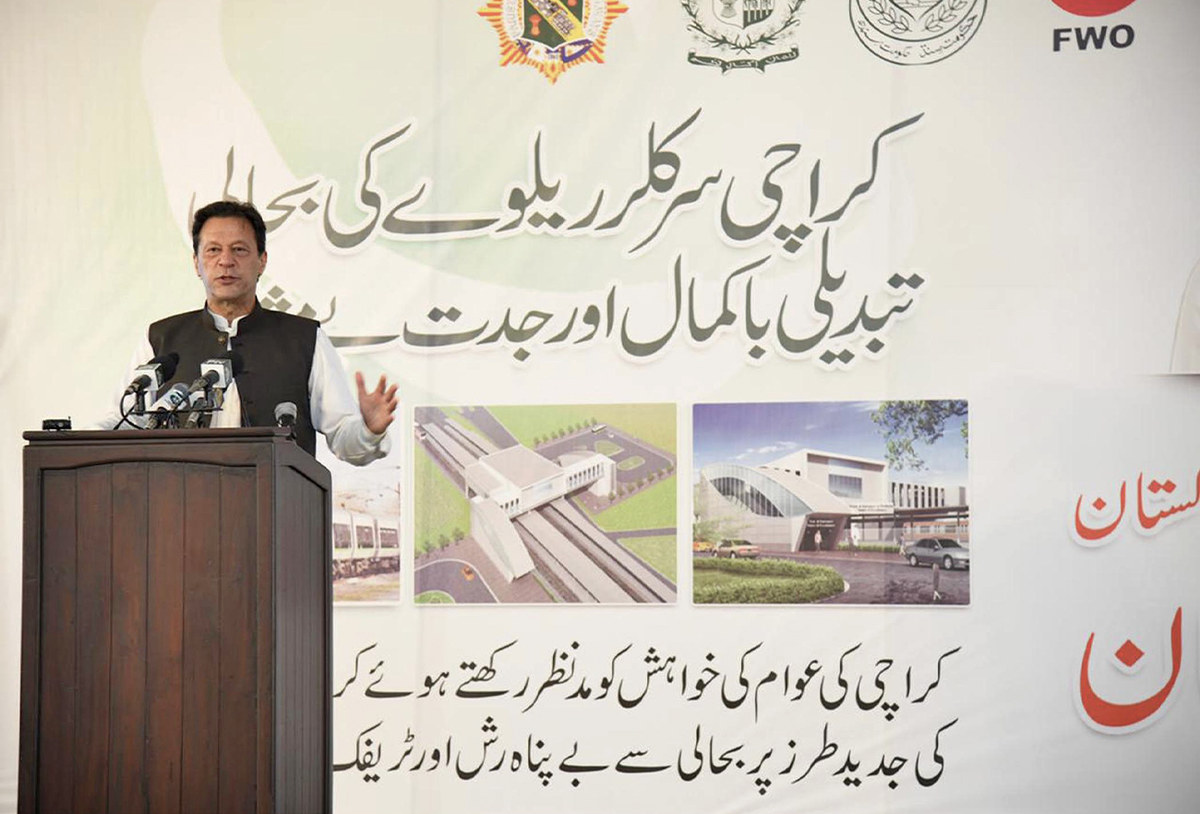


Pakistan's Prime Minister Imran Khan addresses the groundbreaking ceremony of Karachi Circular Railway (KCR) infrastructure project in Karachi, Pakistan, on September 27, 2021. (Photo courtesy: PID)

Commissioned in 1964, the KCR was originally designed to help the employees of Pakistan Railways travel between their workplaces and residences in Karachi’s eastern neighborhoods.
The service later turned into a full circle of 44 kilometers in 1970 and connected Karachi’s four main work areas — the port, the Sindh Industrial Trading Estate, the city’s central commercial areas such as Saddar, and the Landhi Industrial Area.
It remained the means of transportation till 1984 when the number of trains was reduced, but a lack of maintenance and repair and a growing gap between expenditure and revenue led to the service being shut down in 1999.
In March 2020, the Supreme Court ordered authorities to revive the rail transit project.
Earlier on Monday, Railways Minister Azam Khan Swati said in a statement that the KCR project would be completed in three years at a cost of Rs20.7 billion. 


Pakistan downs drones near Kohat after Kabul accuses Islamabad of deadly airstrikes

Updated 6 sec ago
Follow

Pakistan downs drones near Kohat after Kabul accuses Islamabad of deadly airstrikes

  • The exchange marks a sharp escalation in a conflict that began last month when Islamabad launched aerial campaign inside Afghanistan
  • Pakistani official says there is just one consistent demand from the Afghan side: ‘stop supporting terrorists, harboring their leadership’

ISLAMABAD: Pakistan on Friday said it had conducted “precision strikes” against militant camps and support infrastructure inside Afghanistan, with the Taliban authorities saying the strikes had hit civilians and damaged infrastructure in capital Kabul and other border provinces. 

The latest exchange marks a sharp escalation in a conflict that began last month when Islamabad launched a sustained aerial campaign inside Afghanistan, saying it was targeting sanctuaries of the Tehreek-e-Taliban Pakistan (TTP), a militant group responsible for a surge in attacks within Pakistan. The Afghan government denies the allegations.

A Pakistani security official confirmed on Friday that the strikes were carried out last night, destroying “four key locations,” including infrastructure of a corps headquarters and an ammunition dump in Kabul, a militant training camp in Kandahar, an oil storage facility in Kandahar, and a militant camp in Paktia. 

“The message is clear: no let-up, no negotiations, and no delegation sent by Pakistan,” the official, who requested anonymity, told Arab News. “There is just one consistent demand from the Afghan Taliban regime: stop supporting terrorists and harboring terrorist leadership or face the consequences.” 

However, the Taliban government said the strikes had hit non-military targets, with Taliban spokesman Zabihullah Mujahid stating on X that the bombardment hit Kabul, Kandahar, Paktia, and Paktika provinces. 

“With the continued airstrikes and crimes, once again the Pakistani military regime has bombed Kabul, Kandahar, Paktia, Paktika, and some other areas, destroying civilian homes in some places, which martyred women and children,” Mujahid said, adding that in some instances, the strikes hit “empty deserts and vacant spots.” 

In Kabul, police spokesman Khalil Zadran told AFP that the strikes killed four people and wounded 15 others, noting that residential homes were among the buildings hit. 

The Taliban further alleged that a strategic fuel depot in the southern city of Kandahar was destroyed.

“The Pakistani military regime’s aircraft set fire to the fuel storage of Kam Air, a private airline company, near Kandahar International Airport. This company supplies fuel to civilian airlines and United Nations aircraft,” Mujahid stated, adding that the “oppression will not go unanswered.” 

In response, the Afghan Ministry of National Defense claimed its Air Force targeted strategic Pakistani military centers in the Kohat area of Khyber Pakhtunkhwa on Friday morning. 

“During the strikes, the Kohat military fort was hit. Additionally, the command center for Durand Line combat operations and the office of the fort’s commander were precisely targeted,” the Afghan Ministry of National Defense said, adding that the strikes caused “heavy human casualties.” 

However, Pakistani security officials disputed the Taliban’s account of a successful strike, stating that the attack involved “rudimentary drones” that were effectively intercepted. 

“Afghan Taliban-backed FAK (TTP) terrorists tried to use three rudimentary drones in Kohat; however, the drones were effectively brought down,” said one official. “Due to falling debris, two civilians were injured.” 

Afghan and Pakistani forces have also clashed repeatedly at the border in recent weeks, hampering trade and forcing nearby residents to leave their homes. Casualty claims from both sides are difficult to verify independently.